What is Yield to Worst?
Yield to Worst (YTW) is the minimum return received on a callable bond, i.e. the “floor yield”, aside from the yield if the issuer were to default.

Yield to Worst (YTW) is the minimum return received on a callable bond, i.e. the “floor yield”, aside from the yield if the issuer were to default.
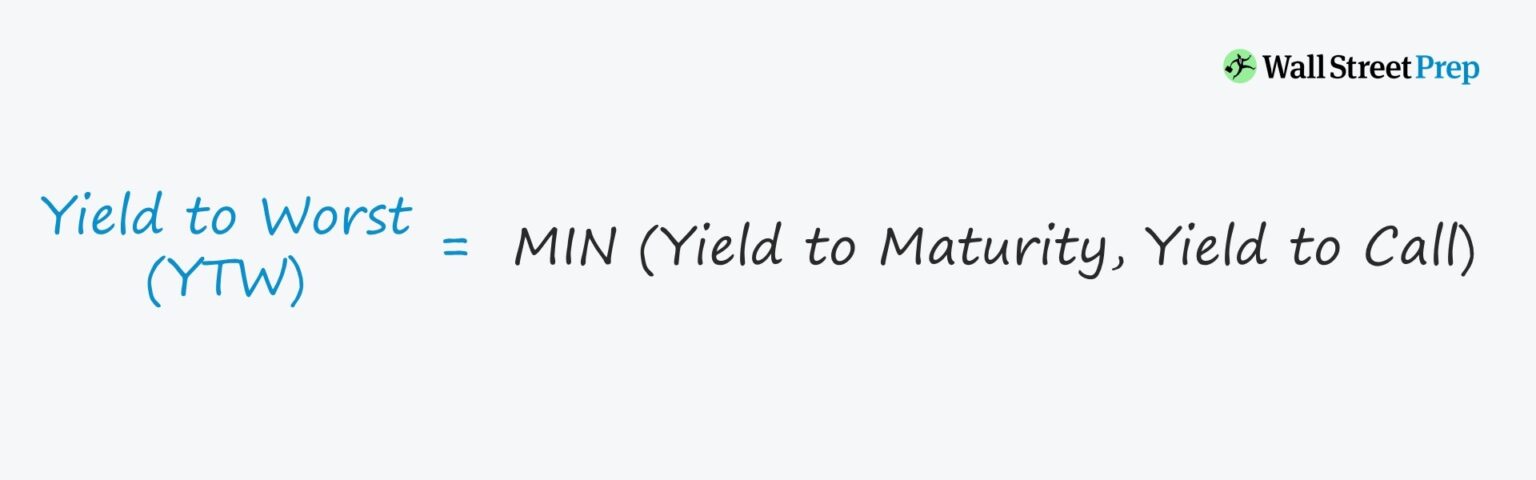
The yield to worst represents the lowest potential yield that a bondholder could receive on a callable bond – assuming the issuer does not default.
Certain types of bond issuances are “callable,” meaning that the issuer has the option to redeem them before the stated maturity date, i.e. pay the debt off earlier.
Within the debentures of such bonds, the earliest date the callable feature is permitted will be clearly stated, along with details regarding any side fees incurred.
As worst-case scenario contingency planning, bondholders often estimate the yield to worst (YTW) – but to clarify, “worst-case” in these cases refers to the bond being redeemed by the issuer at the earliest possible date, rather than the yield on a bond that has defaulted.
From determining the yield to worst (YTW), bondholders can mitigate their downside risk better to reduce the odds of being blindsided by an issuer calling a bond before it matures.
The yield to worst (YTW) on a callable bond is the lower return between the yield to maturity (YTM) and the yield to call (YTC).
In the first step, the yield to maturity (YTM) and yield to call (YTC) can be calculated using the built-in “YIELD” Excel function.
The inputs within the formula are as follows:
In the subsequent step, the "MIN" function picks the lower value between the YTM and YTC, i.e. the yield to worst (YTW) of the bond.
The general rule of thumb is that interest rates and yield have an inverse relationship.
However, there are more moving pieces to consider for callable bonds, so the prior statement is not necessarily true or false without further context.
More specifically, the issuer could view the low-interest rate environment as an opportunity to refinance its existing debt at more favorable rates.
Most bonds are structured with prepayment fees as compensation for the following:
If we assume there are two identical bonds – with the only difference being that one is “callable” whereas the other is “non-callable” – then the callable bond is more likely to be negatively impacted.
Why? The chance of bonds being called tends to increase if interest rates fall and drop lower compared to when the original issuance occurred.
If interest rates decline, the issuer can be incentivized to redeem the bonds, making the callable feature unfavorable for the bondholder.
Calculating the yield to worst (YTW) is most relevant for premium bonds (i.e. "trading above par"), given how they are directly tied to collapsing interest rates.
We’ll now move to a modeling exercise, which you can access by filling out the form below.

In our illustrative exercise, we’ll calculate the yield on the bond under three different pricing scenarios.
Suppose the bond issuance has a maturity of ten years and was finalized on 12/31/2021 with the first call date 12 months after the settlement date.
At a par value of $1,000 (i.e. “100”), the three prices for each scenario are as follows:
As for the coupon, we'll assume that the bond pays an annual coupon at an interest rate of 6%.
Now, we'll enter our assumptions into the Excel formula from earlier to calculate the yield to maturity (YTM):
In contrast, the YTC switches the “maturity” to the first call date and “redemption” to the call price, which we’ll assume is set at 104.
The call price of 104 is the quoted price the bond issuer must pay to redeem the debt issuance entirely (or partially) before the maturity date.
Side Note: From the italics, we can identify which parts of the formula were adjusted in the YTC calculation.
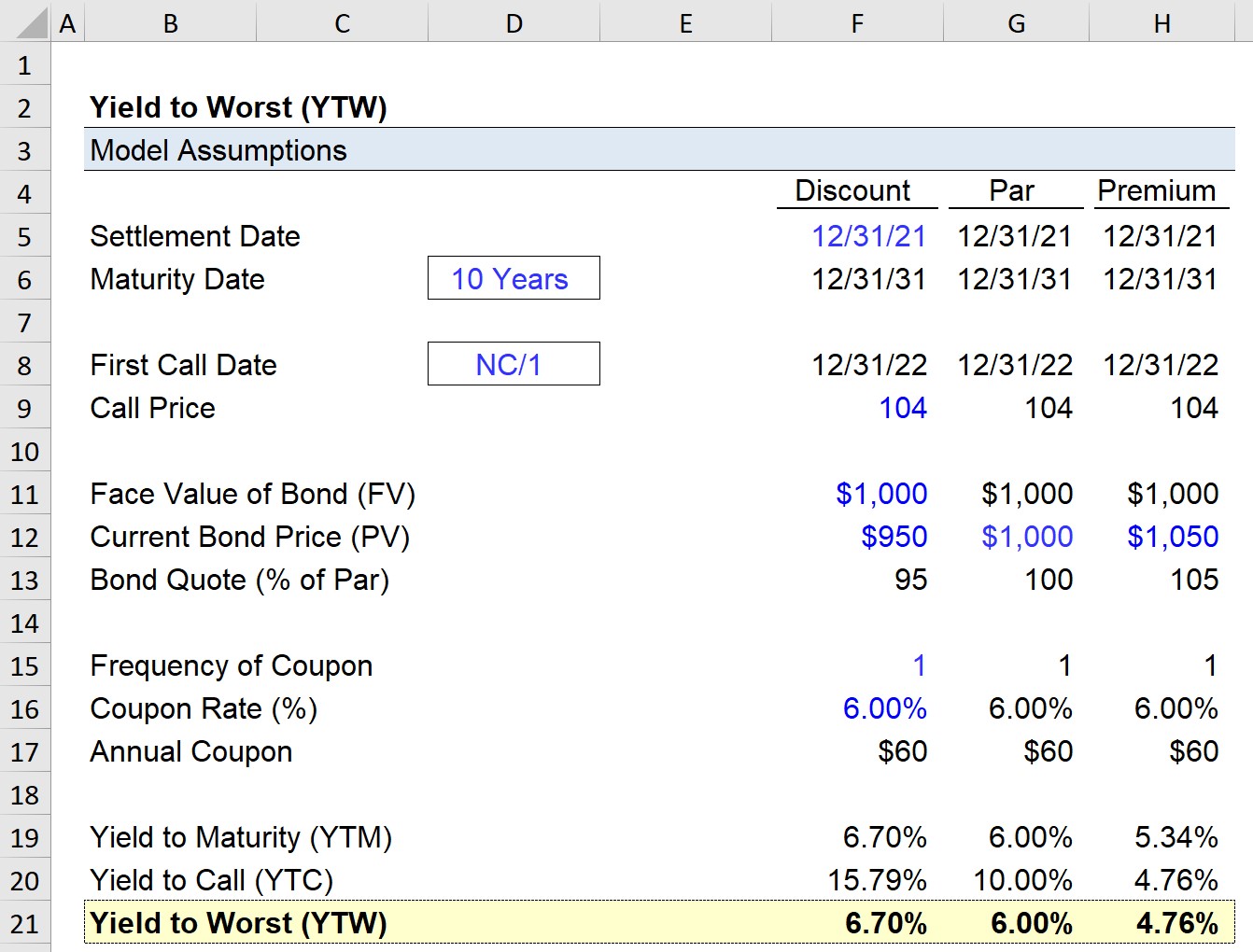
If the bond trades at a discount or par, the yield to maturity (YTM) is lower than the yield to call (YTC) – which is why the yield to worst (YTW) is the yield to maturity (YTM).
However, if the bond trades at a premium, the contrary is true, where the YTC is the lower between the two yield metrics and can be considered the YTW.
Unlike the discount and par bond, the premium bond’s yield to worst (YTW) is the yield to call (YTC) of 4.8% – depicting why the YTW is only relevant if the bond is trading at a premium to par.
A step-by-step course designed for those pursuing a career in fixed income research, investments, sales and trading or investment banking (debt capital markets).


No comments yet.