What is APR?
The Annual Percentage Rate (APR) is the interest rate charged by a lender on a yearly basis, expressed in the form of a percentage.

The Annual Percentage Rate (APR) is the interest rate charged by a lender on a yearly basis, expressed in the form of a percentage.
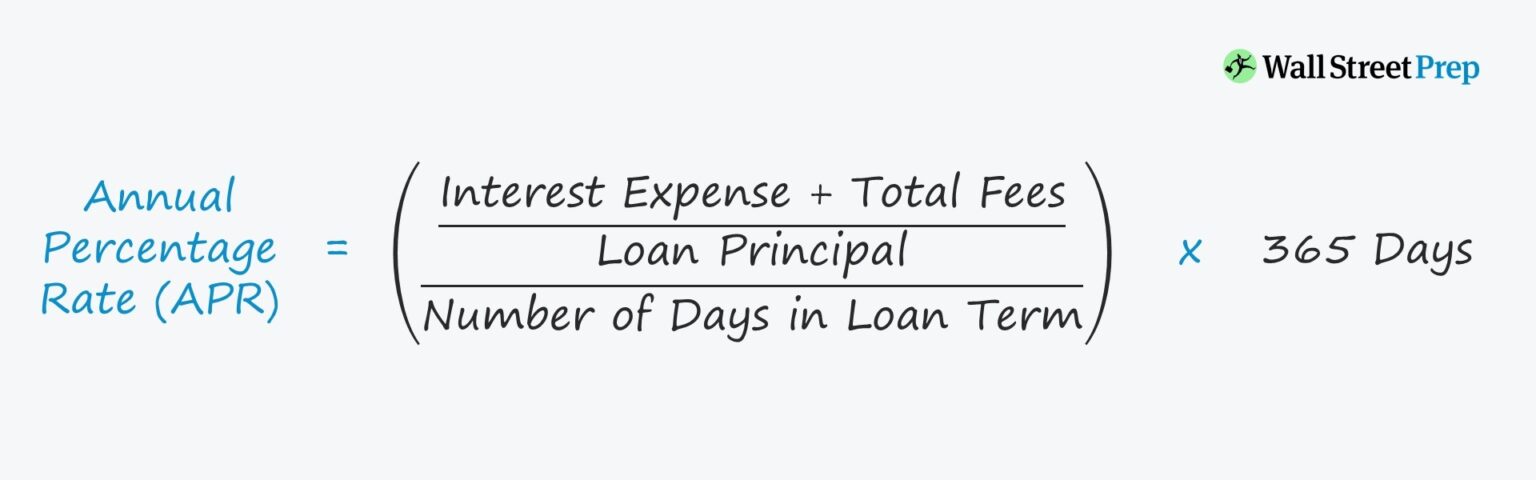
The APR, or “Annual Percentage Rate”, is defined as the interest rate paid each year on an outstanding loan amount.
Conceptually, the APR represents the estimated cost of the yearly fees associated with a specific type of borrowing.
APR is a standard calculation used regularly by lenders, as the financial metric is designed to help borrowers understand the implied returns and compare different loan options.
The stated interest rate on a loan is not usually enough on its own to make the right borrowing decision – for instance:
The annual percentage rate (APR) is calculated using the following formula.
Where:
To express the APR as a percentage, the amount must be multiplied by 100.
The annual percentage rate (APR) on a loan – under a mortgage financing scenario, for example – marks the total yearly cost associated with borrowing money from a financial institution.
Since more fees beyond just interest expenses are considered in the APR of a loan, the metric provides a more accurate estimation of how much in total a borrower must pay to take out a loan.
The APR on loans facilitates comparisons across different loan offerings (i.e. for the borrower to pick the cheapest option), yet in actuality, the comparison is not “apples-to-apples” due to several factors:
The annual percentage rate (APR) is a relevant concept for numerous financing scenarios, most notably:
Depending on the specific circumstances of the financing, the additional fees incurred on the side could include:
Under the context of credit cards, the annual percentage rate (APR) determines the amount of interest due based on the carrying balance from month to month.
If each monthly bill is paid in full and on time, no interest is incurred, since the obligation is met.
Unique to credit cards, interest is calculated daily, meaning that a credit card company charges borrowers by multiplying the ending balance by the APR and then dividing by 365.
The amount of interest charged is subsequently added to the outstanding balance the following day.
In contrast to credit cards, the APR on a loan reflects more than just the interest payments that must be met.
One common mistake is to confuse the annual percentage rate (APR) with the annual percentage yield (APY).
To distinguish between the two finance terms, the annual percentage rate (APR) is the interest that a borrower must pay on a loan, whereas the annual percentage yield (APY) is the interest a lender would expect to earn on an investment.
APR is an annualized simple interest rate, while the APY calculation considers the effects of compounding.
As a general rule, the higher the interest rate and the fewer compounding periods there are, the greater the discrepancy between the annual percentage rate (APR) and the annual percentage yield (APY).
The final difference we'll explain is between a fixed APR and a variable APR:
A fixed APR is thus more predictable than a variable APR, which is a function of the market conditions and the specific benchmark by which its value is influenced.
We’ll now move to a modeling exercise, which you can access by filling out the form below.


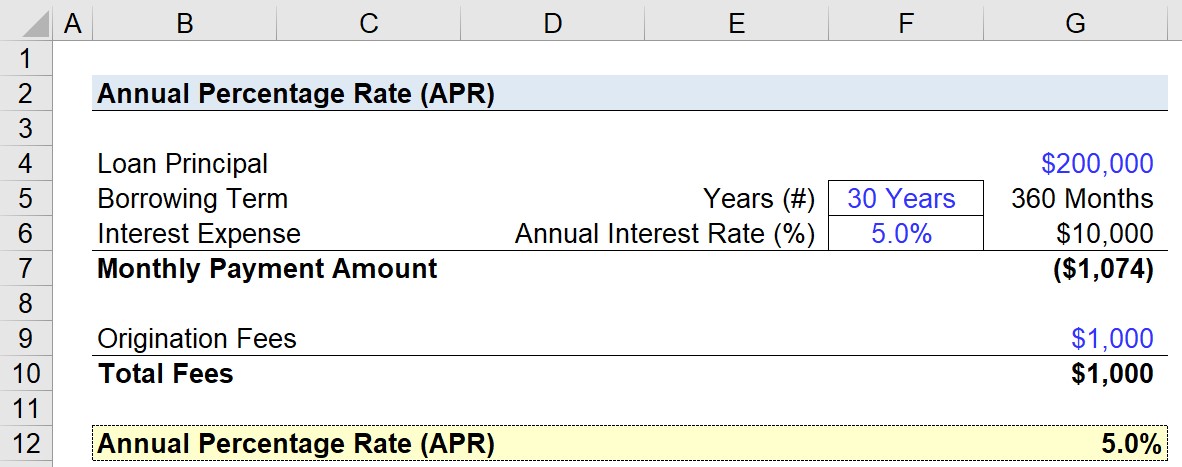
Suppose you've taken out a mortgage loan with the following lending terms:
Remember, APR does not just factor in the interest expense, but related fees, too.
Using the “PMT” function in Excel, we can calculate the monthly payment amount.
If we plug in our numbers, we get the following:
The “RATE” Excel function can then be utilized to arrive at our mortgage’s annual percentage rate (APR).
Since we already have all the required inputs, the only remaining step is to plug them into the Excel formula from earlier.
The annual percentage rate (APR) on the mortgage loan comes out to be approximately 5.0%.

Enroll in The Premium Package: Learn Financial Statement Modeling, DCF, M&A, LBO and Comps. The same training program used at top investment banks.


No comments yet.