What is Current Yield?
The Current Yield measures the expected annual return of a bond and is calculated by dividing the annual coupon by the current market price.

The Current Yield measures the expected annual return of a bond and is calculated by dividing the annual coupon by the current market price.
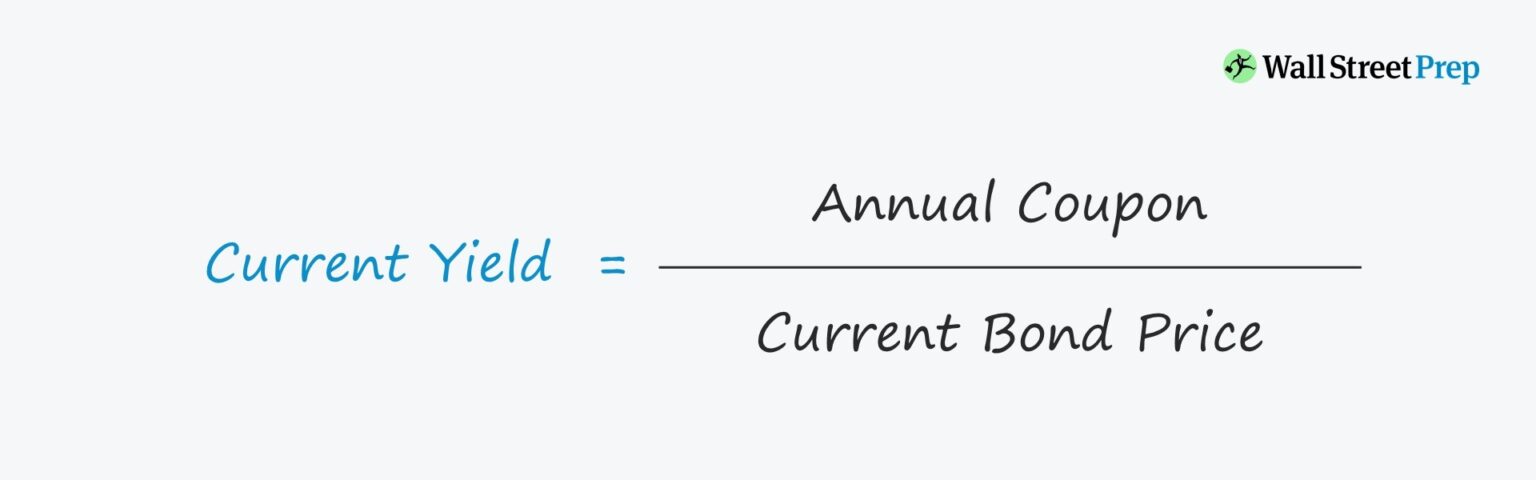
The current yield is equal to the annual coupon on a bond, depicted as a percentage of the market price – which could be higher or lower than its par value.
Conceptually, the current yield represents the bondholder's rate of return if the investment is held for the next year.
The calculation of the current yield is a straightforward 3-step process:
The formula for calculating the current yield on a bond is as follows.
For instance, if a corporate bond with a $1,000 face value (FV) and an $80 annual coupon payment is trading at $970, then the implied yield is 8.25%.
In practice, the calculation of the metric is simple and convenient, yet its utility tends to be limited in scope.
The current yield is most often relevant only if the market price deviates from its par value.
Since the price of a bond adjusts based on the prevailing macro conditions and news surrounding the underlying issuer, bonds can be purchased at discounts or premiums relative to par.
The yield-to-maturity (YTM) is the annualized return expected to be earned on a bond, assuming that the bond is held until the date of maturity.
Moreover, YTM is the internal rate of return (IRR) on the bond and is widely considered a far more useful measure for comparisons among different bonds.
One criticism of YTM is that all coupons are implicitly presumed to be received on time and reinvested at the same interest rate.
The current yield entirely disregards the effects of principal repayment and reinvestment – therefore, the yield metric is not a sufficient standalone measure of the actual yield on a bond.
The only income source considered under the calculation of the metric is the anticipated annual coupon payment – while neglecting reinvestment risks, capital gains/losses, compounding, and the time value of money.
We’ll now move to a modeling exercise, which you can access by filling out the form below.

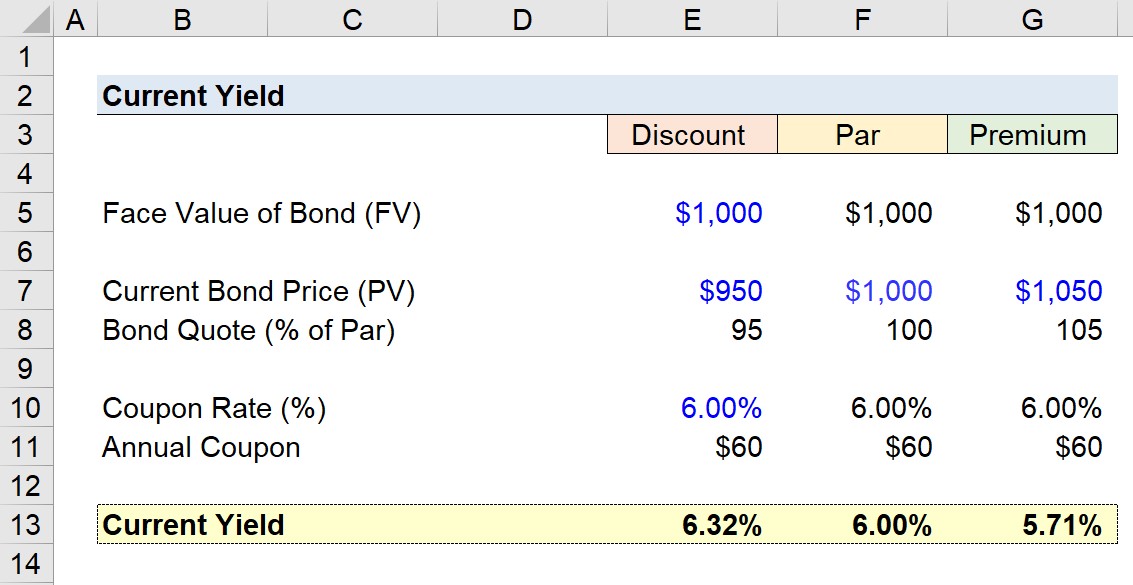
In our illustrative scenario, we’ll assume three bonds were each issued at a face (par) value of $1,000 with an annual coupon rate of 6%.
Since the annual coupon depends on the bond's original face value (FV), the coupon can be calculated by multiplying the coupon rate by the FV of the bond.
However, the current market prices of the bonds are all different, with the bonds trading below par, at par, and above par, respectively:
For each bond, the current yield is equal to the annual coupon divided by the bond's face value (FV).
If a bond is trading at par, the implied yield is equivalent to the stated coupon rate – thus, the par bond's yield is 6%.
But for the discount bond, the yield (6.32%) is higher than the coupon rate, whereas the opposite is true for the premium bond (5.71%).
Conversely, another method to calculate the current yield is to divide the coupon rate by the bond quote (% of par) – with the result then multiplied by 100.
Enroll in The Premium Package: Learn Financial Statement Modeling, DCF, M&A, LBO and Comps. The same training program used at top investment banks.


No comments yet.