What is Reinvestment Risk?
Reinvestment Risk is the potential risk where future proceeds, such as the coupon payments or debt principal, will need to be reinvested at a lower interest rate compared to the original yield (i.e. on a debt security).

Reinvestment Risk is the potential risk where future proceeds, such as the coupon payments or debt principal, will need to be reinvested at a lower interest rate compared to the original yield (i.e. on a debt security).
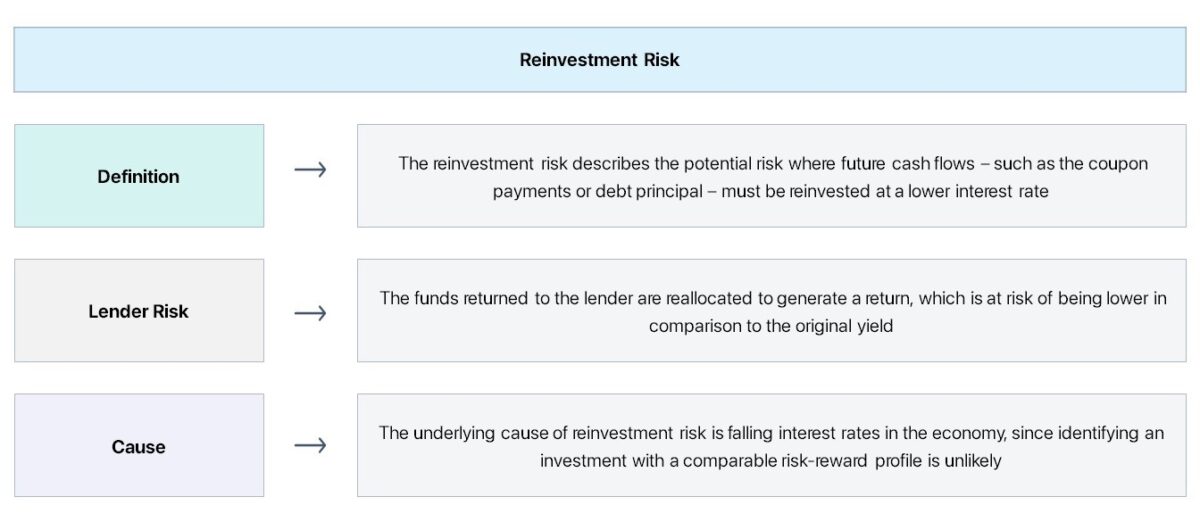
Reinvestment risk is a form of financial risk where the proceeds from an investment cannot be reinvested at the same rate of return as the original investment.
In practice, reinvestment risk is most common in the fixed income market for securities such as corporate bonds, where the issuer is obligated to pay interest to the investor per the lending agreement.
As part of the financing arrangement, the investor – i.e. the lender – expects to generate periodic interest payments that will subsequently be reinvested upon receipt.
The degree of reinvestment risk is contingent on the change in the market interest rate, which is an unpredictable external variable.
In the former scenario, the investor must reinvest the returned funds at a lower rate than the original debt issuance. But in the latter scenario, the investor can reinvest the returned funds at a higher rate than the interest rate on the original debt security.
In fact, the investor can force the issuer to repurchase the debt obligation if the underlying security is a puttable bond, i.e. a plain, vanilla bond with an embedded put option.
Therefore, the reinvestment risk can either benefit the lender (i.e. the investor) or the borrower (i.e. the issuer), which is a risk that must be understood by both parties.
The most frequently utilized strategies to mitigate the reinvestment risk in debt financing are as follows.
Suppose an investor purchased a 10-year semi-annual bond that pays a coupon based on an annual interest rate of 4.0%. Since the security is a semi-annual bond, interest is earned by the investor twice per year, so 2.0% every six months.
Over the course of the next five years, say the market interest rates fall to 2.0%, a reduction of 2.0% from the original issuance date.
Because of the reduction in the prevailing interest rate in the market, the investor can only reinvest the coupon payments at the current 2.0%, rather than the original 4.0%, which illustrates the concept of reinvestment risk.
Hypothetically, if the market interest rate remains at 2.0% until maturity, the principal is also subject to the reinvestment rate, not just the coupon payments.
Reinvestment risk and interest rate risk are two closely tied types of financial risks associated with debt financing, particularly in the fixed-income market, where the securities pay periodic interest.
In conclusion, reinvestment risk pertains more to the impact on future cash flows (and the yield on reinvested funds), whereas interest rate risk references the effect that changing interest rates can have on the pricing of bonds.
Learn how institutional investors identify high-potential undervalued stocks. Enrollment is open for the upcoming cohort.


No comments yet.