What is FCCR?
The Fixed Charge Coverage Ratio (FCCR) measures if a company’s cash flows are sufficient to cover its interest expense, mandatory debt repayment, and lease expenses.

The Fixed Charge Coverage Ratio (FCCR) measures if a company’s cash flows are sufficient to cover its interest expense, mandatory debt repayment, and lease expenses.
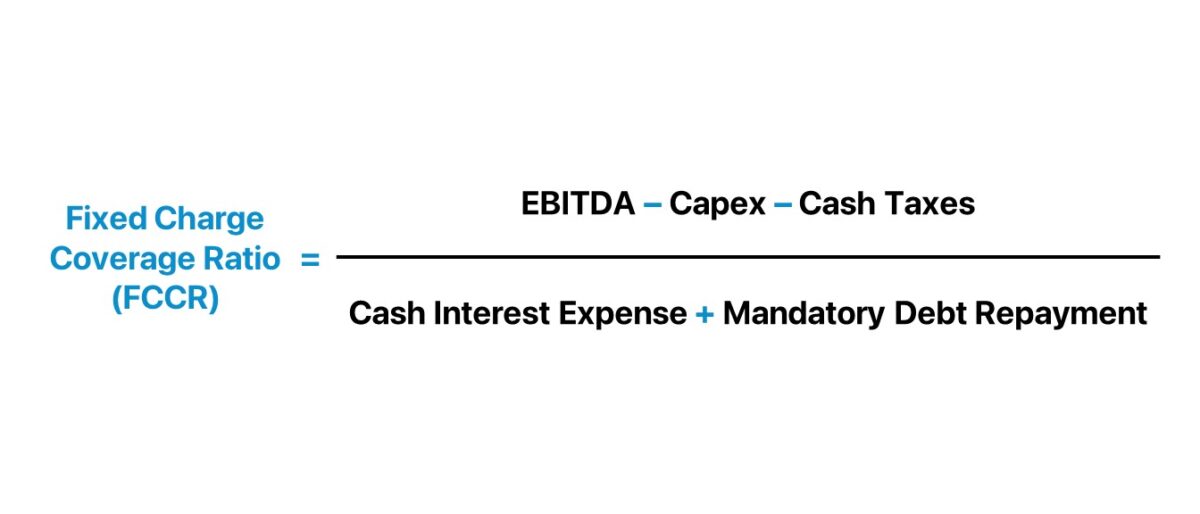
The fixed charge coverage ratio (FCCR) is a solvency ratio that assesses if a company's cash flows are adequate to meet its fixed charges.
The fixed charge coverage ratio (FCCR) answers the question: “Does the company generate enough cash flow to meet its fixed charges?”
Conceptually, the FCCR represents the number of times a company could hypothetically pay off its annual fixed charges.
Oftentimes, lenders utilize the FCCR to determine the creditworthiness of a potential or existing borrower.
Classifying costs as fixed charges requires some discretion, but in general, they must meet the following criteria:
For example, the amount due and the dates when interest expense and mandatory debt repayment come due are outlined in the loan agreement.
In addition, the debt associated with these cash outflows was issued to fund operations (or related functions), and the fixed costs were pre-negotiated.
Broadly, the fixed charge coverage ratio (FCCR) is a ratio that compares an earnings metric to the total fixed charges.
There are two common approaches to calculating the FCCR, which we'll refer to as the “GAAP” and “Non-GAAP” variations for simplicity.
The first method abides closer to GAAP accounting and divides a company’s earnings before interest and taxes (EBIT) by fixed charges before taxes plus interest expense.
Suppose that a company has the following financials.
The numerator is equal to $400,000 ($250,000 + $150,000), whereas the denominator is equal to $160,000 ($150,000 + $10,000).
However, EBIT is a GAAP measure of profitability – thus, many equity analysts adjust the metric given the drawbacks of accrual accounting, such as the inclusion of non-cash items, most notably depreciation and amortization (D&A).
That being said, the second approach for calculating FCCR starts with a non-GAAP metric, earnings before interest, taxes, depreciation, and amortization (EBITDA).
In the non-GAAP approach, FCCR is calculated as the ratio between.
Capex is subtracted while D&A is added back (i.e., EBITDA) since Capex is a real cash outflow, but D&A is a non-cash expense related to accrual accounting.
EBITDA is already a non-GAAP metric, yet in this context, it can be further changed by discretionary adjustments – as long as there is an agreement in writing allowing as such between the borrower and lender(s).
The latter non-GAAP EBITDA approach is far more common in practice, whereas the GAAP EBIT approach is more often taught in academia.
Besides interest and mandatory principal amortization, the following charges could also be included if deemed appropriate:
In the FCCR equation, growth Capex or optional prepayment of debt should be excluded, since they constitute discretionary spending.
PIK interest and deferred taxes should also be excluded, because they are non-cash (i.e. no real cash outflow occurred).
Like the interest coverage ratio (ICR) – also known as the times interest earned (TIE) ratio – the higher the ratio, the better the company's creditworthiness.
The higher the FCCR, the stronger the company's creditworthiness as a borrower – all else being equal.
Companies with higher FCCRs have fewer earnings spent on fixed charges like interest, leases, and principal repayments. Therefore, more free cash flows (FCFs) remain.
Further, higher FCFs reduce the borrower's risk of missing a scheduled payment to a third party and allow for more reinvestment and discretionary spending to drive growth.
Certain lending agreements contain covenants based in part on the fixed charge coverage ratio (FCCR).
The so-called “FCCR minimum" frequently appears in secured credit facilities, e.g. ABL revolvers and senior term loans.
The FCCR covenant forces the borrower to maintain certain metrics above a specified threshold – because a lower FCCR presents greater risk to lenders.
The minimum fixed charge coverage ratio (FCCR) is typically set around 1.0x to 1.25x.
If the FCCR declines below 1.0x, the company will turn cash flow negative unless additional external financing is obtained – which in such a scenario would likely be difficult.
However, lenders do not rely on the FCCR by itself, as the FCCR is one of many credit metrics that help them understand the financial health of a company.
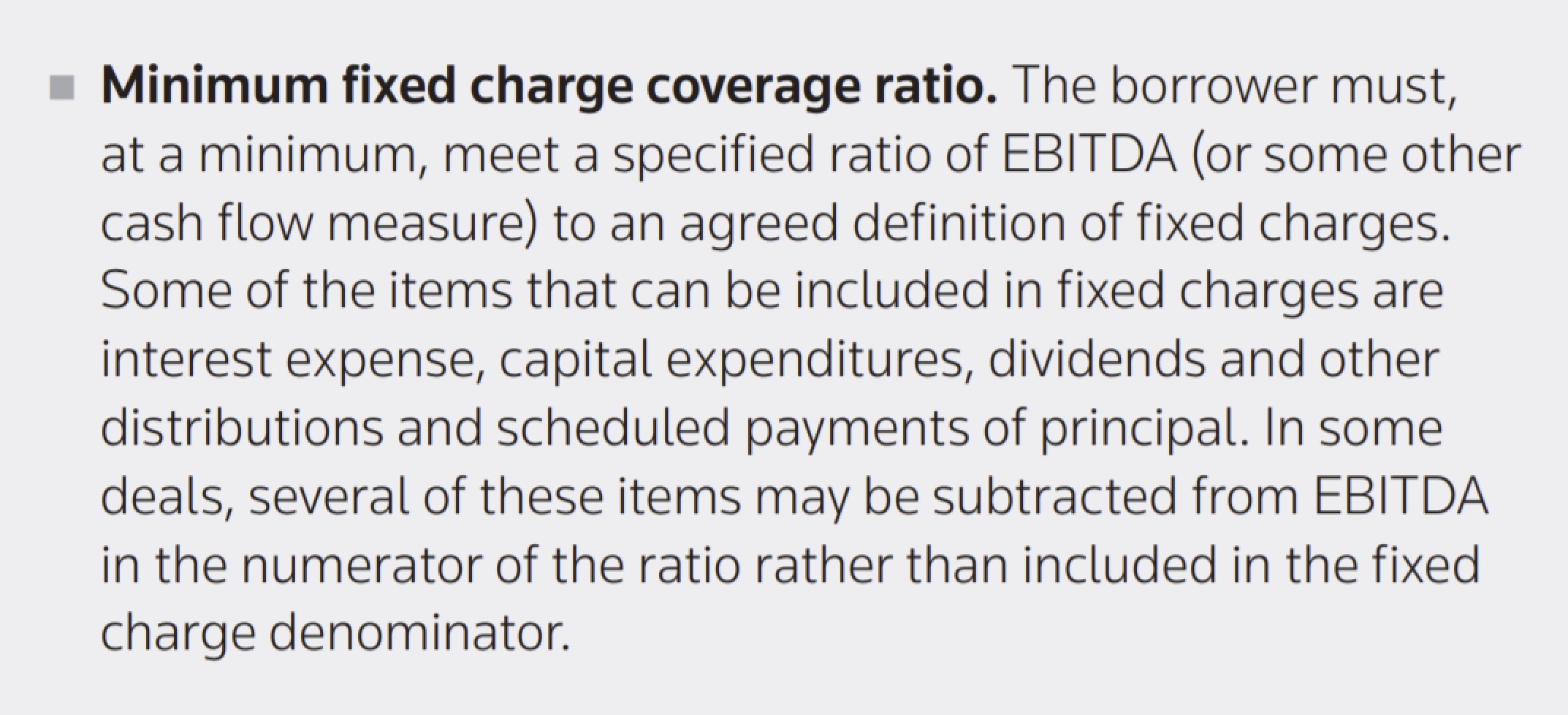
FCCR Formal Definition (Source: Paul Weiss)
Both the fixed charge coverage ratio (FCCR) and times interest earned ratio (TIE) conceptually have the same objective, which boils down to deciding if the company has adequate earnings to meet certain payments.
The difference between FCCR and the TIE ratio is as follows.
We’ll now move on to a modeling exercise, which you can access by filling out the form below.


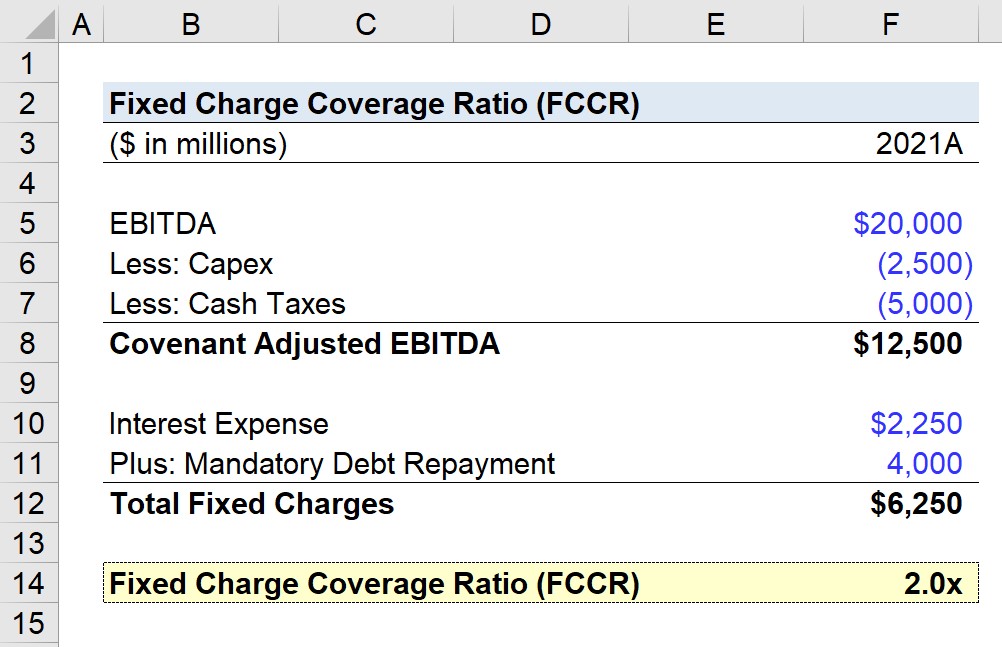
In our illustrative example, we'll calculate a company's fixed charge coverage ratio (FCCR) using the following assumptions.
Financial Data (2021A)
After subtracting Capex and cash taxes from EBITDA, we're left with $12.5 million for the covenant-adjusted EBITDA, i.e., the lender-negotiated earnings amount that the covenant is set upon.
In the next step, we will add our two fixed charges – the interest expense and mandatory debt repayment – for a total fixed charges amount of $6.25 million.
In the final step, we can now calculate the fixed charge coverage ratio by dividing the Covenant Adjusted EBITDA by the Total Fixed Charges.
In this case, the 2.0x FCCR suggests the Company's earnings are sufficiently adequate to pay off its total fixed charges two times.

Enroll in The Premium Package: Learn Financial Statement Modeling, DCF, M&A, LBO and Comps. The same training program used at top investment banks.


No comments yet.