What is Illiquidity Discount?
Illiquidity describes assets that cannot be readily sold in the open market — which usually warrants a discount to be attached to the valuation due to the absence of marketability.

Illiquidity describes assets that cannot be readily sold in the open market — which usually warrants a discount to be attached to the valuation due to the absence of marketability.
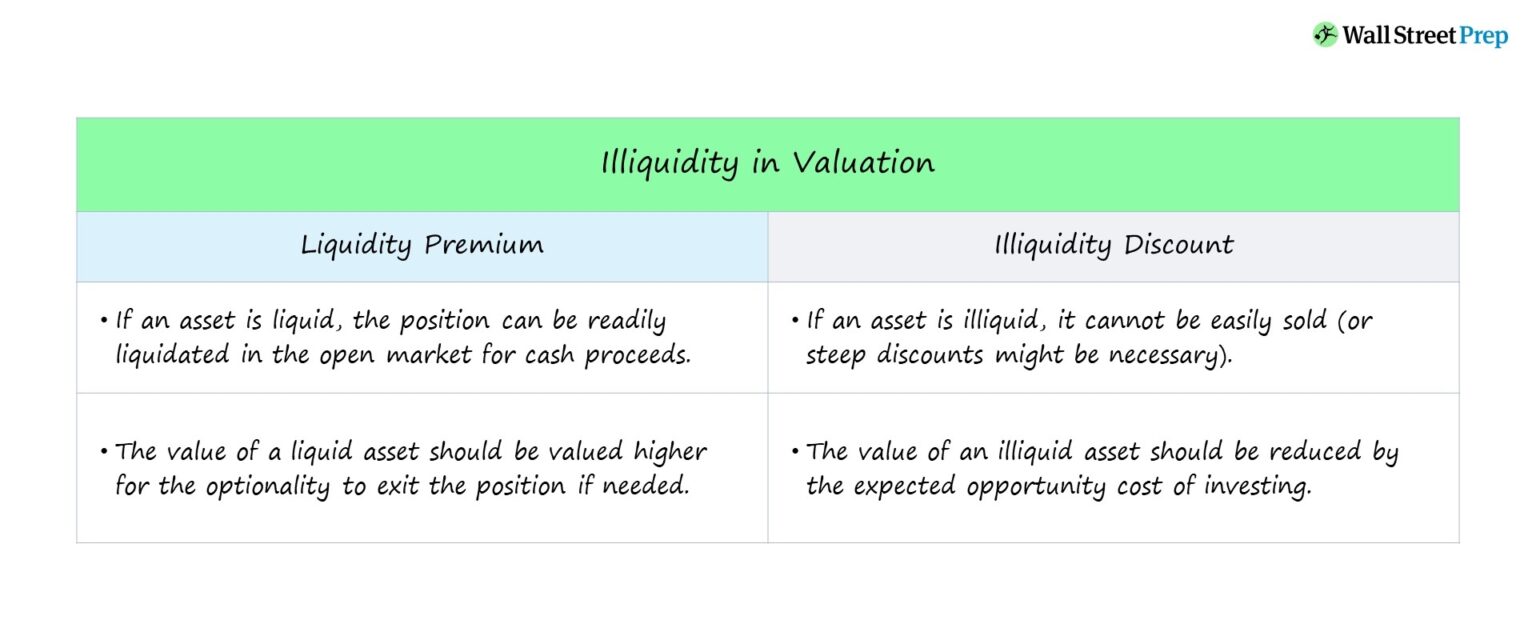
The illiquidity discount is the discount applied to the valuation of an asset, as compensation for the reduced marketability.
In other words, upon purchasing the investment, there is an immediate risk of value loss where the asset cannot be sold again – i.e. the cost of buyer’s remorse in which it is difficult to reverse the purchase.
The illiquidity discount stems from liquidity risk, which is the incurred loss in asset value from the inability to easily liquidate the position.
The opposite of illiquidity is the concept of liquidity, which is the ability of an asset to be:
In short, liquidity measures of how quickly an asset can be sold in the open market without requiring a significant discount
But for an illiquid asset, liquidating the position could be challenging due to:
In the second scenario, to exit the position, the seller must often offer steep discounts compared to the purchase price in order to sell the illiquid asset — resulting in greater capital loss.
The illiquidity discount is a function of the required compensation demanded by the investor in order to invest in an illiquid asset, which takes into consideration the:
The more illiquid an asset is, the greater the discount expected by investors for the incremental risk of purchasing an investment with limited flexibility of selling in the future.
For example, early-stage investors (e.g. venture capital) require illiquidity discounts because of the long-term holding period for when their capital contribution is locked up.
The size of the illiquidity discount is contingent on the opportunity cost of tying up the capital to the investment as compared to investing in assets with lower risk (i.e. assets that could be sold even if the valuation were to decline).
All else being equal, illiquidity results in a negative impact on the valuation of an asset, which is why investors expect more compensation for the added risk.
Conversely, a liquidity premium can be added to the valuation of an asset that can easily be sold/exited.
In practice, the value of the asset is first calculated ignoring the fact that it is illiquid, and then at the end of the valuation process, a downward adjustment is made (i.e. the illiquidity discount).
The size of the illiquidity discount is largely up for debate, but for most private companies, the discount tends to range between 20-30% of the estimated value as a general rule of thumb.
However, the illiquidity discount is a subjective adjustment for the buyer and a function of the particular company’s financial profile and capitalization.
Thus, depending on the circumstances, the illiquidity discount can be as low as 2% to 5%, or as high as 50%.
The preference for liquid assets with frequent pricing appeals to short-term investors, such as traders, but one alternative perspective is that the forced long-term holding periods of illiquid assets could potentially result in better returns.
Why? An investor cannot “panic sell” and is basically forced to hold onto the investment regardless of the near-term volatility in price movements.
Patience in terms of timing an exit can often benefit long-term return prospects.
AQR Liquidity Discount
“What if illiquid, very infrequently and inaccurately priced investments made them better investors as essentially it allows them to ignore such investments given low measured volatility and very modest paper drawdowns? “Ignore” in this case equals “stick with through harrowing times when you might sell if you had to face up to the full losses.”
– Cliff Asness, AQR
Source: The Illiquidity Discount?
The statement that publicly-trading stocks (i.e. listed on exchanges) are all liquid whereas privately-held companies are all illiquid is a vast oversimplification.
For instance, let’s compare the liquidity of two different companies:
In this comparison, the public company is more likely to receive a discount to its valuation due to illiquidity.
Other determining factors of the illiquidity discount specific to private companies are:
The more venture funding received by a private company and the more diluted the ownership structure is — rather than being a small business with no institutional investors — the more liquid the equity tends to be.
Similar to equity issuances, in which the liquidity is largely dependent on the underlying company's financial health, the liquidity of debt issuances declines from companies with high credit ratings to those with low credit ratings (and vice versa).

Enroll in The Premium Package: Learn Financial Statement Modeling, DCF, M&A, LBO and Comps. The same training program used at top investment banks.


No comments yet.