What is the Statement of Owner’s Equity?
The Statement of Owner’s Equity tracks the changes in the value of all equity accounts attributable to a company’s shareholders and impacts the ending shareholder’s equity carrying value on the balance sheet.

The Statement of Owner’s Equity tracks the changes in the value of all equity accounts attributable to a company’s shareholders and impacts the ending shareholder’s equity carrying value on the balance sheet.
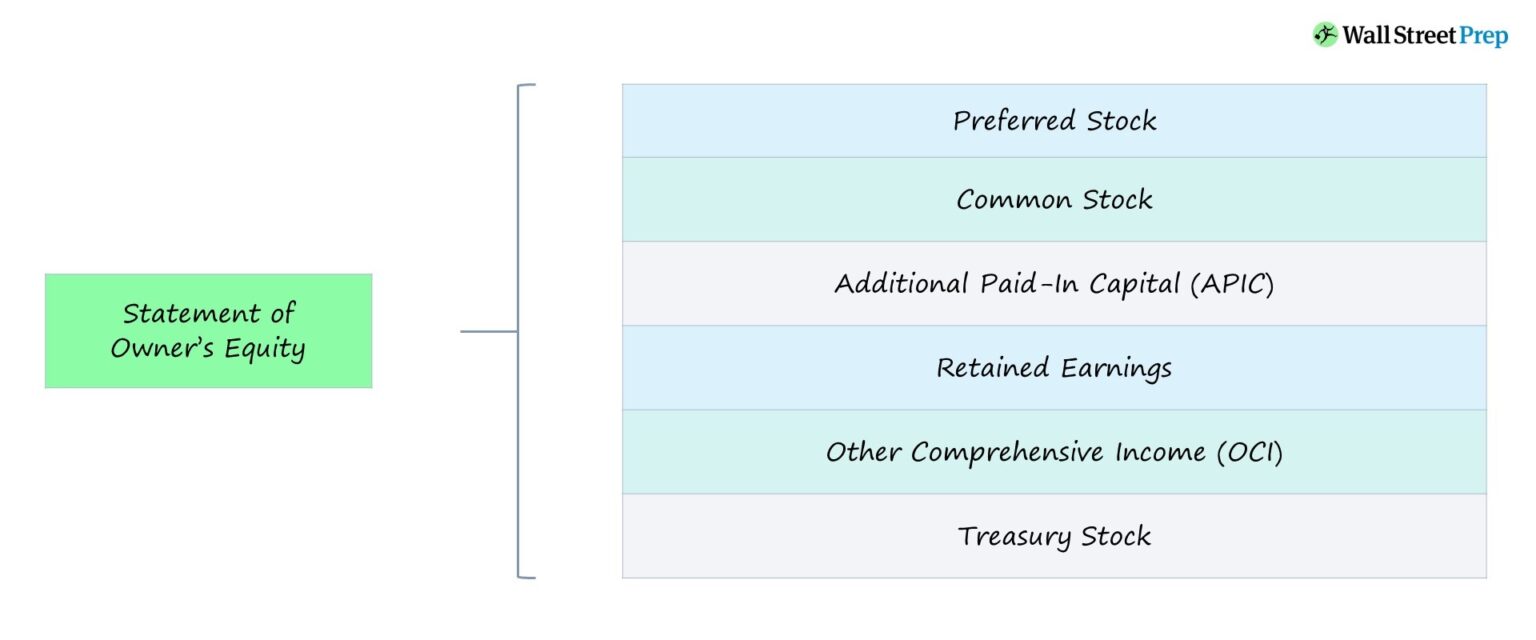
The statement of owner’s equity provides investors with a more detailed understanding of how each individual equity account has been specifically adjusted across different periods.
The statement of owner’s equity, also known as the “statement of shareholder’s equity”, is a financial document meant to offer further transparency into the changes occurring in each equity account.
Both U.S. GAAP and IFRS require companies to include a document that outlines the changes in all equity accounts for greater investor transparency.
The statement of owner’s equity is meant to be supplementary to the balance sheet. The document is therefore issued alongside the B/S and can usually be found directly below (or near) it.
The balance sheet — one of the three core financial statements — shows a company's assets, liabilities, and shareholders' equity at a specific point in time.
There are limitations to the balance sheet (and thus, the income statement, too), thus supplementary disclosures aim to provide investors and all applicable parties with more details, i.e. a more in-depth understanding of the movement of the shareholders’ equity carrying amount on the B/S.
The list below defines the most common items that appear in the statement of owner's equity:
Based on the reporting guidelines established by U.S. GAAP, the supplementary report is set up in a grid-like pattern.
As an illustrative example, below is the statement of stockholders’ equity for Amazon (AMZN) during the fiscal year ending 2021.
The starting line item is the beginning balance as of January 1, 2019, and from there, a breakdown of all of the changes in Amazon’s equity accounts between current and prior accounting periods are reflected.
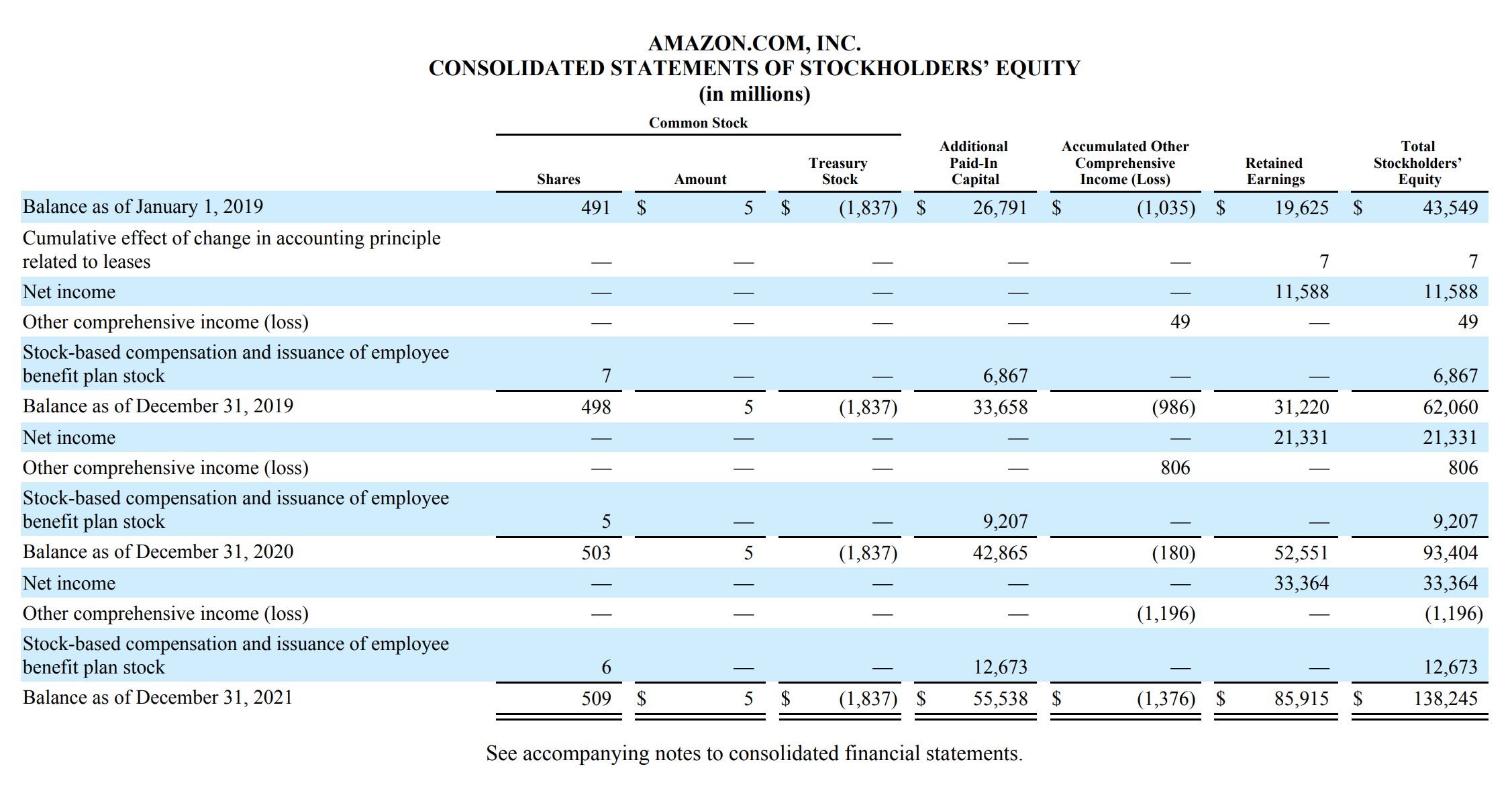
Amazon Statement of Stockholders’ Equity Example (Source: Amazon 10-K)
We’ll now move to a modeling exercise, which you can access by filling out the form below.


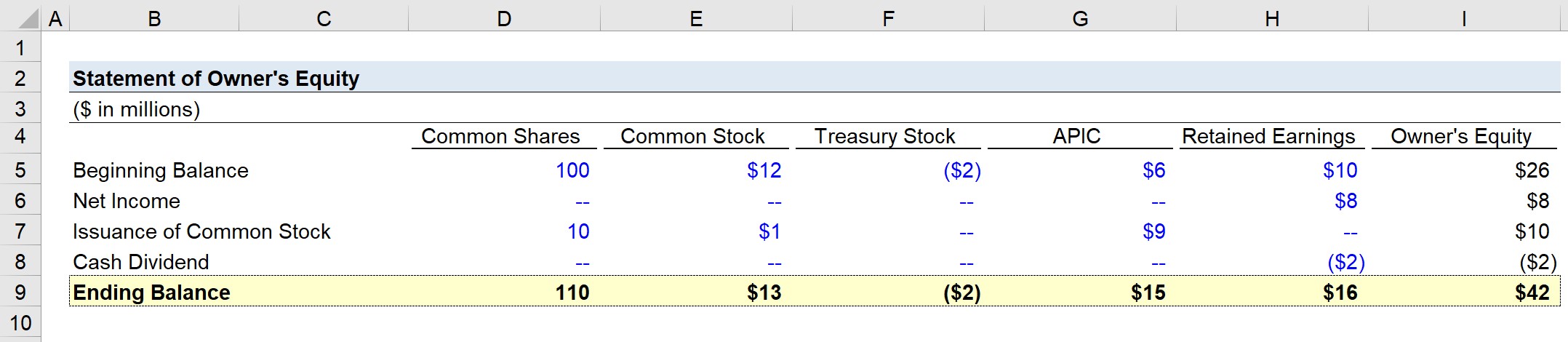
Suppose a company’s equity accounts on January 1, 2020, the start of its fiscal year 2020, consists of the following.
By adding each of the columns on the left — excluding the number of shares — the owner’s equity at the beginning of 2020 is $26 million.
The following changes occurred in the equity accounts throughout 2021.
In terms of the balance sheet values, we’ll start with retained earnings.
Since the beginning balance was $10 million, net income was $8 million, and the cash dividend was $2 million, the ending balance is $16 million
For the additional paid-in capital (APIC) account, the beginning balance was $6 million and the impact from the issuance of common stock in the period, i.e. the excess amount paid over par, was $9 million, so the ending balance is $15 million.
From 2020 to 2021, the company’s share count rose from 100 to 110, the common stock amount increased from $12 million to $13 million, the treasury stock account remained constant, APIC increased from $6 million to $15 million, and retained earnings increased from $10 million to $16 million.
Our table specifically details what changes contributed to our hypothetical company’s owner’s equity account increasing from $26 million to $42 million.
The difference between the statement of owner’s equity and the cash flow statement (CFS) is that the former portrays the changes in a company’s equity over a period in more detail.
In contrast, the cash flow statement — or statement of cash flows — tracks the changes in a company’s cash and cash equivalents over a period of time.
All financial statements are closely linked and supplemental disclosures are meant to ensure there is no misunderstanding from investors.
The statement of owner’s equity essentially displays the “sources” of a company’s equity and the “uses” of its equity.
On the other hand, the cash flow statement is more about tracking the movement of a company’s cash and cash equivalents across a specified period and is comprised of three distinct sections:
The cash flow statement (CFS) is, therefore, more comprehensive with regard to understanding the financial health of a company, but does not offer the same type of transparency into any specific line item.

Enroll in The Premium Package: Learn Financial Statement Modeling, DCF, M&A, LBO and Comps. The same training program used at top investment banks.


No comments yet.