The LBO Model Test refers to a common interview exercise given to prospective candidates during the private equity recruiting process.
Usually, the interviewee will receive a “prompt,” which contains a description containing a situational overview and certain financial data for a hypothetical company contemplating a leveraged buyout.
Upon receipt of the prompt, the candidate will build an LBO model using the assumptions provided to calculate the return metrics, i.e. the internal rate of return (IRR) and the multiple on invested capital (“MOIC”).
Basic LBO Model Test: Practice Tutorial Guide
The following LBO model test is an appropriate place to start to ensure you understand the modeling mechanics, particularly for those starting to prepare for private equity interviews.
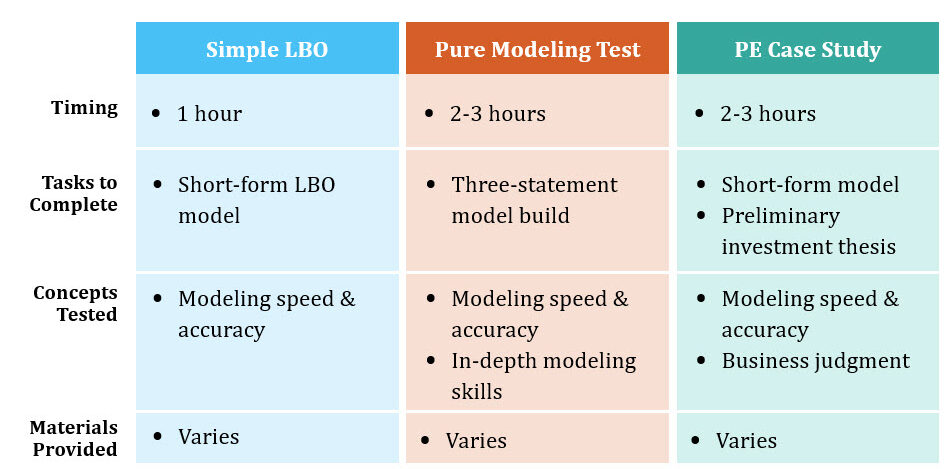
Excel Usage: Unlike the paper LBO, which is a pen-and-paper exercise given in earlier stages of the PE recruiting process, in an LBO Modeling Test, candidates are given access to Excel and expected to construct an operating and cash flow forecast, financing sources & uses and ultimately determine the implied investment returns and other key metrics based on the information provided in the prompt.
Time Limit: The various LBO Excel modeling tests you encounter throughout the recruitment process will most commonly be either 30 minutes, 1 hour or 3 hours, depending on the firm and how near you are to the final stage before offers are made. The one covered in this post should take approximately one hour at most, assuming that you're starting from a blank spreadsheet.
Prompt Format: In some cases, you will be provided a brief prompt consisting of a few paragraphs on a fictitious scenario and be asked to build a quick model from scratch – whereas, in others, you may be given the confidential information memorandum (CIM) of a real acquisition opportunity to put together an investment memo alongside an LBO model to support your thesis. For the latter, the prompt is usually left vague intentionally, and asked in the form of a "share your thoughts" open-ended context.
LBO Modeling Test Interview Grading Criteria
Every firm has a slightly different grading rubric for the LBO modeling test, yet at its core, most boil down to two criteria:
Accuracy: How well do you understand the underlying mechanics of an LBO model?
Speed: How quickly can you complete the task without a loss in accuracy?
For more complex case studies, where you will be given more than three hours, your ability to interpret the output of the model and make an informed investment recommendation will be just as important as your model flowing correctly with the right linkages.
In-Person LBO Modeling Test Spectrum
Continue Reading Below
The Wharton Online and Wall Street Prep Private Equity Certificate Program
Level up your career with the world’s most recognized private equity investing program. Enrollment is open for the upcoming cohort.
The basic LBO modeling test is essential in private equity training but can often oversimplify complex transactions due to manual processing limitations. Artificial intelligence elevates the LBO modeling experience by generating multiple scenarios in real time, stress-testing assumptions, and uncovering subtle risk factors. Through the AI for Business & Finance Certificate Program — designed by Wall Street Prep and Columbia Business School Executive Education — professionals develop the skills to apply AI-powered modeling tools that increase both precision and efficiency in private equity analysis.
Let's get started! An illustrative prompt on a hypothetical leveraged buyout (LBO) can be found below.
LBO Model Test Instructions
A private equity firm is considering the leveraged buyout of JoeCo, a privately-owned coffee company. In the last twelve months (“LTM”), JoeCo generated $1bn in revenue and $100mm in EBITDA. If acquired, the PE firm believes JoeCo's revenue can continue to grow 10% YoY while its EBITDA margin remains constant.
To fund this transaction, the PE firm was able to obtain 4.0x EBITDA in Term Loan B (“TLB”) financing – which will come with a seven-year maturity, 5% mandatory amortization, and priced at LIBOR + 400 with a 2% floor. Packaged alongside the TLB is a $50mm revolving credit facility (“revolver”) priced at LIBOR + 400 with an unused commitment fee of 0.25%. For the last debt instrument used, the PE firm raised 2.0x in Senior Notes that carries a seven-year maturity and an 8.5% coupon rate. The financing fees were 2% for each tranche while the total transaction fees incurred were $10mm.
On JoeCo’s balance sheet, there is $200mm of existing debt and $25mm in cash, of which $20mm is considered excess cash. The business will be delivered to the buyer on a "cash-free, debt-free basis", which means the seller is responsible for extinguishing the debt and keeps all the excess cash. The remaining $5mm in cash will come over in the sale, as this is cash that the parties determined is required to keep the business operating smoothly.
Assume for each year that JoeCo’s depreciation & amortization expense ("D&A") will be 2% of revenue, capital expenditures ("Capex") requirement will be 2% of revenue, the change in net working capital ("NWC") will be 1% of revenue, and the tax rate will be 35%.
If the PE firm were to purchase JoeCo at 10.0x LTM EV/EBITDA on 12/31/2020 and then exit at the same LTM multiple after a five-year time horizon, what would the implied IRR and cash-on-cash return of the investment be?
LBO Model Test – Excel Template
Use the form below to download the Excel file used to complete the modeling test.
However, while most firms will provide the financials in an Excel format that you could use as a "guiding" template, you should still be comfortable with creating a model starting from scratch.
Get the Excel Template!
You’re logged in! Form submission not required. Access your file below.
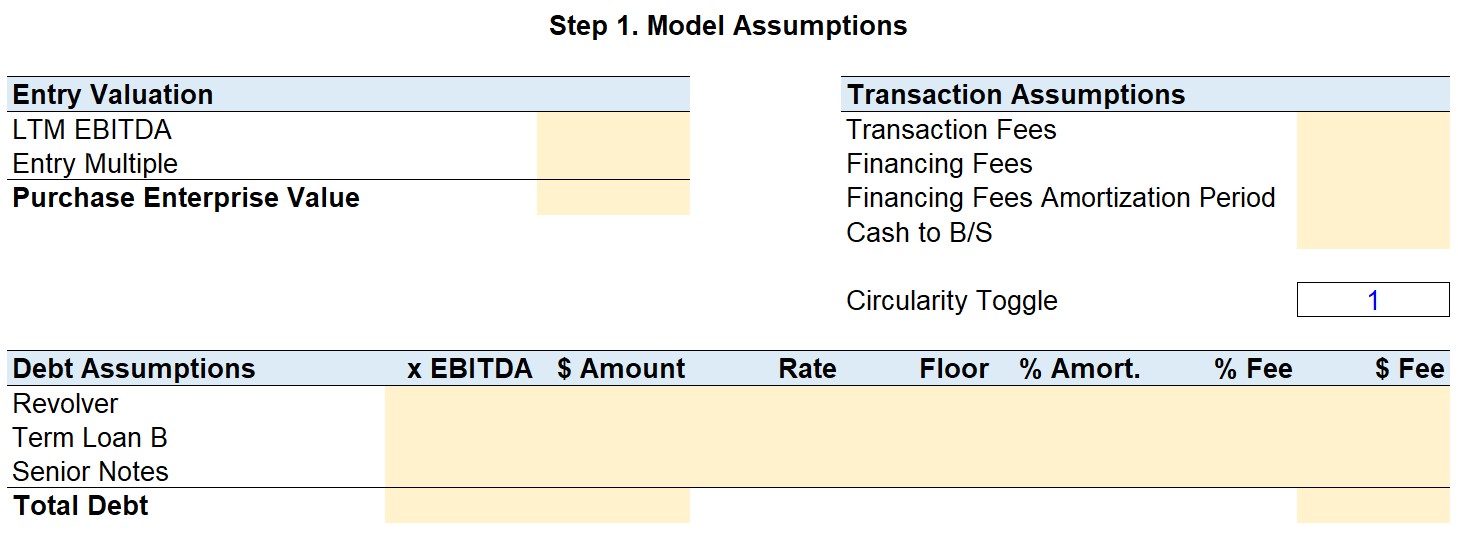
The first step of the LBO modeling test is to determine the entry valuation of JoeCo on the date of the initial purchase.
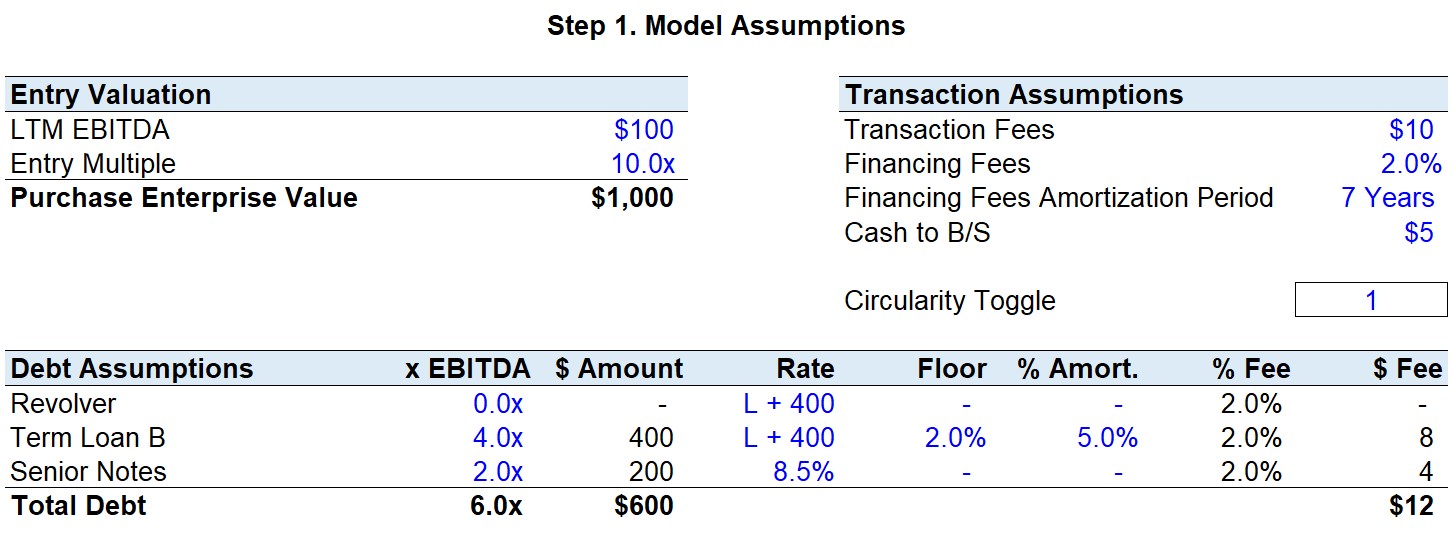
By multiplying JoeCo’s $100mm LTM EBITDA by the entry multiple of 10.0x, we know the enterprise value at purchase was $1bn.
"Cash-Free Debt-Free" Transaction
Since this deal is structured as a cash-free debt-free transaction (CFDF), the sponsor is not assuming any JoeCo debt or getting any of JoeCo's excess cash.
From the sponsor's perspective, there is no net debt, and thus the equity purchase price equals the enterprise value.
The private equity firm is essentially saying: “JoeCo can have the excess cash sitting on its balance sheet, but on the basis that JoeCo will pay off its outstanding debt in return.”
Most PE deals are structured as cash-free, debt-free (CFDF). The notable exceptions are go-private transactions where the sponsor acquires each share for a defined offer price per share and thus acquires all assets and assumes all liabilities.
Transaction Assumptions
Next, we will list out the transaction assumptions provided.
Transaction Fees: The transaction fees were $10mm – this is the amount paid to investment banks for their M&A advisory work, as well as to lawyers, accountants, and consultants who helped on the deal. These advisory fees are treated as a one-time expense, as opposed to being capitalized.
Financing Fees: The 2% deferred financing fee refers to the costs incurred while raising debt capital to fund this transaction. This financing fee will be based on the total magnitude of debt used and will be amortized over the tenor (term) of the debt – which is seven years in this scenario.
Cash to B/S: The minimum cash balance required post-closing of the transaction (i.e. "Cash to B/S") was stated as $5mm, which means JoeCo needs $5mm in cash-on-hand to continue operating and meet its short-term working capital obligations.
Debt Assumptions
With the entry valuation and transaction assumptions filled out, we can now list out the debt assumptions related to each debt tranche, such as the turns of EBITDA ("x EBITDA"), pricing terms, and amortization requirements.
The amount of debt that a lender has provided is expressed as a multiple of EBITDA (also called a “turn”). For instance, we can see that $400mm was raised in Term Loan B as the amount was 4.0x EBITDA.
In total, the initial leverage multiple used in this transaction was 6.0x – since 4.0x was raised from TLB and 2.0x in Senior Notes.
Moving onto the columns on the right, the "Rate" and "Floor" are used to calculate the interest rate of each debt tranche.
The two senior secured debt tranches, the Revolver and Term Loan B, are priced off LIBOR + a spread (i.e. priced at a "floating rate"), meaning that the interest rate paid on these debt instruments fluctuates based on LIBOR ("London Interbank Offered Rate"), the global standard benchmark used to set lending rates.
The general convention is to state the pricing of debt in terms of basis points ("bps") rather than by "%". The "+ 400" just means 400 basis points, or 4%. Therefore, the interest rate pricing on the Revolver and TLB will be LIBOR + 4%.
The Term Loan B tranche has a 2% "Floor", which reflects the minimum amount required to be added to the spread. LIBOR will often fall below the floor rate during periods of low-interest rates, so this feature is meant to ensure that a minimum yield is received by the lender.
For example, if LIBOR was at 1.5% and the floor was 2.0%, the interest rate on this Term Loan B would be 2.0% + 4.0% = 6.0%. But if LIBOR was at 2.5%, the interest rate on the TLB would be 2.5% + 4% = 6.5%. As you can see, the interest rate cannot fall below 6% because of the floor.
The third tranche of debt used, the Senior Notes, is priced at 8.5% (i.e. priced at a "fixed rate"). This type of pricing is simpler because regardless of whether LIBOR goes up or down, the interest rate will remain unchanged at 8.5%.
In the final column, we can calculate the financing fees based on the amount of debt raised. Since $400mm was raised in Term Loan B and $200mm was raised in Senior Notes, we can multiply each by the 2% financing fee assumption and sum them up to arrive at $12mm in financing fees.
Step 1: Formulas Used
Purchase Enterprise Value = LTM EBITDA × Entry Multiple
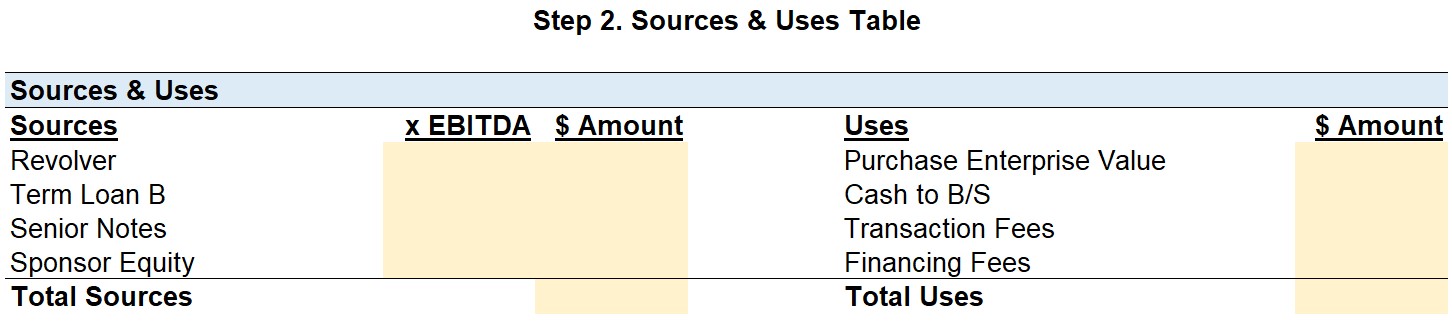
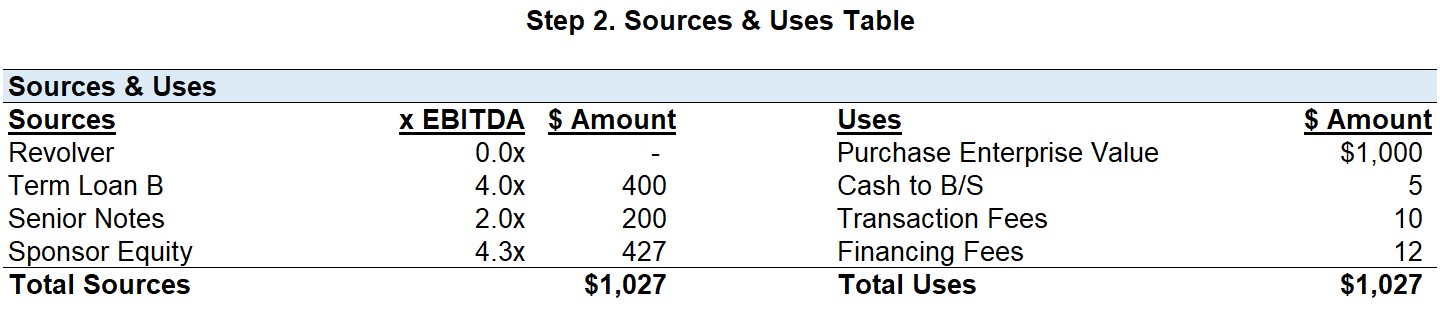
In the next step, we will build out the Sources & Uses schedule, which lays out how much it will cost in total to acquire JoeCo and where the required funding will come from.
Uses Side
It is recommended to start on the "Uses" side and then complete the "Sources" side afterward since you need to figure out how much something costs before thinking about how you will come up with the funds to pay for it.
Purchase Enterprise Value: To start, we have already calculated the “Purchase Enterprise Value” in the previous step and can directly link to it. The $1bn is the total amount being offered by the private equity firm to acquire the equity of JoeCo.
Cash to B/S: We must recall that JoeCo's cash balance cannot dip below $5mm post-transaction. As a result, the "Cash to B/S" in effect will increase the total funding required – hence, it will be on the "Uses" side of the table.
Transaction Fees and Financing Fees: To finish the Uses section, the $10mm in transaction fees and $12mm in financing fees were already calculated earlier and can be linked to the relevant cells.
Therefore, $1,027mm in total capital will be required to complete this proposed acquisition of JoeCo, and the "Sources" side will now illustrate how the PE firm intends to finance the acquisition.
Sources Side
We will now outline how the PE firm came up with the necessary funds to meet the cost of purchasing JoeCo.
Revolver: Since there was no mention of the revolving credit line being drawn, we can assume that none was used to help fund the purchase. The revolver is generally undrawn at close but could be drawn from if needed. Think of the revolver as a "corporate credit card" meant for use during emergencies – this line of credit is extended to borrowers by lenders to make their financing packages more attractive (i.e. for the Term Loan B in this scenario) and to provide JoeCo a "cushion" for unexpected liquidity shortages.
Term Loan B (“TLB”): Next, a term loan B is provided by an institutional lender and is generally a senior, 1st lien loan with a 5 to 7 year maturity and low amortization requirements. The amount of TLB raised was calculated earlier by multiplying the 4.0x TLB leverage multiple by the LTM EBITDA of $100mm – thus, $400mm in TLB was raised to fund this purchase.
Senior Notes: The third debt tranche raised was Senior Notes at a leverage multiple of 2.0x EBITDA, so $200mm was raised. Senior Notes are junior to secured bank debt (e.g. Revolver, Term Loans), and provide a higher yield to compensate the lender for undertaking the additional risk of holding a debt instrument lower in the capital structure.
Now that we have determined how much the firm needs to pay and the amount of debt funding, the “Sponsor Equity” is the plug for the remaining funds needed.
If we add up all the funding sources (i.e. the $600mm raised in debt) and then deduct it from the $1,027mm in “Total Uses”, we see $427mm was the initial equity contribution by the sponsor.
Step 2: Formulas Used
Sponsor Equity = Total Uses – (Revolver + Term Loan B + Senior Notes Amounts)
Total Sources = Revolver + Term Loan B + Senior Notes + Sponsor Equity
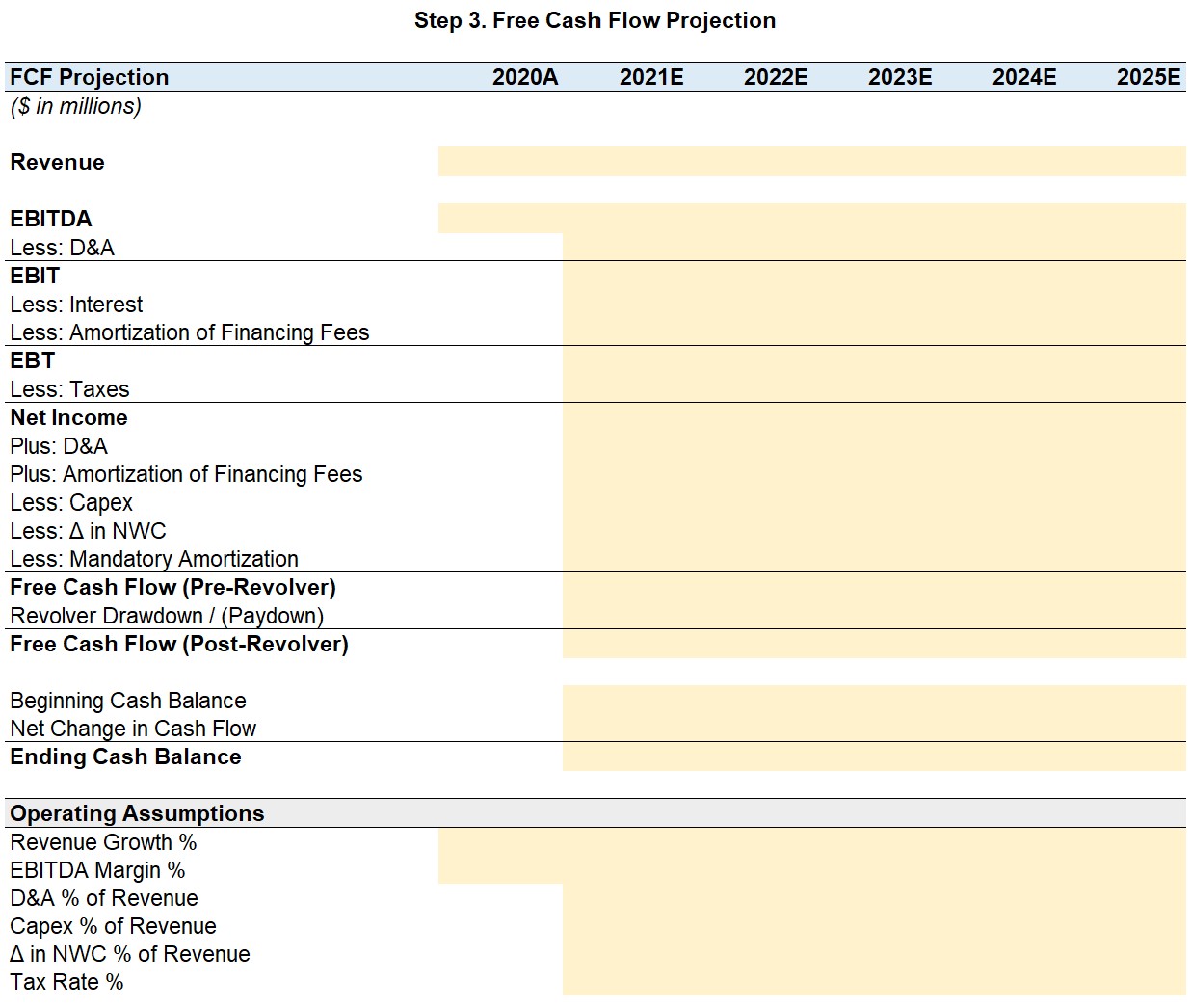
Step 3. Free Cash Flow Projection
Revenue and EBITDA
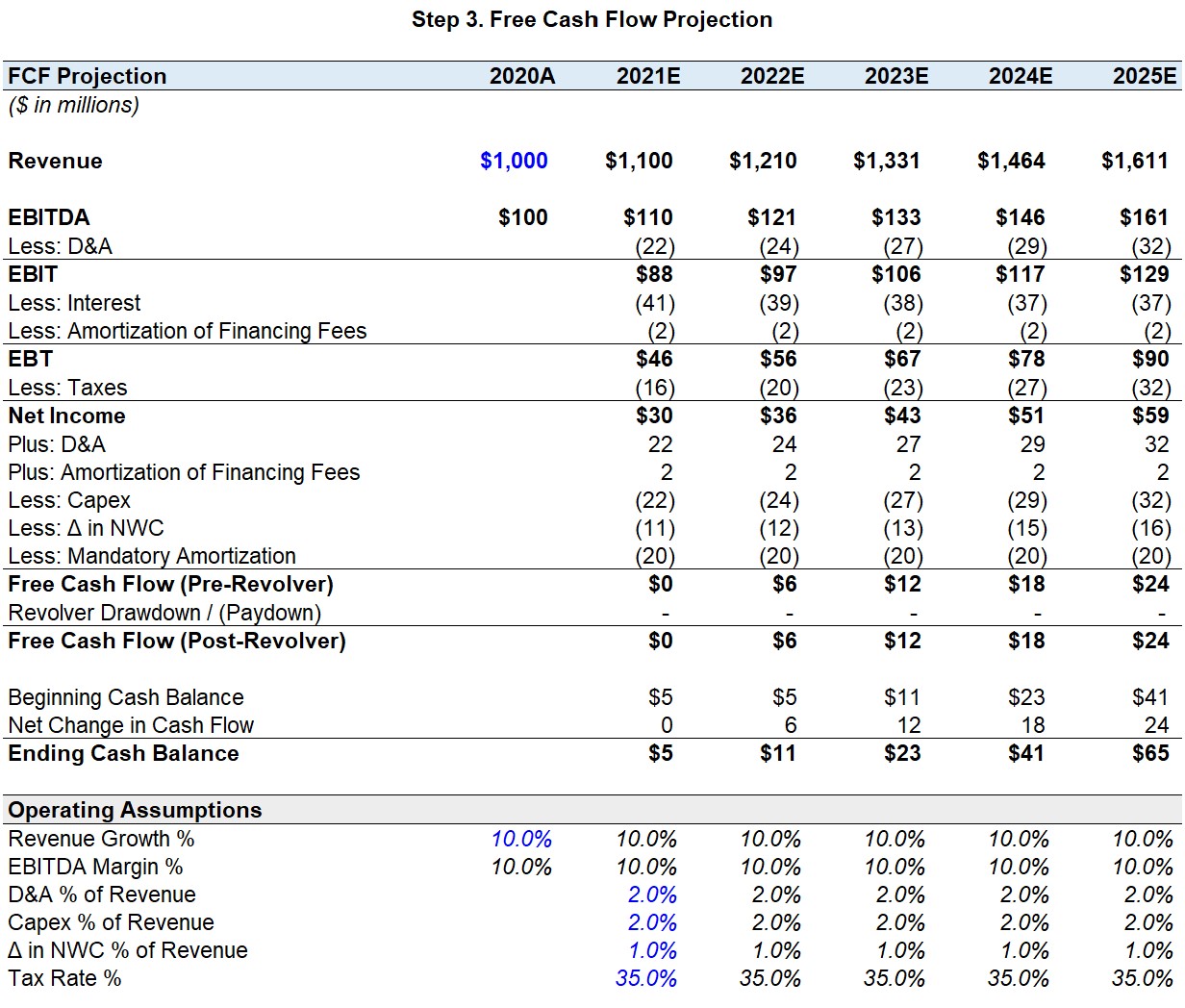
Thus far, the Sources & Uses table has been completed and the transaction structure has been determined, meaning that the free cash flows ("FCFs") of JoeCo can be projected.
To start the forecast, we begin with Revenue and EBITDA since most of the operating assumptions provided are driven by a certain percentage of revenue.
As a general modeling best practice, it is recommended to place all the drivers (i.e. operating assumptions") grouped together in the same section near the bottom.
The prompt stated the year-over-year ("YoY") revenue growth will be 10% throughout the holding period with the EBITDA margins held constant from the LTM performance.
While the EBITDA margin was not explicitly stated in the prompt, we can divide the LTM EBITDA of $100mm by the $1bn in LTM revenue to get a 10% EBITDA margin.
Once you have inputted the revenue growth rate and EBITDA margin assumptions, we can project the amounts for the forecast period based on the formulas below.
Operating Assumptions
As stated in the prompt, D&A will be 2% of revenue, Capex requirements are 2% of revenue, the change in NWC will be 1% of revenue, and the tax rate will be 35%.
All these assumptions will remain unchanged throughout the forecast period; therefore, we can "straight-line" them, i.e. reference the current cell to the one on the left.
Net Income
The formula for free cash flow before any revolver drawdown / (paydown) begins with net income.
Therefore, we need to work our way down from EBITDA to net income ("the bottom line"), meaning the subsequent step is to subtract D&A from EBITDA to calculate EBIT.
We are now at Operating Income (EBIT) and will subtract "Interest" and the "Amortization of Financing Fees".
The interest expense line item will remain blank for now as the debt schedule has not yet been completed – we will return to this later.
For the financing fees amortization, we can compute this by dividing the total financing fee ($12mm) by the tenor of the debt, 7 years – doing so will leave us with ~$2mm each year.
The only expenses remaining from Pre-Tax Income (EBT) are the taxes paid to the government. This tax expense will be based on JoeCo's taxable income. Therefore, we will multiply the 35% tax rate by EBT.
Once we have the amount in taxes due each year, we will subtract that amount from EBT to arrive at net income.
Free Cash Flow (Pre-Revolver)
The FCFs generated are central to an LBO as they determine the amount of cash available for debt amortization and the servicing of the due interest expense payments each year.
To calculate the FCF, we will first add back D&A and the Amortization of Financing Fees to Net Income since they are both non-cash expenses.
We calculated them both earlier and can just link to them but with the signs flipped since we are adding them back (i.e. more cash than net income showed).
Next, we subtract out Capex and the change in NWC. An increase in Capex and NWC are both outflows of cash and decrease the FCF of JoeCo, thus make sure to insert a negative sign at the front of the formula to reflect this.
In the final step before arriving at FCF, we will deduct the mandatory debt amortization associated with the Term Loan B.
For the time being, we'll keep this part blank and return it once the debt schedule has been finalized.
Step 3: Formulas Used
Total Uses = Purchase Enterprise Value + Cash to B/S + Transaction Fees + Financing Fees
Revenue = Prior Revenue × (1 + Revenue Growth %)
EBITDA = Revenue × EBITDA Margin %
Free Cash Flow (Pre-Revolver) = Net Income + Depreciation & Amortization + Mandatory Amortization
Free Cash Flow (Pre-Revolver) = Net Income + D&A + Amortization of Financing Fees – Capex – Δ in NWC – Mandatory Debt Amortization
If a line item has "Less" at the front, confirm it is reflected as a negative outflow of cash, and vice versa if it has "Plus" in front. Assuming you followed the sign conventions as recommended, you can just sum up net income with the five other line items to arrive at the pre-revolver FCF.
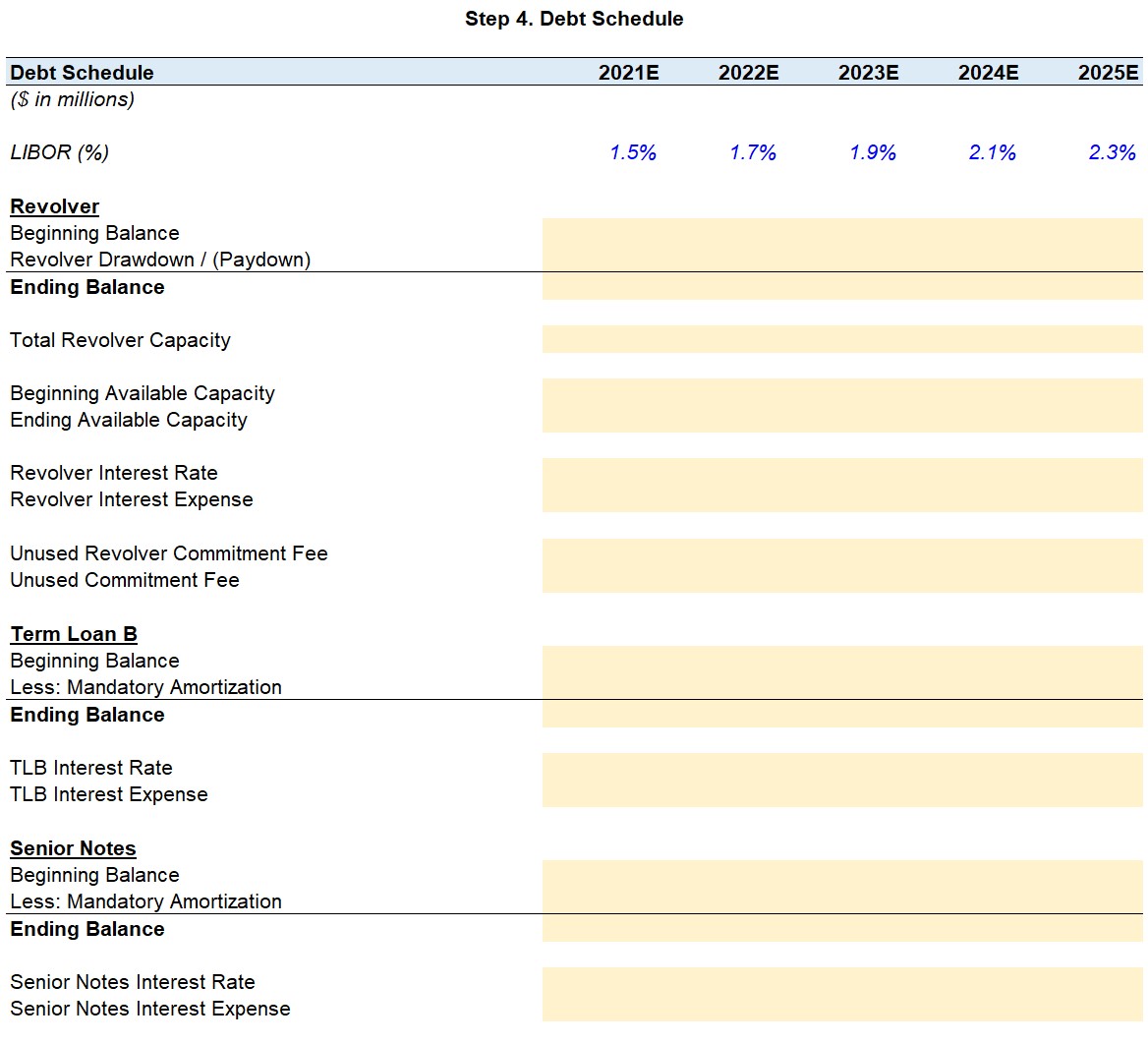
Step 4. Debt Schedule
The debt schedule is arguably the trickiest part of the LBO Modeling Test.
In the previous step, we calculated the free cash flow available before any revolver drawdown / (paydown).
The missing line items that we had skipped over earlier will be derived from the debt schedule to complete those FCF projections.
To take a step back, the purpose of creating this debt schedule is to keep track of JoeCo's mandatory payments to its lenders and assess its revolver needs, as well as calculate the interest due from each debt tranche.
The borrower, JoeCo, is legally required to pay down debt tranches in a specific order (i.e. waterfall logic) and must abide by this lender agreement. Based on this contractual obligation, the revolver will be paid off first, followed by the Term Loan B, and then the Senior Notes.
For each debt tranche, we will utilize roll-forward calculations, which refer to a forecasting approach that connects the current period forecast to the prior period after accounting for the line items that increase or decrease the ending balance.
Roll-Forward Approach ("BASE" or "Cork-Screw")
Roll-forwards refers to a forecasting approach that connects the current period forecast to the prior period:
This approach is very useful in adding transparency to how schedules are constructed. Maintaining strict adherence to the roll-forward approach improves a user's ability to audit the model and reduces the likelihood of linking errors.
Revolving Credit Facility (Revolver)
As mentioned in the beginning, the revolver functions similarly to a corporate credit card and JoeCo will draw down from it when it is short on cash and will pay off the balance once it has cash in excess.
If there is a shortage of cash, the revolver balance will rise – this balance will be paid down once there is a surplus of cash
The revolver sits at the very top of the debt waterfall and has the highest claim on JoeCo's assets if the company were to be liquidated.
To start, we will create three line items:
Total Revolver Capacity The "Total Revolver Capacity" refers to the maximum amount that can be drawn from the revolver, and it comes out to $50mm in this scenario.
Beginning Available Revolver Capacity The "Beginning Available Revolver Capacity" is the amount that can be borrowed in the current period after deducting the amount already drawn in previous periods. This line item is calculated as the total revolver capacity minus the beginning of period balance.
Ending Available Revolver Capacity The "Ending Available Revolver Capacity" is the amount of the beginning available revolver capacity minus the amount drawn from in the current period.
For example, if JoeCo has drawn $10mm to date, the beginning available revolver capacity for the current period is $40mm.
To continue building out this revolver roll-forward, we link the beginning of period balance in 2021 to the amount of revolver used to fund the transaction in the Sources & Uses table. In this case, the revolver was left undrawn, and the beginning balance is thereby zero.
Then, the line that comes after will be "Revolver Drawdown / (Paydown)".
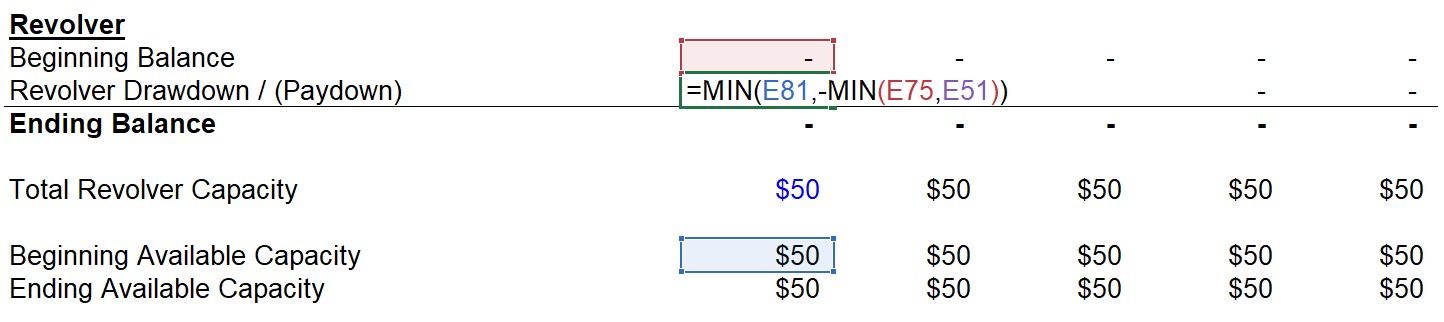
The formula for the "Revolver Drawdown / (Paydown)" in Excel is shown below:
The "Revolver Drawdown" comes into play when the FCF of JoeCo has turned negative and the revolver will be drawn from.
Again, JoeCo can borrow at most up to the Available Revolver Capacity. This is the purpose of the 1st "MIN" function, it ensures no more than $50mm could be borrowed. It is entered as a positive because when JoeCo draws from the revolver, it is an inflow of cash.
The 2nd "MIN" function will return the lesser value between the "Beginning Balance" and the "Free Cash Flow (Pre-Revolver)".
Take notice of the negative sign in front – in the case that the "Beginning Balance" is the smaller value of the two, the output will be negative and the existing revolver balance will be paid down.
The "Beginning Balance" figure cannot turn negative as that would imply that JoeCo paid down more of the revolver balance than it had borrowed (i.e. the lowest it can be is zero).
On the other hand, if the "Free Cash Flow (Pre-Revolver)" is the lesser value of the two, the revolver will be drawn from (as the two negatives will make a positive).
For instance, let's say that JoeCo's FCF has turned negative $5mm in 2021, the 2nd "MIN" function will output the negative free cash flow amount, and the negative sign placed in front will make the amount positive – which makes sense since this is a drawdown.
This is how the revolver balance would change if JoeCo's pre-revolver FCF had turned negative by $5mm in 2021:
As you can see, the drawdown in 2021 would be $5mm. The ending balance of the revolver has increased to $5mm. In the next period, since JoeCo has sufficient pre-revolver FCF, it will pay down the outstanding revolver balance. The ending balance in the 2nd period has thus returned to zero.
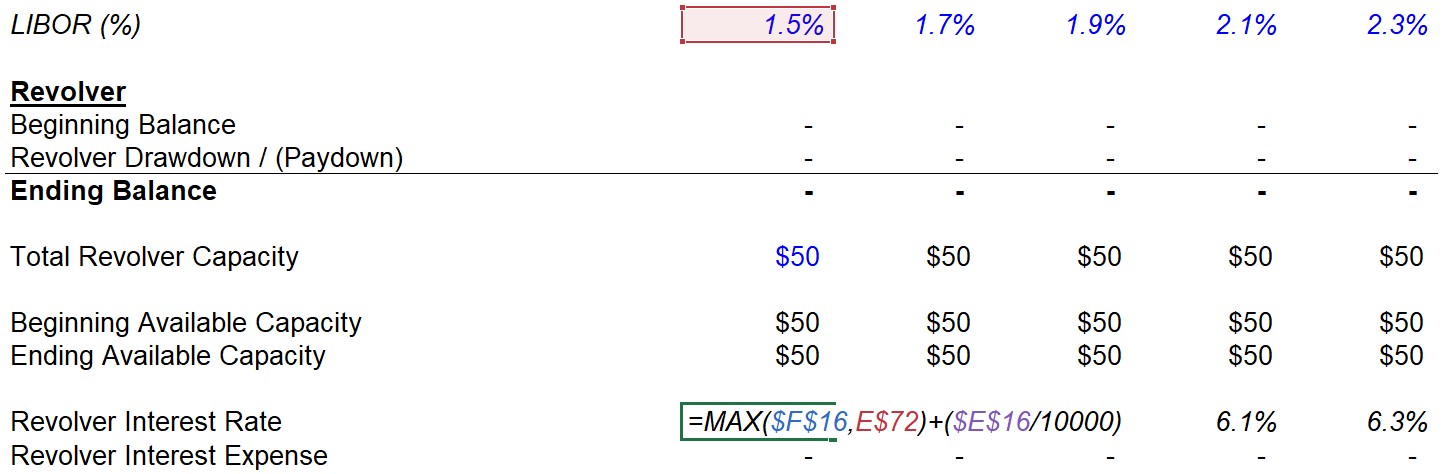
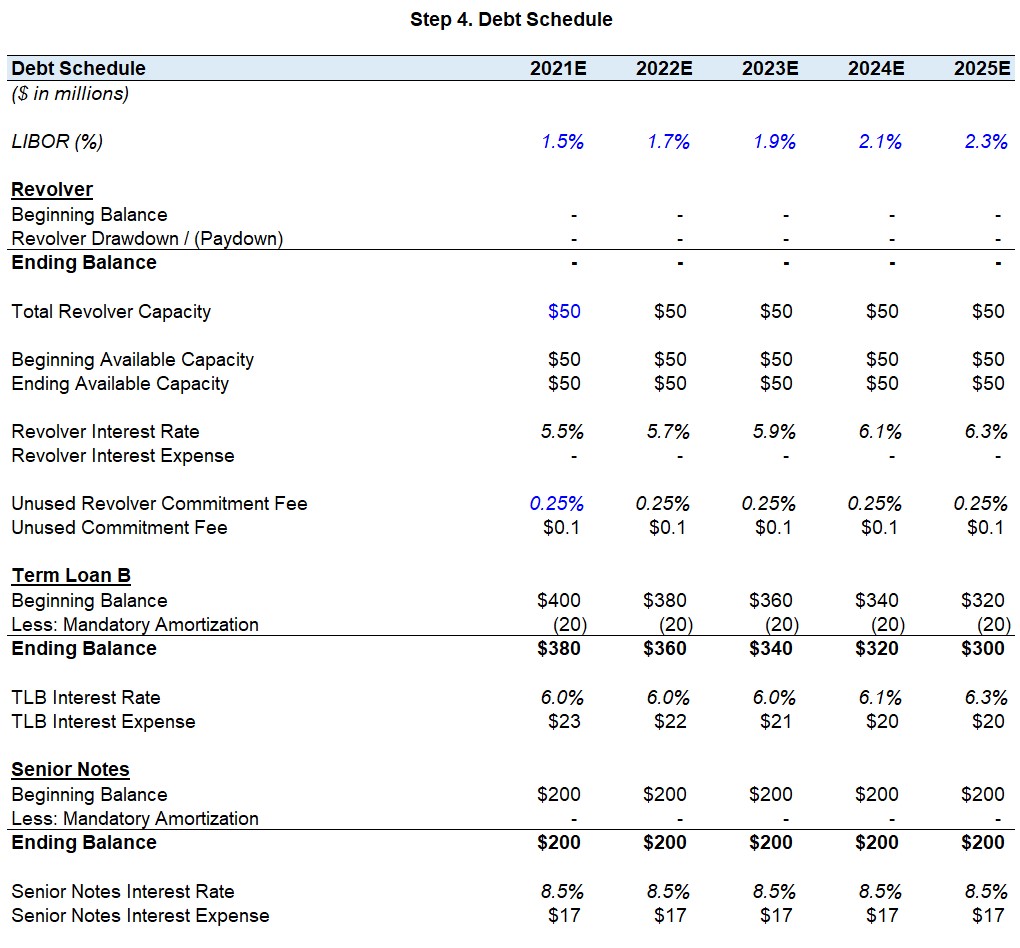
To calculate the interest expense associated with the revolver, we first need to get the interest rate. The interest rate is calculated as LIBOR plus the spread, "+ 400". Since it was stated in terms of basis points, we divide 400 by 10,000 to get .04, or 4%.
Although the Revolver has no floor, it is a good habit to put the LIBOR rate in a "MAX" function with the floor, which is 0.0% in this case. The "MAX" function will output the larger value of the two, which is LIBOR in all the forecasted years. For example, the interest rate in 2021 is 1.5% + 4% = 5.5%.
Note that if LIBOR were stated in basis points, the top line would look like "150, 170, 190, 210, and 230". The formula would change in that LIBOR (Cell "F$73" in this case) will be divided by 10,000.
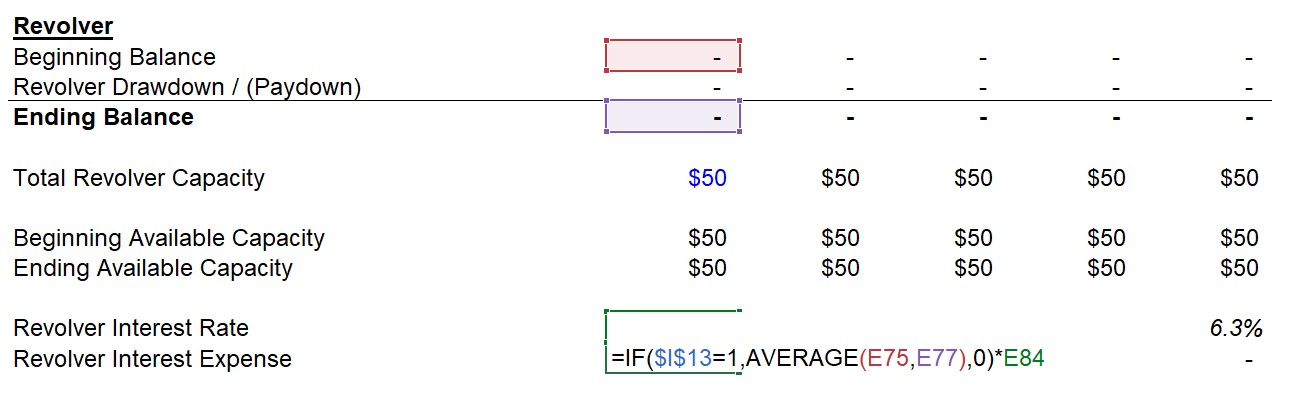
Now that we have calculated the interest rate, we can multiply it by the average of the beginning and ending revolver balance. If the revolver remains undrawn throughout the entire duration of the holding period, the interest paid will be zero.
Once we link the interest expense back into the FCF forecast, a Circularity will be introduced into our model. Therefore, we have added a circularity toggle in case the model breaks.
Basically, what the formula above is saying is:
If the toggle is switched to "1", then the average of the beginning and ending balance will be taken
If the toggle is switched to "0", then a zero will be output, which removes all the cells populated with "#VALUE" (and can be toggled back to use the average)
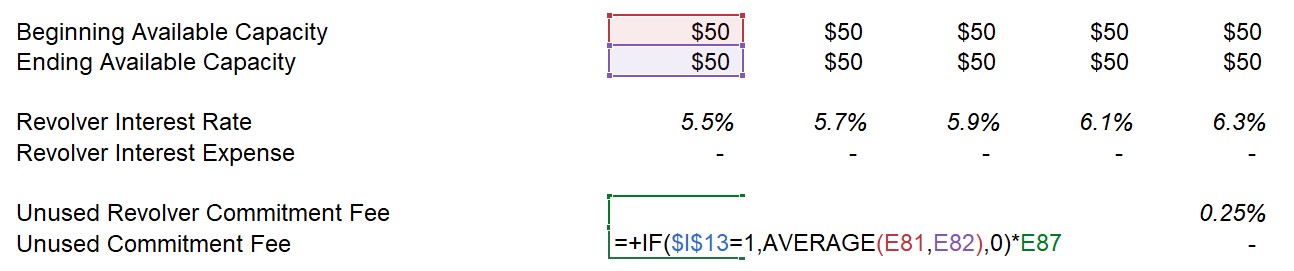
Finally, the revolver comes with an unused commitment fee, which is 0.25% in this scenario. To calculate this annual commitment fee, we multiply this 0.25% fee by the average of the beginning and ending available revolver capacity, since this represents the revolver amount not being used.
Term Loan B (TLB)
Moving onto the next tranche in the waterfall, the Term Loan B will be forecasted in a similar roll-forward but this schedule will be simpler given our model assumptions.
The only factor that impacts the ending TLB balance is the scheduled principal amortization of 5%. For each year, this will be calculated as the total amount raised (i.e. the principal) multiplied by the 5% mandatory amortization.
While it is less relevant to this scenario, we have wrapped a "-MIN" function to output the lesser number between the (Principal * Mandatory Amortization %) and the Beginning TLB Balance. This prevents the principal amount paid down from exceeding the balance remaining.
For example, if the required amortization was 20% per year and the holding period was 6 years, without this function in place – JoeCo would still be paying the mandatory amortization in year 6 despite the principal being fully paid off (i.e. the beginning balance in Year 6 would be zero, so the function will output the zero rather than the mandatory amortization amount)
The amortization amount is based on the original debt principal regardless of how much of the debt has been paid down to date.
In other words, the mandatory amortization of this TLB will be $20mm each year until the remaining principal will be due in one final payment at the end of its maturity.
The interest rate calculation for TLB is shown below:
The formula is the same as the revolver, but this time there is a LIBOR floor of 2%. Since LIBOR is 1.5% in 2021, the "MAX" function will output the larger number between the floor and LIBOR – which is the 2% floor for 2021.
The 2nd part is the spread of 400 basis points divided by 10,000 to arrive at 0.04, or 4.0%.
Given how LIBOR is 1.5% in 2021, the TLB interest rate will be calculated as 2.0% + 4.0% = 6.0%.
Then, to calculate the interest expense – we take the TLB interest rate and multiply it by the average of the beginning and ending TLB balance.
Notice how as the principal is paid down, the interest expense decreases. Contrast this to mandatory amortization, in which the amount paid remains constant regardless of the principal paydown.
The approximate interest expense is ~$23mm in 2021 and falls to ~$20mm by 2025.
However, this dynamic is less apparent in our model given the mandatory amortization is only 5.0% and we are assuming no cash sweeps (i.e. prepayment using excess FCF is not allowed).
Senior Notes
Relative to equity and other riskier notes/bonds that the PE firm could have potentially used as funding sources, Senior Notes are higher up in the capital structure and considered to be a “safe” investment from the perspective of most lenders. However, Senior Notes are still below bank debt (e.g. Revolver, TLs) and usually unsecured despite the name.
One characteristic of these Senior Notes is that there will be no required principal amortization, meaning the principal will not be paid until maturity.
We saw how with the TLB, the interest expense (i.e. the proceeds to the lender) decreases as the principal is gradually paid down. So, the lender of the Senior Notes chose to neither require any mandatory amortization nor allow prepayment.
As you can see below, the interest expense is $17mm each year, and the lender receives an 8.5% yield on the $200mm outstanding balance for the entire tenor.
Forecast Completion
The debt schedule is now done, so we can return to the parts of the FCF forecast that we skipped over and left blank.
Interest Expense: The interest expense line item will be calculated as the sum of all of the interest payments from each debt tranche, as well as the unused commitment fee on the revolver.
Mandatory Amortization: In order to complete the forecast, we will link the mandatory amortization amount due from the TLB directly to the "Less: Mandatory Amortization" line item on the forecast, right above the "Free Cash Flow (Pre-Revolver)".
For more complex (and realistic) transactions where various debt tranches require amortization, you would take the sum of all of the amortization payments due that year and then link it back to the forecast.
Our free cash flow projection model is now complete with those two final linkages made.
Step 4: Formulas Used
Available Revolver Capacity = Total Revolver Capacity – Beginning Balance
As a side note, one common feature in LBO models is a "cash sweep" (i.e. optional repayments using excess FCFs), but this was excluded in our basic model. For this reason, the "Free Cash Flow (Post-Revolver)" will be equal to the "Net Change in Cash Flow" since there are no more uses of cash.
Step 5. Returns Calculation
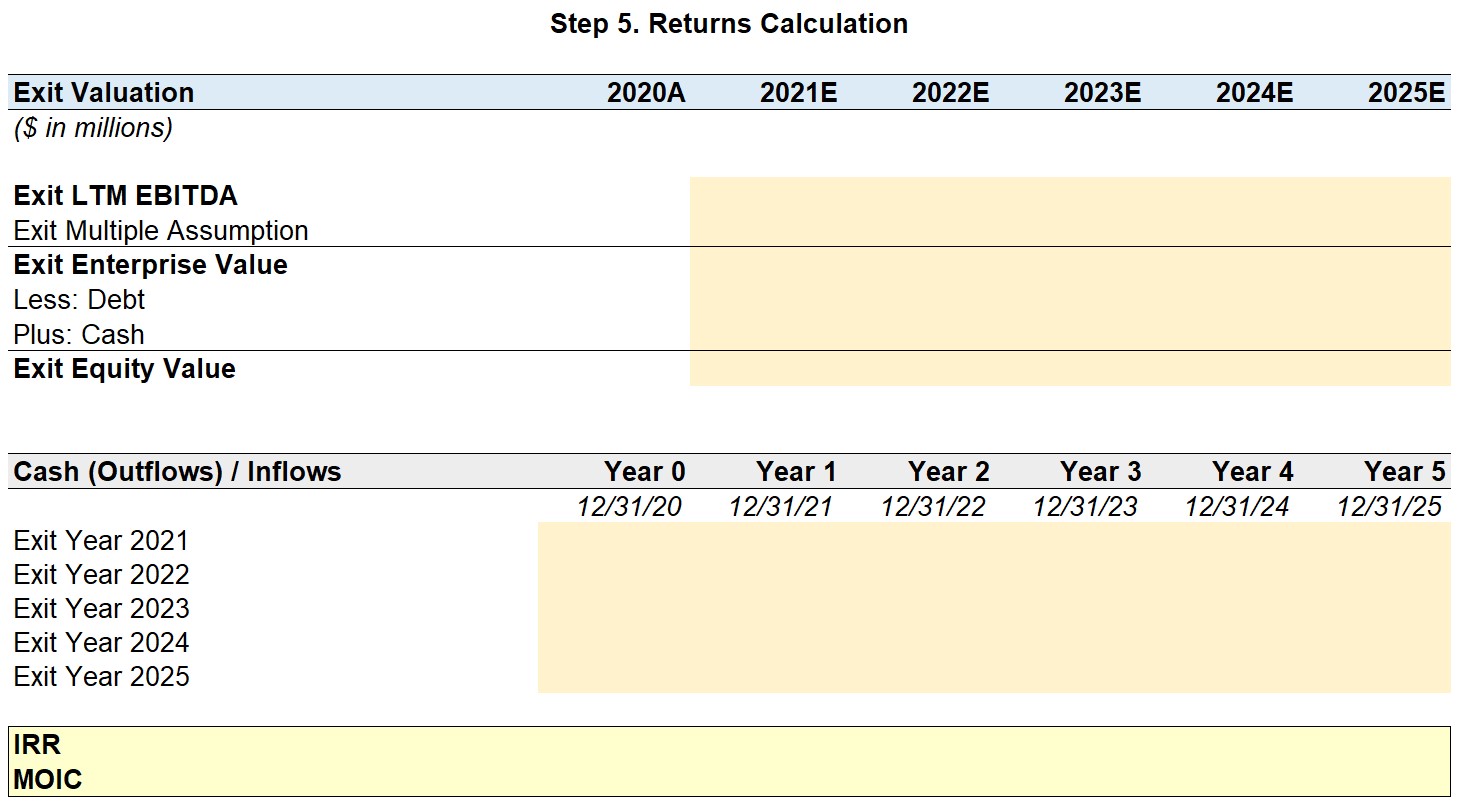
Exit Valuation
Now that we have projected the financials of JoeCo and the net debt balance for the five-year holding period, we have the necessary inputs to calculate the implied exit value for each year.
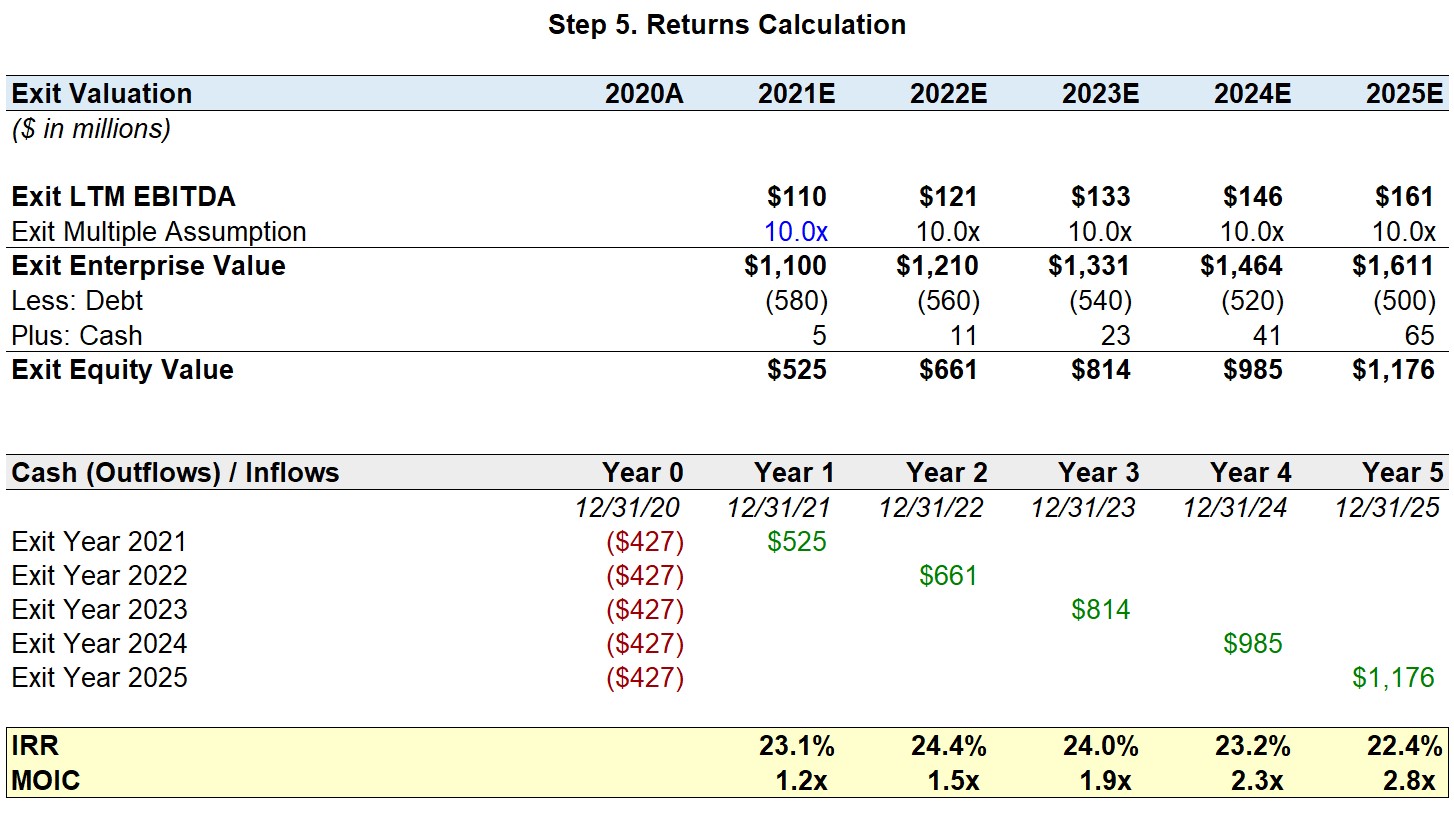
Exit Multiple Assumption: The first input will be the "Exit Multiple Assumption", which was stated as being the same as the entry multiple, 10.0x.
Exit EBITDA: In the next step, we'll create a new line item for "Exit EBITDA" which simply links to the EBITDA of the given year. We will grab this figure from the FCF forecast.
Exit Enterprise Value: We can now calculate the "Exit Enterprise Value" by multiplying the Exit EBITDA by the Exit Multiple Assumption.
Exit Equity Value: Similar to how we did in the first step for the entry valuation, we will then deduct the net debt from the enterprise value to arrive at the "Exit Equity Value". The total debt amount is the sum of all of the ending balances in the debt schedule, while the cash balance will be pulled from the cash roll forward in the FCF forecast (and Net Debt = Total Debt – Cash)
Internal Rate of Return (IRR)
In the final step, we will calculate the two return metrics we were instructed to by the prompt:
Starting with the internal rate of return (IRR), to determine the IRR of this investment in JoeCo, you first need to gather the magnitude of the cash (outflows) / inflows and the coinciding dates of each.
The initial equity contribution by the financial sponsor needs to be inputted as a negative since the investment is an outflow of cash. In contrast, all cash inflows are inputted as positives. But in this case, the only inflow will be the proceeds received from the exit of JoeCo.
Once the "Cash (Outflows) / Inflows" section has been completed, enter "=XIRR" and drag the selection box across the entire range of cash (outflows) / inflows in the relevant year, insert a comma, and then do the same across the row of dates. The dates must be formatted correctly for this to work properly (e.g. “12/31/2025” rather than “2025”).
Multiple on Invested Capital (MOIC)
The multiple-on-invested-capital (MOIC), or "cash-on-cash return", is calculated as the total inflows divided by the total outflows from the perspective of the PE firm.
Since our model is less complex with no other proceeds (e.g. dividend recaps, consulting fees), the MOIC is the exit proceed divided by the $427 initial equity investment.
To perform this in Excel, use the "SUM" function to add up all the inflows received during the holding period (green font), and then divide by the initial cash outflow in Year 0 (red font) with a negative sign in front.
Step 5: Formulas Used
Exit Enterprise Value = Exit Multiple × LTM EBITDA
Debt = Revolver Ending Balance + Term Loan B Ending Balance + Senior Notes Ending Balance
IRR: "= XIRR (Range of Cash Flows, Range of Timing)"
MOIC: "=SUM (Range of Inflows) / – Initial Outflow"
Basic LBO Modeling Test: Interview Answers
In closing, if we assume an exit in Year 5, the private equity firm was able to fetch a 2.8x MOIC on its initial equity investment in JoeCo and achieve an IRR of 22.4% throughout the holding period.
Internal Rate of Return (IRR) = 22.4%
Multiple on Invested Capital (MOIC) = 2.8x
Frequently Asked Questions
How long does it take to get good at LBO modeling?
Most candidates can build a functional basic LBO model within two to three weeks of focused practice — enough to complete a one-hour test under pressure without major errors. Getting genuinely fast and accurate across basic, standard, and advanced tests typically takes two to three months of regular drilling. The inflection point is usually when the mechanics become automatic — sources and uses, debt waterfall, free cash flow build, returns calculation — so you stop thinking about structure and start thinking about whether the numbers make sense. That shift from mechanical execution to analytical judgment is what separates candidates who pass from those who stand out.
What's the difference between LBO modeling and M&A modeling?
LBO modeling focuses on return analysis from a financial buyer's perspective — how much debt can be loaded onto a business, how quickly it gets paid down, and what IRR and MOIC the sponsor achieves at exit. M&A modeling (merger/accretion dilution) analyzes how an acquisition affects the acquirer's earnings per share — it's about the impact on a strategic buyer's income statement, not leveraged returns. The two models overlap in that both start with a target company's financials, but LBO models center on debt capacity and cash flow, while M&A models center on EPS impact, synergies, and deal structure.
What accounting knowledge do you need for an LBO modeling test?
The core requirement is a solid understanding of how the three financial statements connect, specifically how net income flows into free cash flow and how debt repayments and cash balances roll forward on the balance sheet. You also need to understand the difference between cash and non-cash expenses — knowing why financing fee amortization gets added back on the cash flow statement while mandatory amortization does not is a common sticking point. Beyond that, familiarity with interest expense accruals, deferred taxes, and working capital mechanics becomes increasingly important as tests move from basic to standard to advanced difficulty.
What is a revolving credit facility and how does it work in an LBO?
A revolving credit facility — the "revolver" — is a flexible credit line that a company can draw from when cash runs short and pay back when cash is available. In an LBO, it sits at the top of the capital structure and is typically left undrawn at close, serving as a liquidity buffer rather than a primary funding source. If the company's free cash flow turns negative in a given year, the model draws on the revolver to cover the shortfall. Once cash flow recovers, the revolver gets paid down first. Lenders charge both an interest rate on drawn balances and an unused commitment fee on undrawn capacity, which is why the revolver generates interest expense even when nothing has been borrowed.
Why do LBO models use EBITDA as the primary valuation metric?
EBITDA strips out the effects of capital structure, taxes, and non-cash charges to give a cleaner picture of a company's operating cash generation — which is what PE firms care most about when evaluating debt capacity and exit value. Because leverage is central to an LBO, the ability to service debt depends on operating cash flow, not net income. EBITDA also enables apple-to-apple comparisons across companies with different capital structures, tax situations, and depreciation policies. Entry and exit multiples are expressed as EV/EBITDA because it captures what a buyer is paying for the core business independent of how it's financed.
What is the difference between transaction fees and financing fees in an LBO?
Transaction fees are advisory costs paid to investment banks, lawyers, and accountants for their work on the deal — they're treated as a one-time expense that flows through the income statement and reduces equity value at close. Financing fees are costs incurred to raise the debt tranches — they're capitalized on the balance sheet and amortized over the life of the debt as a non-cash annual expense. Both increase the total amount of capital required and therefore show up on the uses side of the sources and uses table, but they're treated very differently on the financial statements and have different tax implications.
What is a term loan B and why is it commonly used in LBOs?
A term loan B is an institutional loan — typically provided by hedge funds, CLOs, and other non-bank lenders — that combines relatively low mandatory amortization (usually 1–5% per year) with a large bullet payment at maturity. It's a preferred LBO instrument because the low amortization requirement preserves cash flow for operations and optional debt paydown, while the institutional lender base is more tolerant of high leverage than traditional banks. TLBs are usually first-lien secured, pricing off a floating rate benchmark plus a spread, and often include a rate floor to protect the lender when benchmark rates are very low.
What happens to the IRR if the holding period changes?
IRR is highly sensitive to holding period because it's an annualized return metric. A 3.0x MOIC over three years produces a much higher IRR than the same multiple over seven years — even though the total cash returned is identical. This is why PE firms have strong incentives to exit investments as quickly as possible once they've hit their return targets. Extending a hold period without growing EBITDA or paying down meaningful debt dilutes the IRR even if the exit proceeds look the same in absolute terms. Most sensitivity tables in LBO models show returns across both exit multiple and exit year axes to capture this dynamic.
How does debt paydown create returns in an LBO?
When a PE firm acquires a company using debt, the equity it holds represents the residual value after that debt is subtracted. As the company generates cash and pays down debt over the holding period, the equity slice grows — even if the company's total enterprise value stays flat. This mechanism, called deleveraging, is one of the three primary return drivers in PE alongside EBITDA growth and multiple expansion. In a basic LBO model, you can see it clearly: the ending net debt balance at exit is lower than at entry, which means more of the exit enterprise value flows to equity holders, increasing the sponsor's proceeds without any change in the exit multiple or EBITDA.
Can you build an LBO model from scratch without a template?
Yes — and for most interviews, you should be able to. The structure is consistent enough that with sufficient practice it becomes second nature: entry assumptions and valuation, sources and uses, free cash flow projection, debt schedule, returns calculation. Starting from a blank sheet forces you to understand the architecture rather than fill in cells, which is also what interviewers are testing. The key is having a repeatable build sequence so you don't get lost under time pressure. Most candidates who struggle in timed tests aren't weak on the concepts — they slow down because they haven't practiced the muscle memory of building from scratch enough times to make it automatic.
In step 3 there is already interest expense, how is that possible?
because it is stated that for a while we leave it as a blank
Jeff Schmidt
October 4, 2021 12:47 pm
Jonibek:
That’s only because we are using screenshots from the completed model.
Best,
Jeff
Chris
March 10, 2022 2:22 pm
Why are we adding back the amortization of financing fees? I understand that it’s a form of amortization, but it seems to me that it’s a cash expense?
Brad Barlow
March 10, 2022 9:22 pm
Hi, Chris,
It is a non-cash expense. The fees are paid up front in cash out of the proceeds from the debt issuance, like a prepaid expense. But they are expensed over the life of the debt as a non-cash expense.
Brad
Chris
March 10, 2022 9:25 pm
This makes sense. Thank you for the clarification!
Brad Barlow
March 11, 2022 12:49 pm
You’re welcome!
Alexandre Gbakatchetche
May 3, 2022 6:16 pm
Hi, in the FCF pre revolver, why do we subtract “mandatory amortization? Is it a real cash out flow?
Brad Barlow
May 5, 2022 1:59 pm
Hi, Alexandre,
Yes, they are real cash outflows. Mandatory amortization (or principal payments) must be made before any revolver payments are made, so we need to include them in pre-revolver FCF.
BB
Anqi
June 9, 2022 7:22 am
So that means we can possibly use the revolver to pay the mandatory amortization of other debts?
Brad Barlow
June 10, 2022 3:17 pm
Hi, Anqi,
Yes, we could use the revolver to make a mandatory amortization payment if we had no other source of funds.
BB
Diana
May 17, 2022 2:26 pm
Hi, in case I have a lot of unused cash and no debt to pay off before the purchase, can I use it as a source of funding? If so, how can I add this step to the model?
Thanks a lot!
D.
Brad Barlow
May 17, 2022 4:00 pm
Hi, Diana,
Yes, if a company has excess cash and no debt to pay off, that cash is netted against the purchase price as a ‘source of funds’ in the LBO model.
BB
Lisa
June 14, 2022 3:56 pm
Hi, how would you account for the transaction fee in the final returns calculation?
Thanks a lot for your help and great tutorial!
Brad Barlow
June 15, 2022 10:42 am
Hi, Lisa,
As long as the transaction and financing fees are included in uses of funds, then the amount of equity that the sponsor has to inject in order to come up with the total sources of funds will be impacted by those fees, and therefore the final return calculation will incorporate it.
BB
Lisa
June 19, 2022 2:29 pm
Got it, thanks a lot Brad, great tutorials!
Brad Barlow
June 20, 2022 10:26 am
You’re welcome, Lisa!
Casey Smith
August 18, 2022 3:33 pm
How long should it take to build this model from scratch (blank excel) and complete the exercise? thanks
Justin Kim
August 18, 2022 11:55 pm
If starting from scratch, the basic modeling test should take approximately 45 minutes to complete (and an hour at most).
Casey Smith
August 19, 2022 1:46 am
thank you!
Brad Barlow
August 20, 2022 2:47 pm
Yes, thank you, Justin!
Lily
September 2, 2022 8:54 am
Why didn’t we add the $50mm under “$ amount” for revolver in “Debt Assumptions”? Why are we just including it in the debt schedule?
Justin Kim
January 18, 2023 1:58 am
Hi Lily – the revolving credit facility is assumed to be undrawn on the date of initial purchase.
The $50 million is the revolver’s predefined capacity, i.e. the maximum amount that can be drawn if the borrower experienced a cash shortfall.
If left undrawn, the revolver is a source of funding the borrower can access “on a need basis”, rather than actual debt.
Rohit Nasa
September 22, 2022 9:52 am
Thanks for this post – it is very useful! A question on the calculation of IRR and MOIC, what did you do to make the functions applied to all the cells on the right and give out correct answer? i tried to use apply the formulas to the right use CRTL+R but it messed up – tried different ways to lock the cell also didn’t work – would appreciate your help on this!
Brad Barlow
January 18, 2023 6:54 pm
Hi, Rohit,
Good question. This is hard to do because each exit year calculation is in a different row, so you cannot simply copy to the right. You could put the calculation of IRR and MOIC off to the right, and copy the formula down, and then you could copy those cells and transpose them below.
BB
Krishna
January 2, 2023 8:46 pm
Hi,
In Step 3. could you please explain why amortization of financing fees is included as part of net income but mandatory amortization of term loan isn’t? Shouldn’t net income include all debt related repayments? Thanks.
Brad Barlow
January 4, 2023 4:45 pm
Hi, Krishna,
Amortization of financing fees is an accrual expense that reduces net income but is added back on the cash flow statement. It is treated like non-cash interest expense, part of the cost of the loan. Amortization of loan principle is not a cost of the loan, it is simply paying the loan back, so while it reduces cash flow, it does not impact net income or the income statement.
BB
Leo
January 18, 2023 1:41 am
Hi,
For the calculation of unlevered FCF, aren’t we supposed to add back interest expense x (1-t) ?
Unlevered FCF = Net income + depreciation and amortization + interest expense (1-t) – capital expenditures – change in net working capital
Brad Barlow
January 18, 2023 6:04 pm
Hi, Leo,
That would be the correct formula for Unlevered FCF. However, in this LBO model, what we mean by FCF is not UFCF, but the FCF available to pay down the revolver, and after the revolver is paid, the increase in the cash balance. So, it needs to incorporate interest expense, and thus we do not add it back.
BB
Leo
January 18, 2023 6:35 pm
Great thanks !
Brad Barlow
January 18, 2023 6:41 pm
You’re welcome!
Anthony
January 18, 2023 1:02 pm
Hi, I was wondering if the formula of the UFCF is missing something.
If we start with NI, isn’t it UFCF = NI + D&A + I (1-t) – CAPEX – Change in NWK?
I don’t see I (1-t) being added back.
Can we also start with NOPAT?
Brad Barlow
January 18, 2023 6:02 pm
Hi, Anthony,
That would be the correct formula for Unlevered FCF, and yes, for UFCF, we would preferably start with NOPAT (which is EBIT * (1-tr). However, in this LBO model, what we mean by FCF is not UFCF, but the FCF available to pay down the revolver, and after the revolver is paid, the increase in the cash balance. So, it needs to incorporate interest expense, and thus we do not add it back.
BB
Avery
January 31, 2023 12:23 am
Hi,
For the revolver, in this scenario it seems that it is set to draw only if pre-revolver fcf is negative but shouldn’t we need to adjust it to reflect the 5mn in minimum cash each year? I realize that because the CFs are all positive that this doesn’t impact the model now but wondering for future cases.
Brad Barlow
February 2, 2023 1:50 pm
Hi, Avery,
Great question, and yes, it should account for the $5mm minimum cash. But that is why we base the revolver draw not only on the pre-revolver FCF from that year, but on the cash available which takes into account the beginning cash balance, the minimum cash balance, and the pre-revolver FCF in every year.
BB
Leo
February 1, 2023 1:26 am
Hello, just two questions regarding the IRR.
1) What do we calculate FCF (post revolver) if at the end we use a multiple of EBITDA and exit value for the calculation of IRR?
2) In the table above IRR increases as the exit years get delayed. I’ve seen some models where IRR decreases instead as the exit years get delayed (IRR is the highest at exit year 1 and 2 for example). Can you please explain why?
Thank you so much!
Brad Barlow
February 2, 2023 1:36 pm
Hi, Leo,
EBITDA is just a way to estimate the enterprise value that we will sell the business for, whereas FCF post revolver helps us to measure how much excess cash we have to pay down debt, and that will increase what is left over for equity value at the end. So these factors work together to contribute to IRR.
As for whether it increases or decreases with the delay in the exit year, it depends on underlying assumptions like the growth in EBITDA (for a high growth company, delaying exit will probably increase IRR) and in general for how the company’s profitability on an unlevered basis compares to the interest rate we pay; again, for a company with increasing profitability borrowing at a lower rate, probably the longer the better. Otherwise, getting cash sooner usually increases IRR.
BB
S K
March 7, 2023 4:03 am
Hi. If in a CFDF txn, the minimum cash stays on the balance sheet and is not taken by the seller, why do we need to show it in the Uses ? Doesnt showing the min cash in the uses imply that the buyer will fund the min cash using the Sources, which will be incorrect since the min cash is already in the balance sheet?
Brad Barlow
March 7, 2023 2:56 pm
Hi, SK,
If the minimum cash is kept in the company as it is turned over to the buyer, then you are correct, there is no need to show cash to B/S as a use of funds. But that also means it is not strictly a CFDF transaction.
BB
S U
March 21, 2024 8:04 am
Hi Brad,
Thank you for all of your responses here. They are very helpful.
I understand that the CFDF article conventionally means the seller takes all the cash regardless of whether it is necessary for the operation or it is excess cash. However, we cannot read as so from the following description of the case: it says the seller keeps all the excess cash.
The business will be delivered to the buyer on a “cash-free, debt-free basis”, which means the seller is responsible for extinguishing the debt and keeps all the excess cash. The remaining $5mm in cash will come over in the sale, as this is cash that the parties determined is required to keep the business operating smoothly.
I suggest that the sentence be modified a bit.
Brad Barlow
March 21, 2024 1:13 pm
Hi, S U,
That is a good catch of a slight inconsistency. But it could go either way: It could be totally CFDF where the seller keeps all cash, then the buyer provides an injection of cash in uses of funds to run the business, in which case they probably try to negotiate a lower purchase price. Or the seller could leave the min cash in the business.
why is the amount under the revolver a dash (-) and not 50million?
Justin Kim
April 13, 2023 6:50 pm
Hi Danielle – the revolver is assumed to be left undrawn on the initial date of purchase, and the formatting is set to display zero as a dash.
cynthia
July 19, 2023 11:04 pm
For the equity value calculation at the end, shouldn’t we exclude the 5m in cash if it is not excess cash and necessary to run the business
Brad Barlow
January 2, 2024 1:33 pm
Hi, Cynthia,
Here is the answer I just gave Andrew above about the cash that is needed to run the business, which should answer your question a well. The exit enterprise value should not include the value of the cash to run the business, we just assume it is done on a CFDF basis. Here is my answer explaining that:
“Yes, typically the seller takes all the cash, which is why the buyer needs to inject some cash as a use of funds. And yes, technically the value of core operations should include some minimum cash, and in that sense, enterprise value is not exactly the same as CFDF; however, customary practice is CFDF and the buyer provides some cash, and that amount would be factored into the negotiated price of the enterprise.”
BB
Andrew Baudo
September 4, 2023 2:50 pm
Thanks for the article – I have a question about transactions that occur on a cash free debt free basis. in a CFDF basis, does the seller take ALL of the cash (including cash needed for daily operations)? OR does the seller just take the excess cash (and you assume the cash needed for ops is kept on the B/S for the buyer to acquire)?
Also – it is my understanding that Enterprise is the value of the company’s core operations. With this in mind, wouldn’t the EV include cash needed for operations? If that’s the case, why would cash to B/S be needed in the uses?
Brad Barlow
January 2, 2024 1:32 pm
Hi, Andrew,
Yes, typically the seller takes all the cash, which is why the buyer needs to inject some cash as a use of funds. And yes, technically the value of core operations should include some minimum cash, and in that sense, enterprise value is not exactly the same as CFDF; however, customary practice is CFDF and the buyer provides some cash, and that amount would be factored into the negotiated price of the enterprise.
BB
Sree Kathiravan
November 19, 2023 7:37 pm
Nvm, saw an earlier screenshot.
Sushant Dwivedi
December 25, 2023 12:44 am
The model is really very helpful …I have learned from basic to advanced about LBO modelling just from these few pages of wall street prep.
Brad Barlow
January 2, 2024 1:29 pm
Glad to hear, Sushant!
Jimmy
December 31, 2023 12:11 am
Why is the cash flow not used to pay off the TLB and senior notes? (i.e. why do we not use the min(max) formula instead of assuming only the mandatory amortization amount to be paid off every year?)
Brad Barlow
January 2, 2024 1:28 pm
Hi, Jimmy,
Good question. Our standard LBO test does use excess cash flows to pay down the TLB. Unlikely we will pay the senior notes early, as bonds usually have call protection to prevent early repayment.
BB
Aries
January 11, 2024 11:03 am
Hi WSP team,
I have an odd question – if the sponsor is to buy the target company on a CFDF basis, then shouldn’t the use of fund side begin with purchased equity value rather than the purchased enterprise value? If it is due to the use of entry EV/EBITDA multiple, then I guess the analyst can always add a contra line in the use of fund by deducting the net debt. So the use of fund can be EV – Net Debt + financing fees + transaction fees + cash to B/S. Am I right?
Brad Barlow
January 12, 2024 1:05 pm
Hi, Aries,
No, the use of funds in a CFDF transaction is enterprise value plus fees (possibly plus cash to the B/S). EV is cash free debt free, that is the point; it is the value of the core operations of the business, independently of how it is financed and without any excess cash. From the seller’s perspective, equity value is what is left once they pay off their old debt and keep the excess cash, but from the buyer’s perspective, they are getting the company’s operations on a CFDF basis, which is enterprise value.
BB
Dalongeville
January 12, 2024 10:51 am
Hi Brad,
Thank you for this post.
In the exercice can you explain how LABOR (%) grows by +0,2 PP each year? E.g. from 1,5% in Y1 to 1,7% in Y2.
How are we supposed to know LABOR basis point in the exercise?
I think I missed smt there 🙂
Brad Barlow
January 12, 2024 12:36 pm
Hi, Dalongeville,
The LIBOR is a projection of what the rates are expected to be in the futures market. LIBOR is now discontinued, so you would want the SOFR rate, and you can find a projection of that here: https://www.chathamfinancial.com/technology/us-forward-curves
BB
Emilie
February 21, 2024 4:08 pm
Hi, thanks a lot for the post, very helpful. I have a question regarding the circularity. Even if I look at the tab “Complete” (which includes the circularity toggle), it still gives a circularity error. So, if I switch the toggle from 1 to 0, and then to 1 again, it leaves the interest expenses blank. Is there a way I can solve this?
Brad Barlow
February 22, 2024 2:06 pm
Hi, Emilie,
Make sure in your calculation settings (Alt F T F) you have checked ‘enable iterative calculation’.
BB
Leo
May 31, 2024 8:47 pm
Hi – The revolver wasn’t drawn upon, therefore we didn’t have to reflect a dollar amount on the Sources section, but how come we don’t apply the 2% financing fee to it like we did for the TLB and Senior Notes? If there was a financing fee on the revolver, would we apply that fee to the total revolver capacity –> therefore paying that financing fee + the unused commitment fee?
Thanks.
Brad Barlow
June 2, 2024 8:36 pm
Hi, Leo,
Yes, the revolver would come with a commitment fee based on unused capacity, not a financing fee based on the amount drawn (especially in this case, zero).
BB
Mohit
June 4, 2024 2:42 am
Hi Brad,
Does IRR and MOIC generally move in opposite directions? What is the intuition behind this?
Brad Barlow
June 4, 2024 8:01 pm
Hi, Mohit,
They do not typically move in opposite directions, but in the same direction. However, they can move in opposite directions when the amount of the total return is larger but the time period is longer; in other words, when there is a change in overall cash returns plus a change in timing.
BB
jean
July 2, 2024 8:42 am
Hi – thanks a lot for this 1h LBO model. Quick question: I am going to have an online 1h LBO test from scratch for a junior analyst position in a top-tiers FoF (so no direct PE investments). Do you think that the test could be harder than this one ? Because I have heard that LBO tests at FoF are mainly Paper LBOs without complexity, and the example you showed can typically be encountered during interviews at classical PE Funds direct investment focused. Thanks in advance !
Brad Barlow
July 2, 2024 2:06 pm
Hi, Jean,
I suppose one would expect a more difficult assignment at a direct investment fund rather than a fund of funds, so you may well be good to go! But definitely check out our other LBO tests if you are feeling the need for more practice.
BB
Anna
August 15, 2024 5:31 pm
Hi! When it comes to cash available for optional payment, why are we not including the BoP Cash? It would be reasonable to assume that the cash that the company has available at the end of the year should be included in the calculation and continue to roll through the forecast period
Brad Barlow
August 16, 2024 10:23 am
Hi, Anna,
We should include the BOP cash, and that is why the best way to calculate cash available for additional prepayment is to us the calculation of cash available for the revolver payment minus the revolver payment itself.
BB
Anna
August 16, 2024 5:28 pm
Hi! But we are not counting in the cash to B/S (5m $), that should be BOP cash that are available that can be used to repay optional paydown? That is not included in the calculations for the optional payments?
Brad Barlow
August 18, 2024 7:31 pm
Hi, Anna,
You are correct, and it should be included.
BB
Anna
August 20, 2024 4:28 pm
So what you are saying is that the calculation for optional payments are wrong in this example? As it is supposed to include the 5 millions BoP from cash to B/S
Brad Barlow
August 20, 2024 4:57 pm
Hi, Anna,
I’m saying it’s an overly simple calculation if it does not include the BOP cash; however, remember that it’s not BOP cash, but rather BOP cash minus minimum cash, which if it happens to be $5mm, then there is no BOP cash available to make optional payments.
BB
Anna
August 21, 2024 3:05 am
Sorry for not fully understanding. In this case we have 5 EURm in cash to B/S but we do not have minimum cash, so then it would be reasonable to include the 5 EURm in cash available for optional payment?
Brad Barlow
August 21, 2024 1:27 pm
Hi, Anna,
All I am saying is that it is not simply the case of adding the beginning balance to the pre-revolver cash flows to determine availability. IF you have a required minimum balance (say, 5mm), then it would have to be subtracted from the beginning balance before adding the pre-revolver cash flows. If there is no required minimum, then yes, the entire 5mm would be available.
BB
Anna
August 22, 2024 4:49 pm
So should the “remaining $5mm in cash will come over in the sale” be treated as minimum cash?
Brad Barlow
August 23, 2024 6:23 pm
Hi, Anna,
This model apparently treats it as such. But as you point out, the formula for cash availability is still wrong for not including the BOP cash in later period when it is greater than 5.
BB
Nevar Semaj
December 30, 2024 8:28 pm
Out of curiosity, say we had several consecutive years of negative FCF (pre-revolver) that added to > $50mm (i.e., 4 consecutive years of $(20)mm). What would be best way to adjust Draw/(Paydown) formula so that your draws capped at the $50mm (i.e., $20mm, $20mm, $10mm $0mm)?
Brad Barlow
January 2, 2025 2:53 pm
Hi, Nevar,
We typically just put in a warning to let us know if we overdraw, and then we have to go back and adjust our assumptions or find another source of cash. If you try to automatically cap the revolver (without adding another revolver or source of cash), you will run into problems, because the point of the revolver is to protect the minimum cash balance. One of them has to give.
BB
BB
Joel Ponmany
September 11, 2025 10:52 pm
Hi – Thank you for the useful resources!
I noticed that mandatory amortization in the account schedule for Senior Notes does not have a negative sign and the MIN function wrt beginning balance like Term Loan B, and is also not included in the mandatory amortization line item when finding Free Cash Flow (Pre-Revolver) from Net Income. I understand there is no amortization according to the problem statement, but shouldn’t we include it in the formula?
Thanks in advance!
Brad Barlow
September 12, 2025 1:54 pm
Hi, Joel,
Great question. Because there is no mandatory amortization of the senior notes, until maturity, they don’t impact cash flows in this case. But you are correct, the payment of senior notes should be included in pre-revolver cash flows, in case they come due, so you could either include them in the mandatory line or add a line for payment of senior notes, and a line could be added post-revolver for the discretionary payment of them.
BB
Joel Ponmany
September 12, 2025 4:09 pm
Got it. Thank you, Brad!
Brad Barlow
September 18, 2025 2:05 pm
You’re welcome, Joel!
Neilee James
December 23, 2025 2:20 pm
In the step 4 debt schedule, why are the interest expense lines not listed as negative values? I thought since they reflect an outflow of cash they should be negative.
Brad Barlow
December 26, 2025 2:21 pm
Hi, Neilee,
You are quite right that one should always show cash outflows (on the CFS) as negative, and we would also recommend showing expenses on the I/S as negative as the best practice, so in linking interest expense to the I/S, make it negative. But when it is originally calculated below the debt schedule, I think it’s a matter of preference.
BB
Neilee James
December 23, 2025 2:25 pm
Why is the amortization of financing fees in row 42 not linked to the sum of the mandatory amortization in row 92 and row 100?
Brad Barlow
December 26, 2025 2:22 pm
Hi, Neilee,
Mandatory amortization refers to the actual payment of principal on the debt, which is done in cash. The amortization of financing fees is a non-cash expense that runs through the I/S but is added back on the CFS (since CFO starts with net income) and rather than being paid in cash just adds to the reported debt balance.

















In step 3 there is already interest expense, how is that possible?
because it is stated that for a while we leave it as a blank
Jonibek:
That’s only because we are using screenshots from the completed model.
Best,
Jeff
Why are we adding back the amortization of financing fees? I understand that it’s a form of amortization, but it seems to me that it’s a cash expense?
Hi, Chris,
It is a non-cash expense. The fees are paid up front in cash out of the proceeds from the debt issuance, like a prepaid expense. But they are expensed over the life of the debt as a non-cash expense.
Brad
This makes sense. Thank you for the clarification!
You’re welcome!
Hi, in the FCF pre revolver, why do we subtract “mandatory amortization? Is it a real cash out flow?
Hi, Alexandre,
Yes, they are real cash outflows. Mandatory amortization (or principal payments) must be made before any revolver payments are made, so we need to include them in pre-revolver FCF.
BB
So that means we can possibly use the revolver to pay the mandatory amortization of other debts?
Hi, Anqi,
Yes, we could use the revolver to make a mandatory amortization payment if we had no other source of funds.
BB
Hi, in case I have a lot of unused cash and no debt to pay off before the purchase, can I use it as a source of funding? If so, how can I add this step to the model?
Thanks a lot!
D.
Hi, Diana,
Yes, if a company has excess cash and no debt to pay off, that cash is netted against the purchase price as a ‘source of funds’ in the LBO model.
BB
Hi, how would you account for the transaction fee in the final returns calculation?
Thanks a lot for your help and great tutorial!
Hi, Lisa,
As long as the transaction and financing fees are included in uses of funds, then the amount of equity that the sponsor has to inject in order to come up with the total sources of funds will be impacted by those fees, and therefore the final return calculation will incorporate it.
BB
Got it, thanks a lot Brad, great tutorials!
You’re welcome, Lisa!
How long should it take to build this model from scratch (blank excel) and complete the exercise? thanks
If starting from scratch, the basic modeling test should take approximately 45 minutes to complete (and an hour at most).
thank you!
Yes, thank you, Justin!
Why didn’t we add the $50mm under “$ amount” for revolver in “Debt Assumptions”? Why are we just including it in the debt schedule?
Hi Lily – the revolving credit facility is assumed to be undrawn on the date of initial purchase.
The $50 million is the revolver’s predefined capacity, i.e. the maximum amount that can be drawn if the borrower experienced a cash shortfall.
If left undrawn, the revolver is a source of funding the borrower can access “on a need basis”, rather than actual debt.
Thanks for this post – it is very useful! A question on the calculation of IRR and MOIC, what did you do to make the functions applied to all the cells on the right and give out correct answer? i tried to use apply the formulas to the right use CRTL+R but it messed up – tried different ways to lock the cell also didn’t work – would appreciate your help on this!
Hi, Rohit,
Good question. This is hard to do because each exit year calculation is in a different row, so you cannot simply copy to the right. You could put the calculation of IRR and MOIC off to the right, and copy the formula down, and then you could copy those cells and transpose them below.
BB
Hi,
In Step 3. could you please explain why amortization of financing fees is included as part of net income but mandatory amortization of term loan isn’t? Shouldn’t net income include all debt related repayments? Thanks.
Hi, Krishna,
Amortization of financing fees is an accrual expense that reduces net income but is added back on the cash flow statement. It is treated like non-cash interest expense, part of the cost of the loan. Amortization of loan principle is not a cost of the loan, it is simply paying the loan back, so while it reduces cash flow, it does not impact net income or the income statement.
BB
Hi,
For the calculation of unlevered FCF, aren’t we supposed to add back interest expense x (1-t) ?
Unlevered FCF = Net income + depreciation and amortization + interest expense (1-t) – capital expenditures – change in net working capital
Hi, Leo,
That would be the correct formula for Unlevered FCF. However, in this LBO model, what we mean by FCF is not UFCF, but the FCF available to pay down the revolver, and after the revolver is paid, the increase in the cash balance. So, it needs to incorporate interest expense, and thus we do not add it back.
BB
Great thanks !
You’re welcome!
Hi, I was wondering if the formula of the UFCF is missing something.
If we start with NI, isn’t it UFCF = NI + D&A + I (1-t) – CAPEX – Change in NWK?
I don’t see I (1-t) being added back.
Can we also start with NOPAT?
Hi, Anthony,
That would be the correct formula for Unlevered FCF, and yes, for UFCF, we would preferably start with NOPAT (which is EBIT * (1-tr). However, in this LBO model, what we mean by FCF is not UFCF, but the FCF available to pay down the revolver, and after the revolver is paid, the increase in the cash balance. So, it needs to incorporate interest expense, and thus we do not add it back.
BB
Hi,
For the revolver, in this scenario it seems that it is set to draw only if pre-revolver fcf is negative but shouldn’t we need to adjust it to reflect the 5mn in minimum cash each year? I realize that because the CFs are all positive that this doesn’t impact the model now but wondering for future cases.
Hi, Avery,
Great question, and yes, it should account for the $5mm minimum cash. But that is why we base the revolver draw not only on the pre-revolver FCF from that year, but on the cash available which takes into account the beginning cash balance, the minimum cash balance, and the pre-revolver FCF in every year.
BB
Hello, just two questions regarding the IRR.
1) What do we calculate FCF (post revolver) if at the end we use a multiple of EBITDA and exit value for the calculation of IRR?
2) In the table above IRR increases as the exit years get delayed. I’ve seen some models where IRR decreases instead as the exit years get delayed (IRR is the highest at exit year 1 and 2 for example). Can you please explain why?
Thank you so much!
Hi, Leo,
EBITDA is just a way to estimate the enterprise value that we will sell the business for, whereas FCF post revolver helps us to measure how much excess cash we have to pay down debt, and that will increase what is left over for equity value at the end. So these factors work together to contribute to IRR.
As for whether it increases or decreases with the delay in the exit year, it depends on underlying assumptions like the growth in EBITDA (for a high growth company, delaying exit will probably increase IRR) and in general for how the company’s profitability on an unlevered basis compares to the interest rate we pay; again, for a company with increasing profitability borrowing at a lower rate, probably the longer the better. Otherwise, getting cash sooner usually increases IRR.
BB
Hi. If in a CFDF txn, the minimum cash stays on the balance sheet and is not taken by the seller, why do we need to show it in the Uses ? Doesnt showing the min cash in the uses imply that the buyer will fund the min cash using the Sources, which will be incorrect since the min cash is already in the balance sheet?
Hi, SK,
If the minimum cash is kept in the company as it is turned over to the buyer, then you are correct, there is no need to show cash to B/S as a use of funds. But that also means it is not strictly a CFDF transaction.
BB
Hi Brad,
Thank you for all of your responses here. They are very helpful.
I understand that the CFDF article conventionally means the seller takes all the cash regardless of whether it is necessary for the operation or it is excess cash. However, we cannot read as so from the following description of the case: it says the seller keeps all the excess cash.
The business will be delivered to the buyer on a “cash-free, debt-free basis”, which means the seller is responsible for extinguishing the debt and keeps all the excess cash. The remaining $5mm in cash will come over in the sale, as this is cash that the parties determined is required to keep the business operating smoothly.
I suggest that the sentence be modified a bit.
Hi, S U,
That is a good catch of a slight inconsistency. But it could go either way: It could be totally CFDF where the seller keeps all cash, then the buyer provides an injection of cash in uses of funds to run the business, in which case they probably try to negotiate a lower purchase price. Or the seller could leave the min cash in the business.
BB
why is the amount under the revolver a dash (-) and not 50million?
Hi Danielle – the revolver is assumed to be left undrawn on the initial date of purchase, and the formatting is set to display zero as a dash.
For the equity value calculation at the end, shouldn’t we exclude the 5m in cash if it is not excess cash and necessary to run the business
Hi, Cynthia,
Here is the answer I just gave Andrew above about the cash that is needed to run the business, which should answer your question a well. The exit enterprise value should not include the value of the cash to run the business, we just assume it is done on a CFDF basis. Here is my answer explaining that:
“Yes, typically the seller takes all the cash, which is why the buyer needs to inject some cash as a use of funds. And yes, technically the value of core operations should include some minimum cash, and in that sense, enterprise value is not exactly the same as CFDF; however, customary practice is CFDF and the buyer provides some cash, and that amount would be factored into the negotiated price of the enterprise.”
BB
Thanks for the article – I have a question about transactions that occur on a cash free debt free basis. in a CFDF basis, does the seller take ALL of the cash (including cash needed for daily operations)? OR does the seller just take the excess cash (and you assume the cash needed for ops is kept on the B/S for the buyer to acquire)?
Also – it is my understanding that Enterprise is the value of the company’s core operations. With this in mind, wouldn’t the EV include cash needed for operations? If that’s the case, why would cash to B/S be needed in the uses?
Hi, Andrew,
Yes, typically the seller takes all the cash, which is why the buyer needs to inject some cash as a use of funds. And yes, technically the value of core operations should include some minimum cash, and in that sense, enterprise value is not exactly the same as CFDF; however, customary practice is CFDF and the buyer provides some cash, and that amount would be factored into the negotiated price of the enterprise.
BB
Nvm, saw an earlier screenshot.
The model is really very helpful …I have learned from basic to advanced about LBO modelling just from these few pages of wall street prep.
Glad to hear, Sushant!
Why is the cash flow not used to pay off the TLB and senior notes? (i.e. why do we not use the min(max) formula instead of assuming only the mandatory amortization amount to be paid off every year?)
Hi, Jimmy,
Good question. Our standard LBO test does use excess cash flows to pay down the TLB. Unlikely we will pay the senior notes early, as bonds usually have call protection to prevent early repayment.
BB
Hi WSP team,
I have an odd question – if the sponsor is to buy the target company on a CFDF basis, then shouldn’t the use of fund side begin with purchased equity value rather than the purchased enterprise value? If it is due to the use of entry EV/EBITDA multiple, then I guess the analyst can always add a contra line in the use of fund by deducting the net debt. So the use of fund can be EV – Net Debt + financing fees + transaction fees + cash to B/S. Am I right?
Hi, Aries,
No, the use of funds in a CFDF transaction is enterprise value plus fees (possibly plus cash to the B/S). EV is cash free debt free, that is the point; it is the value of the core operations of the business, independently of how it is financed and without any excess cash. From the seller’s perspective, equity value is what is left once they pay off their old debt and keep the excess cash, but from the buyer’s perspective, they are getting the company’s operations on a CFDF basis, which is enterprise value.
BB
Hi Brad,
Thank you for this post.
In the exercice can you explain how LABOR (%) grows by +0,2 PP each year? E.g. from 1,5% in Y1 to 1,7% in Y2.
How are we supposed to know LABOR basis point in the exercise?
I think I missed smt there 🙂
Hi, Dalongeville,
The LIBOR is a projection of what the rates are expected to be in the futures market. LIBOR is now discontinued, so you would want the SOFR rate, and you can find a projection of that here: https://www.chathamfinancial.com/technology/us-forward-curves
BB
Hi, thanks a lot for the post, very helpful. I have a question regarding the circularity. Even if I look at the tab “Complete” (which includes the circularity toggle), it still gives a circularity error. So, if I switch the toggle from 1 to 0, and then to 1 again, it leaves the interest expenses blank. Is there a way I can solve this?
Hi, Emilie,
Make sure in your calculation settings (Alt F T F) you have checked ‘enable iterative calculation’.
BB
Hi – The revolver wasn’t drawn upon, therefore we didn’t have to reflect a dollar amount on the Sources section, but how come we don’t apply the 2% financing fee to it like we did for the TLB and Senior Notes? If there was a financing fee on the revolver, would we apply that fee to the total revolver capacity –> therefore paying that financing fee + the unused commitment fee?
Thanks.
Hi, Leo,
Yes, the revolver would come with a commitment fee based on unused capacity, not a financing fee based on the amount drawn (especially in this case, zero).
BB
Hi Brad,
Does IRR and MOIC generally move in opposite directions? What is the intuition behind this?
Hi, Mohit,
They do not typically move in opposite directions, but in the same direction. However, they can move in opposite directions when the amount of the total return is larger but the time period is longer; in other words, when there is a change in overall cash returns plus a change in timing.
BB
Hi – thanks a lot for this 1h LBO model. Quick question: I am going to have an online 1h LBO test from scratch for a junior analyst position in a top-tiers FoF (so no direct PE investments). Do you think that the test could be harder than this one ? Because I have heard that LBO tests at FoF are mainly Paper LBOs without complexity, and the example you showed can typically be encountered during interviews at classical PE Funds direct investment focused. Thanks in advance !
Hi, Jean,
I suppose one would expect a more difficult assignment at a direct investment fund rather than a fund of funds, so you may well be good to go! But definitely check out our other LBO tests if you are feeling the need for more practice.
BB
Hi! When it comes to cash available for optional payment, why are we not including the BoP Cash? It would be reasonable to assume that the cash that the company has available at the end of the year should be included in the calculation and continue to roll through the forecast period
Hi, Anna,
We should include the BOP cash, and that is why the best way to calculate cash available for additional prepayment is to us the calculation of cash available for the revolver payment minus the revolver payment itself.
BB
Hi! But we are not counting in the cash to B/S (5m $), that should be BOP cash that are available that can be used to repay optional paydown? That is not included in the calculations for the optional payments?
Hi, Anna,
You are correct, and it should be included.
BB
So what you are saying is that the calculation for optional payments are wrong in this example? As it is supposed to include the 5 millions BoP from cash to B/S
Hi, Anna,
I’m saying it’s an overly simple calculation if it does not include the BOP cash; however, remember that it’s not BOP cash, but rather BOP cash minus minimum cash, which if it happens to be $5mm, then there is no BOP cash available to make optional payments.
BB
Sorry for not fully understanding. In this case we have 5 EURm in cash to B/S but we do not have minimum cash, so then it would be reasonable to include the 5 EURm in cash available for optional payment?
Hi, Anna,
All I am saying is that it is not simply the case of adding the beginning balance to the pre-revolver cash flows to determine availability. IF you have a required minimum balance (say, 5mm), then it would have to be subtracted from the beginning balance before adding the pre-revolver cash flows. If there is no required minimum, then yes, the entire 5mm would be available.
BB
So should the “remaining $5mm in cash will come over in the sale” be treated as minimum cash?
Hi, Anna,
This model apparently treats it as such. But as you point out, the formula for cash availability is still wrong for not including the BOP cash in later period when it is greater than 5.
BB
Out of curiosity, say we had several consecutive years of negative FCF (pre-revolver) that added to > $50mm (i.e., 4 consecutive years of $(20)mm). What would be best way to adjust Draw/(Paydown) formula so that your draws capped at the $50mm (i.e., $20mm, $20mm, $10mm $0mm)?
Hi, Nevar,
We typically just put in a warning to let us know if we overdraw, and then we have to go back and adjust our assumptions or find another source of cash. If you try to automatically cap the revolver (without adding another revolver or source of cash), you will run into problems, because the point of the revolver is to protect the minimum cash balance. One of them has to give.
BB
BB
Hi – Thank you for the useful resources!
I noticed that mandatory amortization in the account schedule for Senior Notes does not have a negative sign and the MIN function wrt beginning balance like Term Loan B, and is also not included in the mandatory amortization line item when finding Free Cash Flow (Pre-Revolver) from Net Income. I understand there is no amortization according to the problem statement, but shouldn’t we include it in the formula?
Thanks in advance!
Hi, Joel,
Great question. Because there is no mandatory amortization of the senior notes, until maturity, they don’t impact cash flows in this case. But you are correct, the payment of senior notes should be included in pre-revolver cash flows, in case they come due, so you could either include them in the mandatory line or add a line for payment of senior notes, and a line could be added post-revolver for the discretionary payment of them.
BB
Got it. Thank you, Brad!
You’re welcome, Joel!
In the step 4 debt schedule, why are the interest expense lines not listed as negative values? I thought since they reflect an outflow of cash they should be negative.
Hi, Neilee,
You are quite right that one should always show cash outflows (on the CFS) as negative, and we would also recommend showing expenses on the I/S as negative as the best practice, so in linking interest expense to the I/S, make it negative. But when it is originally calculated below the debt schedule, I think it’s a matter of preference.
BB
Why is the amortization of financing fees in row 42 not linked to the sum of the mandatory amortization in row 92 and row 100?
Hi, Neilee,
Mandatory amortization refers to the actual payment of principal on the debt, which is done in cash. The amortization of financing fees is a non-cash expense that runs through the I/S but is added back on the CFS (since CFO starts with net income) and rather than being paid in cash just adds to the reported debt balance.
BB