What is Commitment Fee?
The Commitment Fee is a fee charged by lenders to borrowers on the unused portion (i.e. the undrawn portion) of a line of credit facility.

The Commitment Fee is a fee charged by lenders to borrowers on the unused portion (i.e. the undrawn portion) of a line of credit facility.
Senior loan agreements with revolving credit facilities (or "revolvers") are often structured with a commitment fee as part of the lending terms.
More specifically, the commitment letter for a financing arrangement contains a section outlining the specific details regarding the lending terms and conditional provisions.
Financial institutions, such as traditional corporate banks, charge commitment fees as compensation for keeping the line of credit open (and available to be drawn down).
Certain lenders charge a flat fee as a percentage of the total loan amount. But the far more common type of pricing method is to charge only for the "unused" amount.
Therefore, interest is charged on the revolver only on the amount drawn down, per the lending agreement.
The commitment fee is most frequently associated with a revolver – a line of credit packaged alongside senior loans and meant to be drawn down if the borrower requires immediate short-term liquidity (i.e. “emergency credit card” for companies).
The revolver is placed at the top of the capital structure and is secured (i.e. backed by asset collateral).
Generally, the standard commitment fee typically ranges between a 0.25% to 1.0% annual fee paid to the lender.
While an insignificant source of returns, commitment fees are still charged by lenders to keep the line of credit available to be drawn upon on an "as-needed" basis.
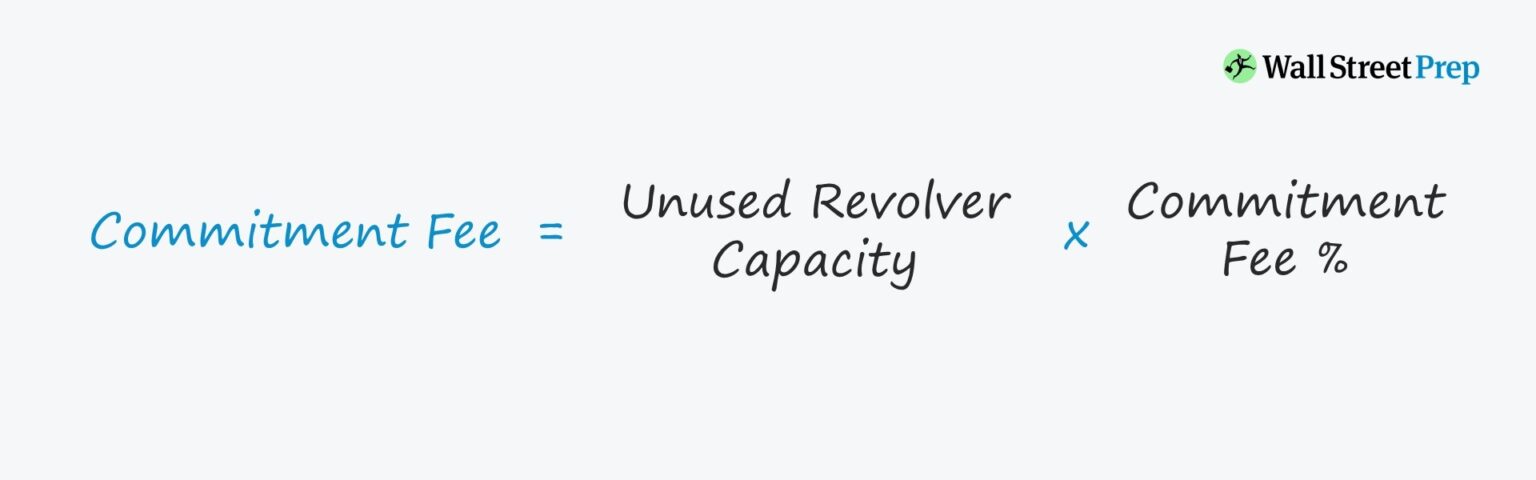
The formula used to calculate the commitment fee on the unused portion of a revolving credit facility ("revolver") is as follows.
Financial models often combine the commitment fee of a revolver into the total interest expense calculation, which is done for simplicity. Yet, there is one clear distinction between the commitment fee and interest expense.
To reiterate from earlier, the commitment fee is calculated on the remaining amount (i.e. undrawn amount) of the credit facility's total capacity.
In contrast, interest expense on the revolver is calculated by multiplying the applicable interest rate by the average of the beginning and ending revolver balance for the period.
Suppose a bank and a company have agreed on a $100m term loan financing package that comes alongside a revolver with the following:
The $20 million is NOT debt capital that is received immediately, but rather, represents the maximum amount of available capital that can be taken out if the company faces a shortfall in cash.
If we assume the company does not need to draw down from the revolver – i.e. its free cash flows (FCFs) are sufficient to meet all expenses, as well as mandatory repayments – the commitment fee in that particular year is equal to $50,000.
Enroll in The Premium Package: Learn Financial Statement Modeling, DCF, M&A, LBO and Comps. The same training program used at top investment banks.


No comments yet.