The Change in Net Working Capital (NWC) measures the net change in a company’s operating assets and operating liabilities across a specified period.
If the change in NWC is positive, the company collects and holds onto cash earlier. However, if the change in NWC is negative, the business model of the company might require spending cash before it can sell and deliver its products or services.
How to Calculate Change in Net Working Capital (NWC)
The net working capital (NWC) metric is a measure of liquidity that helps determine whether a company can pay off its current liabilities with its current assets on hand.
As a general rule, the more current assets a company has on its balance sheet relative to its current liabilities, the lower its liquidity risk (and the better off it’ll be).
Current Liabilities → The near-term obligations that a company is required to pay off (“outflow”) within the year – e.g. accounts payable and accrued expenses
Current Assets → The resources belonging to a company that represent monetary value (e.g. accounts receivable), or can be readily liquidated and converted into cash (“inflow”) or are expected to be used within the year – e.g. accounts receivable (A/R) and inventory
While certain accounting textbooks will define the change in net working capital as current assets minus current liabilities, the more practical formula excludes cash and short-term investments like marketable securities and commercial paper, as well as any interest-bearing debt such as loans and bonds.
Net Working Capital (NWC) = Operating Current Assets – Operating Current Liabilities
Where:
Operating Current Assets → Accounts Receivables (A/R), Inventory, Prepaid Expenses
The reason is that cash and debt are both non-operational and do not directly generate revenue.
In fact, cash and cash equivalents are more related to investing activities, because the company could benefit from interest income, while debt and debt-like instruments would fall into financing activities.
Since we have defined net working capital, we can now explain the importance of understanding the changes in net working capital (NWC).
On the cash flow statement, the changes in NWC are essential, because tracking these changes over time (e.g. year-over-year or quarter-over-quarter) helps assess the degree to which a company's free cash flows will deviate from its accrual-based net income (“bottom line”).
To calculate the change in net working capital (NWC), the current period NWC balance is subtracted from the prior period NWC balance.
Change in Net Working Capital Formula (NWC)
The change in net working capital (NWC) formula is as follows.
Change in Net Working Capital (NWC) = Beginning NWC – Ending NWC
Where:
Beginning NWC → Net Working Capital (NWC) at Beginning of Period (BoP)
Ending NWC → Net Working Capital (NWC) at End of Period (EoP)
As a sanity check, confirm that if the NWC is growing year-over-year (YoY), the change is negative (“cash outflow”).
In contrast, the change should be positive (“cash inflow”) if the NWC is declining year-over-year (YoY).
What is a Good Change in NWC?
If a company’s change in NWC has increased year-over-year (YoY), this implies that either its operating assets have grown and/or its operating liabilities have declined from the preceding period.
An increase in the balance of an operating asset represents an outflow of cash – however, an increase in an operating liability represents an inflow of cash (and vice versa).
If calculating free cash flow – whether on an unlevered FCF or levered FCF basis – an increase in the change in NWC is subtracted from the cash flow amount.
But if the change in NWC is negative, the net effect from the two negative signs is that the amount is added to the cash flow amount.
Increase in Net Working Capital (NWC) → Less Free Cash Flows (FCFs)
Decrease in Net Working Capital (NWC) → More Free Cash Flows (FCFs)
For instance, suppose a company’s accounts receivables (A/R) balance has increased YoY, while its accounts payable (A/P) balance has increased under the same time span.
The net effect is that more customers have paid using credit as the form of payment, rather than cash, which reduces the liquidity (i.e. cash on hand) of the company.
As for accounts payables (A/P), delayed payments to suppliers and vendors likely caused the increase.
Even though the payment obligation is mandatory, the cash remains in the company's possession for the time being, which increases its liquidity.
How to Interpret Negative Net Working Capital
In the absence of further contextual details, negative net working capital (NWC) is not necessarily a concerning sign about the financial health of a company.
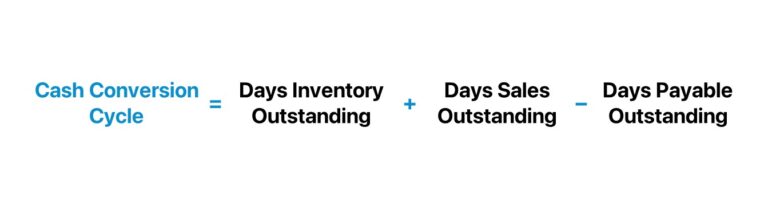
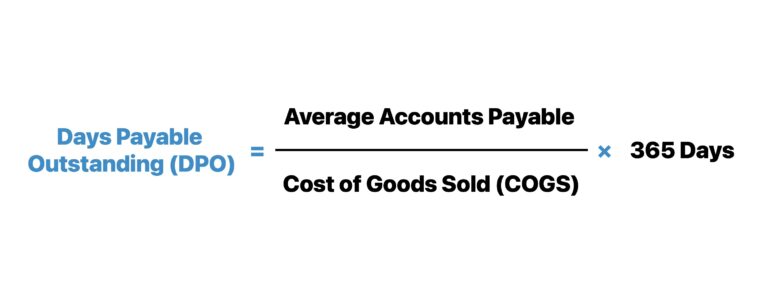
For instance, if NWC is negative due to the efficient collection of receivables from customers who paid on credit, quick inventory turnover, or the delay in supplier/vendor payments, that could be a positive sign.
However, negative working capital could also be a sign of worsening liquidity caused by the mismanagement of cash (e.g. upcoming supplier payments, inability to collect credit purchases, slow inventory turnover).
In such circumstances, the company is in a troubling situation related to its working capital.
How to Find Change in NWC on Cash Flow Statement (CFS)
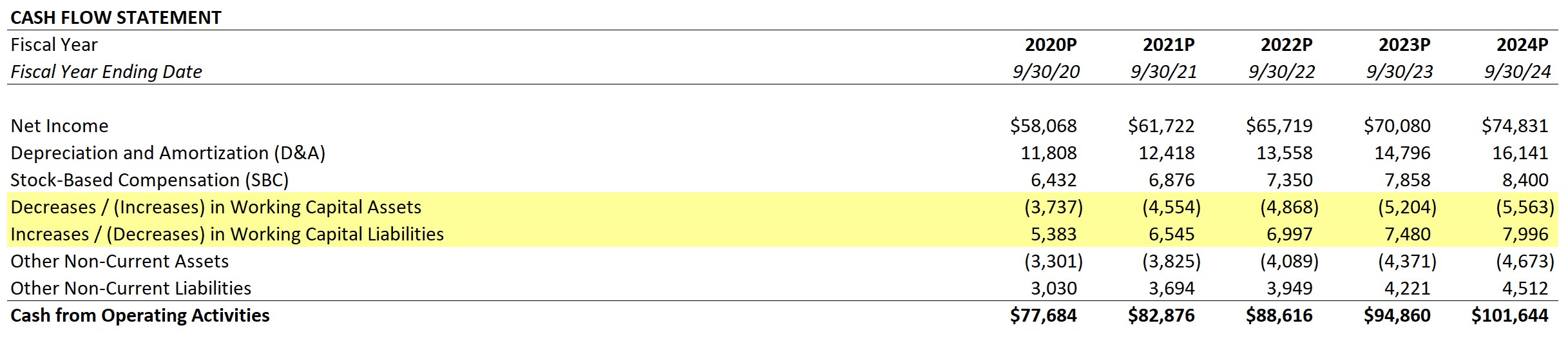
The cash flow statement (CFS) of Apple (NASDAQ: AAPL) is highlighted, to point out which line items measure the increase or decrease in Apple's working capital assets and working capital liabilities.
Understanding changes in net working capital (NWC) is essential for accurate cash flow projections, but the process can be cumbersome and prone to errors. Artificial intelligence streamlines the NWC calculation by quickly processing large volumes of accounting data, identifying anomalies, and forecasting future fluctuations. By leveraging AI-powered analytics, finance professionals can confidently predict liquidity, optimize financial planning, and make more strategic decisions. Wall Street Prep and Columbia Business School Executive Education created the AI for Business & Finance Certificate Program to help finance teams improve forecasting accuracy and integrate advanced automation into their working capital analysis.
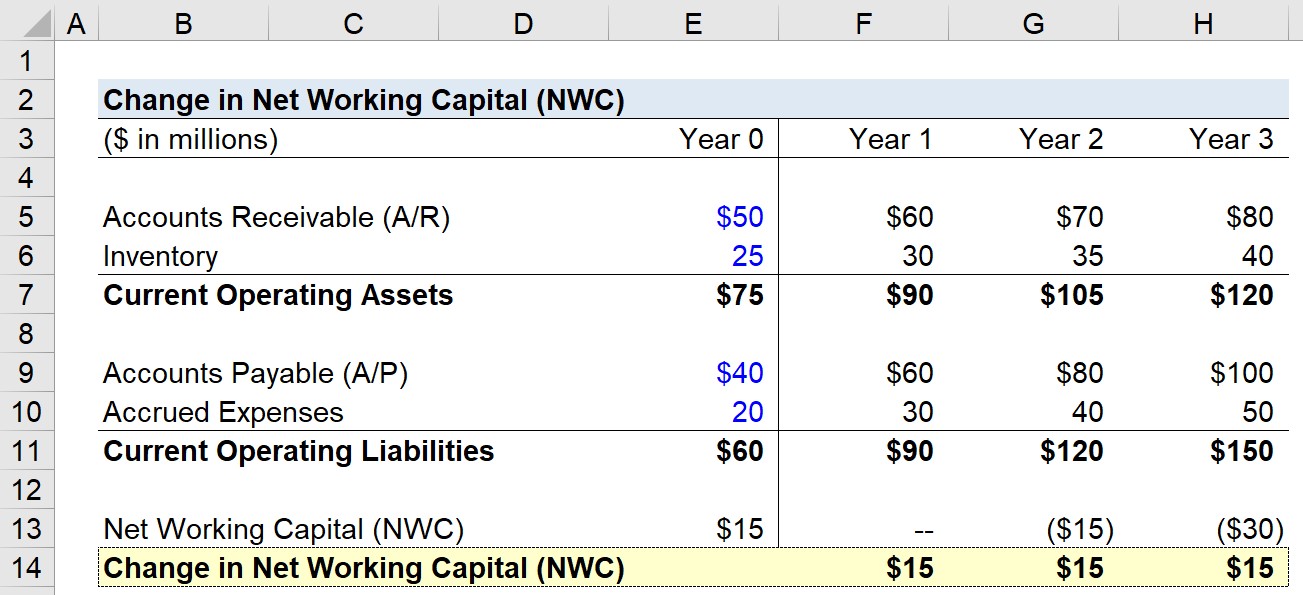
As for the rest of the forecast, we’ll use the following assumptions for each projected year:
Accounts Receivable (A/R) = (+) $10mm Growth YoY
Inventory = (+) $5mm Growth YoY
Accounts Payable = (+) $20mm Growth YoY
Accrued Expenses = (+) $10mm Growth YoY
2. Change in Net Working Capital Calculation Example (NWC)
Once the remaining years are populated with the stated numbers, we can calculate the change in NWC across the entire forecast.
Since the growth in operating liabilities is outpacing the growth in operating assets, we’d reasonably expect the change in NWC to be positive.
The change in NWC comes out to a positive $15mm YoY, which means the company retains more cash in its operations each year.
Change in Net Working Capital (NWC) = $15 million
In conclusion, our change in net working capital (NWC) exercise illustrates how increases in operating current assets are cash outflows, while increases in operating current liabilities are cash inflows.
Continue Reading Below
Step-by-Step Online Course
Everything You Need To Master Financial Modeling
Enroll in The Premium Package: Learn Financial Statement Modeling, DCF, M&A, LBO and Comps. The same training program used at top investment banks.
Wanted to confirm Net Working Capital = Working Capital (Current Year) – Working Capital (Previous Year) ? In this article it states Change in Net Working Capital (NWC) = Prior Period NWC – Current Period NWC
The change in NWC formula is more intuitive if set as prior period NWC less current period NWC.
If a company’s change in NWC increases year-over-year, its cash flows decrease since more cash is tied up in operations – hence, the negative sign in front.
In WallStreetMojo’s Colgate example, the change in NWC comes out to $183m and the parenthesis next to it states “cash outflow” to avoid confusion.
But our formula directly outputs –$183m, which is the same conceptually but just easier and reduces the chance of a mistake.
Also, NWC typically excludes cash & equivalents and all debt & interest-bearing securities to include only operating assets/liabilities. The Colgate example subtracts all current liabilities from all current assets.
Adam O Donoghue
November 20, 2022 2:27 pm
Dear Sir/Madam,
I hope you can offer some assistance with the following. Assuming I use the below formulas.
I am wondering why a component in the operating cash flow formula, inventory in net working capital, has the effect of subtracting from the net income figure.
I am using the following formulas:
Operating cash flow (OCF) = net income + non-cash expenses – change in net working capital (NWC).
Gross income = sales revenue – cost of goods sold (COGS).
COGS = beginning inventory (carried over from last year) + purchases (purchased during the year) – ending inventory (unsold at the end of the year).
Being that the change in NWC is normally subtracted from the other data in the OCF formula. Although, if accounts payable were greater than accounts receivable + inventory, you would now instead, add the change in NWC in the OCF formula.
Accounts receivable increase the net income figure reported, for which cash has not yet been received. In the OCF formula, accounts receivable has the effect of reducing net income. Being a component of NWC.
Accounts payable decreases the net income figure reported, for which cash has not been spent. In the OCF formula, accounts payable has the effect of increasing net income. Being a component of NWC.
Why does inventory (component of NWC) have the effect of subtracting from the net income figure, when the cost of goods sold has been subtracted from sales revenue earlier?
Kind regards,
Adam O’Donoghue
Brad Barlow
November 21, 2022 3:14 pm
Hi, Adam,
I find it helpful to think of adjustments to net income to get to CFO in four quadrants: 1) subtract revenue that has not been collected (e.g., increase in A/R); 2) add back expenses that have not yet been paid in cash (e.g., increase in A/P) or that were paid in cash in a prior period (e.g., D&A, decrease in inventory); 3) add cash inflows that have not yet been recognized as revenue (e.g., increase in deferred revenue) or were recognized in a prior period (e.g., decrease in A/R); 4) subtract cash outflows that are not yet recognized as expense (e.g., purchases of inventories) or pay off expenses recognized in prior periods (e.g., decrease in A/P).
Increases and decreases in Inventory and A/R impact cash flows similarly, but they are in different ‘quadrants’ in my scheme. Hope that helps.
BB
Adam O’Donoghue
December 14, 2022 4:20 pm
Hi Brad,
Definitely helpful.
What gets me is the following:
COGS = Beginning inventory + Purchases throughout year – Ending inventory.
Gross income = Sales revenue – COGS.
The amount of Ending inventory subtracted in COGS has the affect of reducing COGS and increasing gross income, and in turn net income.
Then in the Operating cash flow formula, Ending inventory (part of NWC) has the affect of being subtracted from Net income.
Making it so that the reduction in COGS by the Ending inventory amount, increasing Gross income, is now cancelled out by subtracting Ending inventory from Net income in the Operating cash flow formula.
From what I understand, this would make COGS look like Cost of goods = Beginning inventory + Purchases throughout year.
My question is why was Ending inventory removed from Net income in the Operating cash flow formula? In turn, cancelling out the amount of Ending inventory that reduces COGS.
Brad Barlow
December 17, 2022 2:28 pm
Hi, Adam,
I think the issue is how you are mentally conceptualizing what happens. Given beginning and purchases, the less ending inventory there is, the greater the amount of COGS and the lower gross and net income. However, if COGS was greater than purchases, then that amount must be added back because it was not paid in cash in that period, so it needs to be added back to get to cash flow.
BB
Ajay
July 30, 2024 6:51 am
Very informative article on working capital.
However, I am always confused with the signs used in calculating change in working capital. Is it prior period minus current period or vice versa?
Also wanted to know the signs used in calculation of changes in operating assets and operating liabilities in cash flow statement for each line item.
Thank you,
Ajay
Brad Barlow
July 30, 2024 1:09 pm
Hi, Ajay,
For working capital or other assets, you add the prior period and subtract the current period, and for working capital and other liabilities, you add the current period and subtract the prior period.







Hi Jon,
The change in NWC formula is more intuitive if set as prior period NWC less current period NWC.
If a company’s change in NWC increases year-over-year, its cash flows decrease since more cash is tied up in operations – hence, the negative sign in front.
In WallStreetMojo’s Colgate example, the change in NWC comes out to $183m and the parenthesis next to it states “cash outflow” to avoid confusion.
But our formula directly outputs –$183m, which is the same conceptually but just easier and reduces the chance of a mistake.
Also, NWC typically excludes cash & equivalents and all debt & interest-bearing securities to include only operating assets/liabilities. The Colgate example subtracts all current liabilities from all current assets.
Dear Sir/Madam,
I hope you can offer some assistance with the following. Assuming I use the below formulas.
I am wondering why a component in the operating cash flow formula, inventory in net working capital, has the effect of subtracting from the net income figure.
I am using the following formulas:
Being that the change in NWC is normally subtracted from the other data in the OCF formula. Although, if accounts payable were greater than accounts receivable + inventory, you would now instead, add the change in NWC in the OCF formula.
Accounts receivable increase the net income figure reported, for which cash has not yet been received. In the OCF formula, accounts receivable has the effect of reducing net income. Being a component of NWC.
Accounts payable decreases the net income figure reported, for which cash has not been spent. In the OCF formula, accounts payable has the effect of increasing net income. Being a component of NWC.
Why does inventory (component of NWC) have the effect of subtracting from the net income figure, when the cost of goods sold has been subtracted from sales revenue earlier?
Kind regards,
Adam O’Donoghue
Hi, Adam,
I find it helpful to think of adjustments to net income to get to CFO in four quadrants: 1) subtract revenue that has not been collected (e.g., increase in A/R); 2) add back expenses that have not yet been paid in cash (e.g., increase in A/P) or that were paid in cash in a prior period (e.g., D&A, decrease in inventory); 3) add cash inflows that have not yet been recognized as revenue (e.g., increase in deferred revenue) or were recognized in a prior period (e.g., decrease in A/R); 4) subtract cash outflows that are not yet recognized as expense (e.g., purchases of inventories) or pay off expenses recognized in prior periods (e.g., decrease in A/P).
Increases and decreases in Inventory and A/R impact cash flows similarly, but they are in different ‘quadrants’ in my scheme. Hope that helps.
BB
Hi Brad,
Definitely helpful.
What gets me is the following:
COGS = Beginning inventory + Purchases throughout year – Ending inventory.
Gross income = Sales revenue – COGS.
The amount of Ending inventory subtracted in COGS has the affect of reducing COGS and increasing gross income, and in turn net income.
Then in the Operating cash flow formula, Ending inventory (part of NWC) has the affect of being subtracted from Net income.
Making it so that the reduction in COGS by the Ending inventory amount, increasing Gross income, is now cancelled out by subtracting Ending inventory from Net income in the Operating cash flow formula.
From what I understand, this would make COGS look like Cost of goods = Beginning inventory + Purchases throughout year.
My question is why was Ending inventory removed from Net income in the Operating cash flow formula? In turn, cancelling out the amount of Ending inventory that reduces COGS.
Hi, Adam,
I think the issue is how you are mentally conceptualizing what happens. Given beginning and purchases, the less ending inventory there is, the greater the amount of COGS and the lower gross and net income. However, if COGS was greater than purchases, then that amount must be added back because it was not paid in cash in that period, so it needs to be added back to get to cash flow.
BB
Very informative article on working capital.
However, I am always confused with the signs used in calculating change in working capital. Is it prior period minus current period or vice versa?
Also wanted to know the signs used in calculation of changes in operating assets and operating liabilities in cash flow statement for each line item.
Thank you,
Ajay
Hi, Ajay,
For working capital or other assets, you add the prior period and subtract the current period, and for working capital and other liabilities, you add the current period and subtract the prior period.
BB