What is Net Working Capital?
Net Working Capital (NWC) measures a company’s liquidity by comparing its operating current assets to its operating current liabilities.

Net Working Capital (NWC) measures a company’s liquidity by comparing its operating current assets to its operating current liabilities.
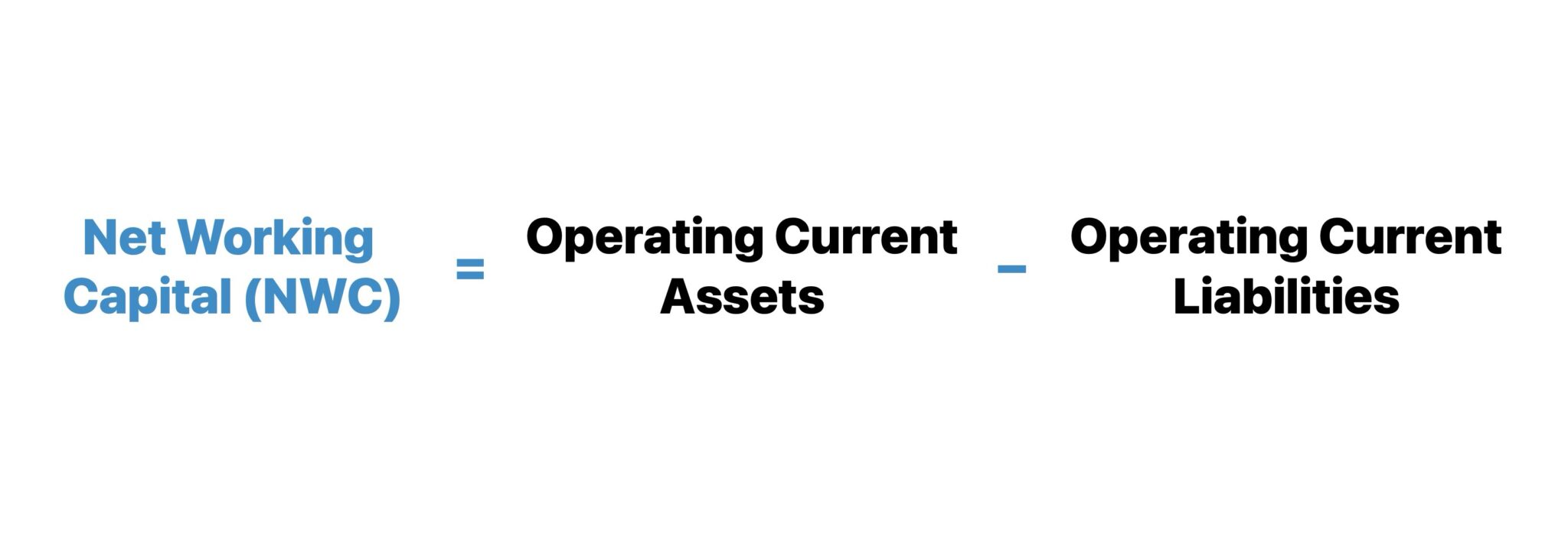
Net working capital, often abbreviated as "NWC", is a financial metric used to evaluate a company’s near-term liquidity risk.
The net working capital (NWC) metric is the ratio between a company’s operating current assets and operating current liabilities.
A company with more operating current assets than operating current liabilities is considered to be in a more favorable financial state from a liquidity standpoint, where near-term insolvency is unlikely to occur.
The most common examples of operating current assets include accounts receivable (A/R), inventory, and prepaid expenses.
On the other hand, examples of operating current liabilities include obligations due within one year, such as accounts payable (A/P) and accrued expenses (e.g. accrued wages).
In particular, creditors such as bank lenders pay close attention to a company’s net working capital (NWC) to understand the borrower’s creditworthiness and borrowing capacity, i.e. quantify the risk of providing debt financing to the company.
Aside from gauging a company’s liquidity, the NWC metric can also provide insights into the efficiency at which operations are managed, such as ensuring short-term liabilities are kept to a reasonable level.
The net working capital (NWC) formula subtracts operating current assets by operating current liabilities.
To reiterate, a positive NWC value is perceived favorably, whereas a negative NWC presents a potential risk of near-term insolvency.
The NWC metric is often calculated to determine the effect that a company’s operations had on its free cash flow (FCF).
Since we're measuring the increase (or decrease) in free cash flow, i.e. across two periods, the “Change in Net Working Capital” is the right metric to calculate here.
The rationale for subtracting the current period NWC from the prior period NWC, instead of the other way around, is to understand the impact on free cash flow (FCF) in the given period.
An increase in an operating current asset (e.g. accounts receivable) from one period to the next represents a "use" of cash, while an increase in an operating current liability (e.g. accounts payable) is a "source" of cash (and vice versa).
With that in mind, the change in NWC is interpreted using the following rules:
The textbook definition of working capital is defined as current assets minus current liabilities.
However, the more practical metric is net working capital (NWC), which excludes any non-operating current assets and non-operating current liabilities.
The interpretation of either working capital or net working capital is nearly identical, as a positive (and higher) value implies the company is financially stable, all else being equal.
The distinction is that net working capital (NWC) focuses on a company’s operational efficiency and the impact on free cash flow (FCF).
We’ll now move on to a modeling exercise, which you can access by filling out the form below.


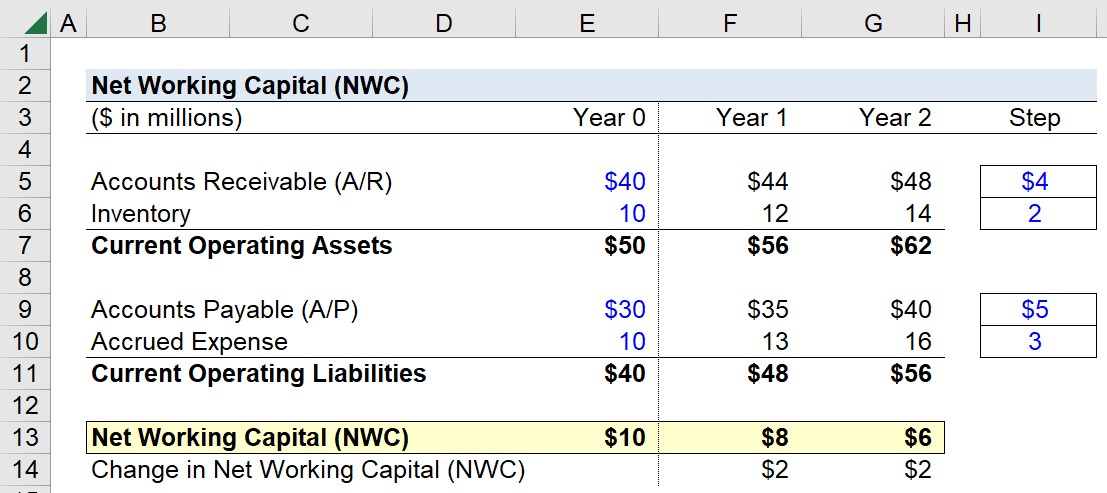
Suppose we’re tasked with calculating the net working capital (NWC) of a company with the following balance sheet data.
| Selected Financial Data | |||
|---|---|---|---|
| ($ in millions) | Year 0 | Year 1 | Year 2 |
| Accounts Receivable (A/R) | $40 | $44 | $48 |
| Inventory | 10 | 12 | 14 |
| Current Operating Assets | $50 | $56 | $62 |
| Accounts Payable (A/P) | $30 | $35 | $40 |
| Accrued Expense | 10 | 13 | 16 |
| Current Operating Liabilities | $40 | $48 | $56 |
Since a company’s net working capital (NWC) is the difference between its operating current assets and operating current liabilities, we can subtract the two in each period to arrive at the following NWC values:
From Year 0 to Year 2, the company’s NWC reduced from $10 million to $6 million, reflecting less liquidity (and more credit risk).
In the final part of our exercise, we’ll calculate how the company’s net working capital (NWC) impacted its free cash flow (FCF), which is determined by the change in NWC.
Therefore, the impact on the company’s free cash flow (FCF) is +$2 million across both periods.
The issue, however, is that an increasing accounts receivable balance implies the company’s cash collection processes might be inefficient, and a rising inventory balance means more inventory is piling up (and not sold).
While A/R and inventory are frequently considered to be highly liquid assets to creditors, uncollectible A/R will NOT be converted into cash. In addition, the liquidated value of inventory is specific to the situation, i.e. the collateral value can vary substantially.
The positive impact on free cash flow (FCF) stems from the growth in accounts payable and accrued expenses year over year (YoY), outpacing the growth in operating current assets.
Since the company is holding off on issuing payments, the increase in payables and accrued expenses tends to be perceived positively.
Until the payment is fulfilled, the cash remains in the possession of the company, hence the increase in liquidity. But it is important to note that those unmet payment obligations must eventually be settled, or else issues could soon emerge.

Enroll in The Premium Package: Learn Financial Statement Modeling, DCF, M&A, LBO and Comps. The same training program used at top investment banks.


Do we need to deduct Capital lease obligations also from current liabilities to get to operating current liability?
Hi, Hussam,
Yes, technically capital lease liability would be considered more like short-term debt than an operating liability like accounts payable.
BB
Hi, is it possible to calculate the financing charge associated with the capital we have invested in NWC? Would we apply the WACC on the invested capital? i.e. can we quantify how much it costs the company to have more capital tied up in working capital
Hi, Ash,
Yes, NWC is part of invested capital, so WACC would apply, and that would help us quantify the cost of that additional capital. Great question!
BB