What is Operating Cycle?
The Operating Cycle tracks the number of days between the initial date of inventory purchase and the receipt of cash payment from customer credit purchases.

The Operating Cycle tracks the number of days between the initial date of inventory purchase and the receipt of cash payment from customer credit purchases.
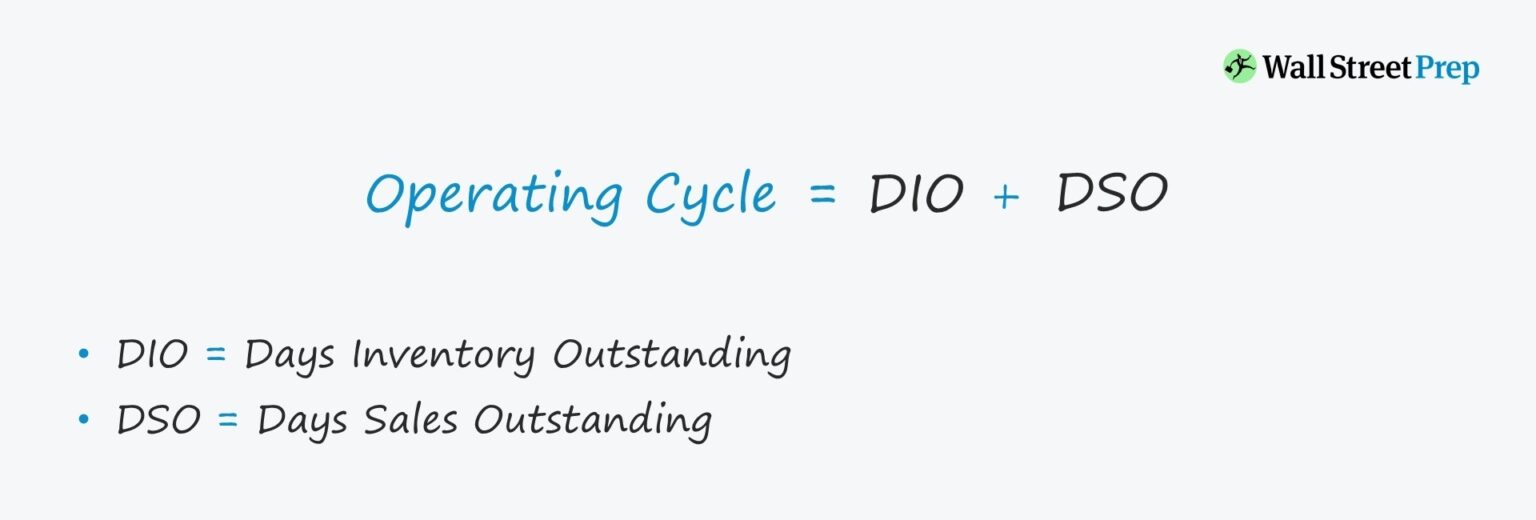
Conceptually, the operating cycle measures the time it takes a company to purchase inventory, sell the finished inventory, and collect cash from customers who paid on credit.
The required inputs for the metric consist of two working capital metrics:
Below are the formulas for calculating the two working capital metrics:
The formula for calculating the operating cycle is the sum of days inventory outstanding (DIO) and days sales outstanding (DSO).
The operating cycle is relatively straightforward to calculate, but more insights can be derived from examining the drivers behind DIO and DSO.
For instance, the duration of a particular company could be high relative to comparable peers. Such an issue could stem from the inefficient collection of credit purchases, rather than due to supply chain or inventory turnover issues.
Once the real underlying issue has been identified, management can better address and fix the problem.
The longer the operating cycle, the more cash is tied up in operations (i.e. working capital needs), which directly lowers a company’s free cash flow (FCF).
The cash conversion cycle (CCC) measures the number of days for a company to clear out its inventory in storage, collect outstanding A/R in cash, and delay payments (i.e. accounts payable) owed to suppliers for goods/services already received.
At the start of the calculation, the sum of DIO and DSO represents the operating cycle – and the added step is subtracting DPO.
Hence, the cash conversion cycle is used interchangeably with the term “net operating cycle”.
We’ll now move to a modeling exercise, which you can access by filling out the form below.


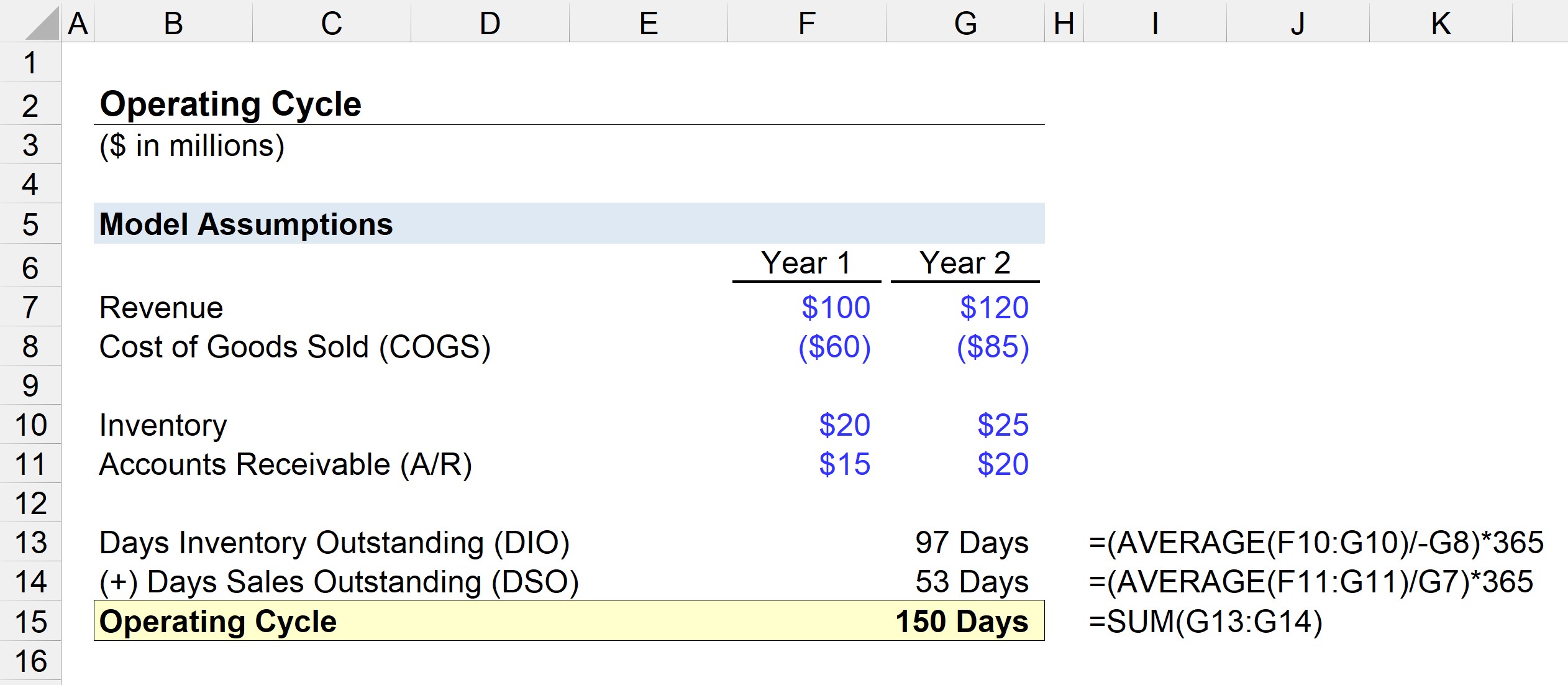
Suppose we're tasked with assessing the working capital efficiency of a company with the following assumptions:
Year 1 Financials
Year 2 Financials
The first step is to calculate DIO by dividing the average inventory balance by the current period COGS and then multiplying it by 365.
On average, it takes the company 97 days to purchase raw material, turn the inventory into marketable products, and sell it to customers.
In the next step, we will calculate DSO by dividing the average A/R balance by the current period revenue and multiplying it by 365.
The operating cycle is equal to the sum of DIO and DSO, which comes out to 150 days in our modeling exercise.

Enroll in The Premium Package: Learn Financial Statement Modeling, DCF, M&A, LBO and Comps. The same training program used at top investment banks.


What if I have a service company that doesn’t has inventory in their statements?
Hi, Jordan,
If that is the case, then the operating cycle would be from when cash was outlaid to pay whatever expenses were needed to get the next service up and running to when the cash was ultimately collected for that service.
BB