Operating Working Capital (OWC) measures the current assets and current liabilities used as part of a company’s core, day-to-day operations.
Cash and cash equivalents are excluded from the calculation of operating working capital (NWC), as well as debt and any interest-bearing securities with debt-like features.
How to Calculate Operating Working Capital (OWC)
The traditional textbook definition of “working capital” refers to a company’s current assets minus its current liabilities.
The “current” categorization signifies an asset that can be converted into cash within twelve months (i.e. high liquidity), or a liability that is coming due within the next twelve months.
However, a more practical variation of working capital is the operating working capital (OWC) metric, which is adjusted to only include items with an integral role in the recurring, core operations of a company.
Specifically, OWC intentionally excludes “Cash and Cash Equivalents” and “Short-Term Debt”.
Cash and Cash Equivalents Exclusion → The issue on-hand is that cash (and items such as short-term investments) are not necessarily an integral component of a company’s cash flow generation. In fact, the categorization of cash as a “Cash Flow from Investing” activity can be argued as more accurate than under “Cash Flow from Operations”, i.e. a company’s cash can be invested into short-debt government securities, marketable securities, certificate of deposit (CD), and more.
Debt and Interest-Bearing Securities Exclusion → The borrowing of capital, i.e. debt and any debt-like instruments are more akin to a “Cash Flow from Financing” activity since these items represent a method of raising the necessary capital to fund ongoing operations.
Operating Working Capital Formula (OWC)
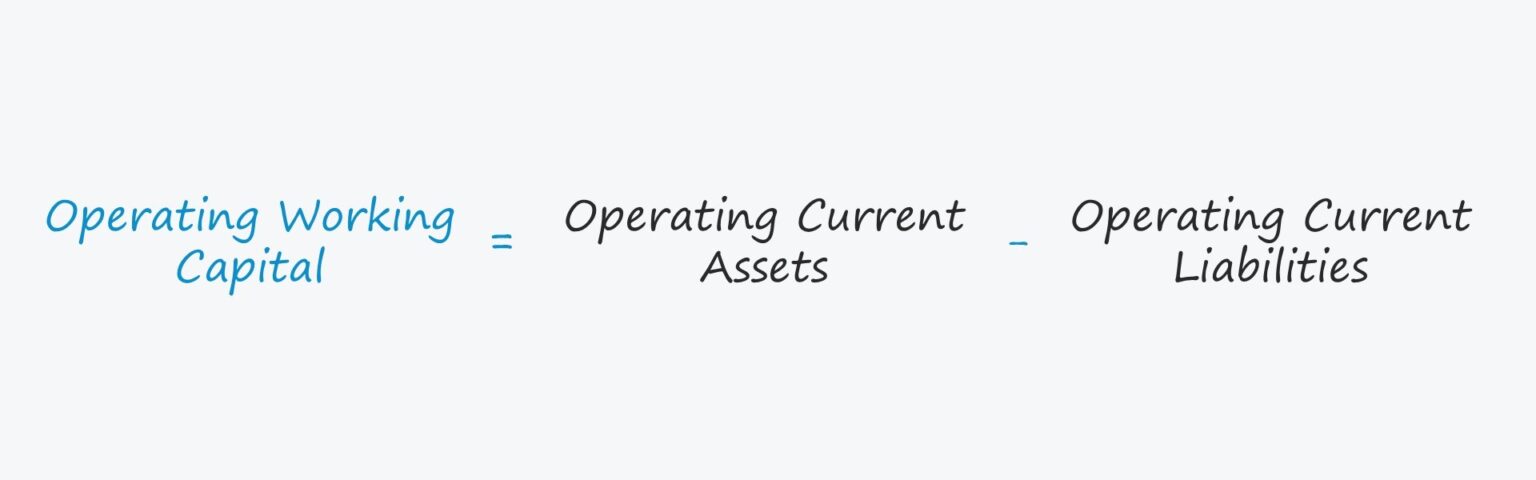
The formula to calculate operating working capital is equal to the operating current assets subtracted by the operating current liabilities.
Operating Working Capital (OWC) = Operating Current Assets – Operating Current Liabilities
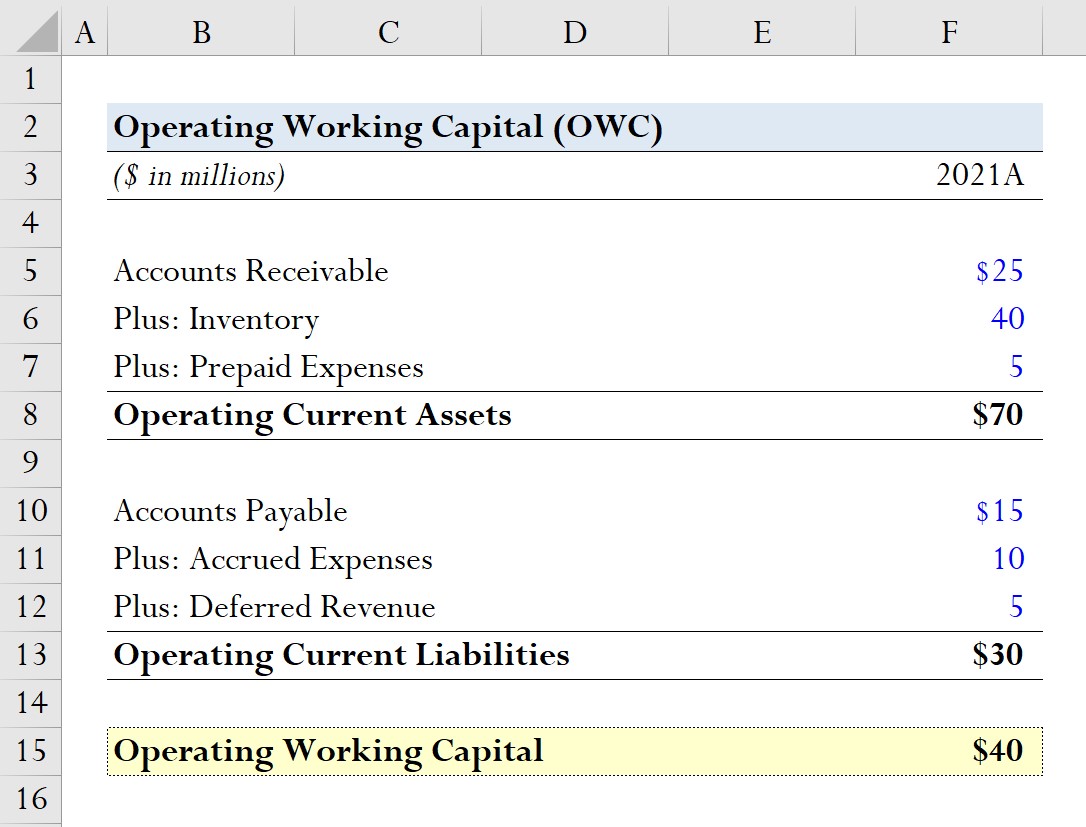
The table below provides examples of the most common operating current assets and operating current liabilities.





No comments yet.