What is a Secondary Buyout?
A Secondary Buyout, or “sponsor-to-sponsor deal”, is an exit strategy in private equity wherein the investment (i.e. the portfolio company) is sold to another financial sponsor.

A Secondary Buyout, or “sponsor-to-sponsor deal”, is an exit strategy in private equity wherein the investment (i.e. the portfolio company) is sold to another financial sponsor.
The term “secondary buyout” refers to a financial sponsor (i.e. a private equity firm) exiting an existing investment by selling its controlling stake in a company to another financial sponsor.
After the sponsor-to-sponsor exit, the portfolio company remains backed by a private equity firm with a new capital structure (and capitalization table). The existing management team usually continues to run the company or is replaced if the new owner views them as unsuited for the role.
Typically, the buyer in the transaction is of a larger size than the seller in terms of assets under management (AUM) and other non-monetary resources, such as industry knowledge, relationships, and operating experience.
Often, the larger-sized firm can take on more risks, utilize different strategies, and/or offer more resources to scale the portfolio company for it to reach the next stage of development, which previously might have been difficult to attain.
The business model in the private equity industry requires investments to be exited within a set number of years, which is frequently between three and five years.
However, there has been a recent trend of moving to longer holding periods, where firms—most often family offices and smaller-sized private equity firms—are exiting their investments after five to eight years. The longer time horizon is attributable to long-term operational improvements being the primary value-add in these investments in lieu of debt paydown.
Furthermore, certain firms face less pressure from limited partners (LPs) to quickly exit an investment and realize a profit (and return their initial capital + share of the sale proceeds).
Level up your career with the world’s most recognized private equity investing program. Enrollment is open for the upcoming cohort.
There are three exit options for private equity firms seeking to exit an investment and realize returns.
On the date of the initial buyout, most private equity firms tend to view a secondary buyout as a back-up plan (and a less desirable exit).
In fact, there is substantial evidence supporting the claim that secondary buyouts tend to exhibit lower fund returns.
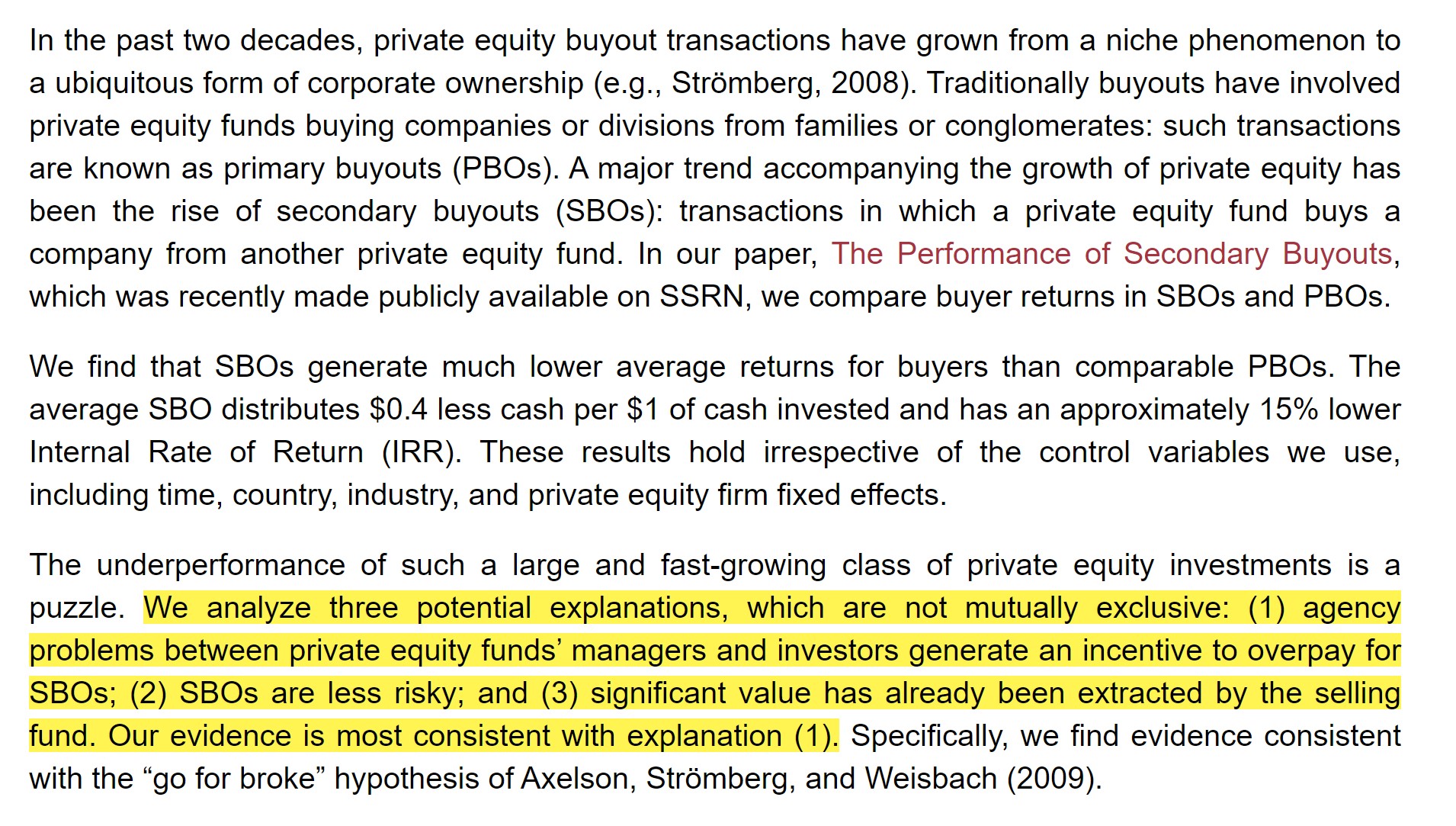
The main benefit of a secondary buyout for the seller is the convenience factor and the immediate liquidity post-sale, i.e. a sponsor-to-sponsor process tends to close more quickly.
Moreover, the original investment thesis of the firm might have changed over time, or the performance of their strategies might not have materialized to date. Therefore, the seller might take the risk-averse approach of exiting the investment, even if it means the returns are less than their fund’s target returns profile, i.e. the internal rate of return (IRR).
Since the portfolio company—in all likelihood—has implemented the standard operational improvements and strategies to drive growth and improve profit margins, the value-add opportunities for the buyer could potentially be limited.
In short, the remaining upside and potential to earn out-sized returns from the secondary buyout can be unfavorable to the new buyer.
Therefore, there must be a clear rationale for the buyer to take on the challenge of improving the previously PE-backed company and creating more value, i.e. the new sponsor must bring something to the table that the prior sponsor could not provide or chose not to.
For example, the sponsor on the buying end might view the past decisions and current direction of the company as being outright wrong with missed opportunities to achieve more growth, resulting in poor current financial performance.
The value drivers of an LBO—from a high level—are essentially the same for all private equity firms, e.g. debt repayment, operational improvements, and multiple expansion. However, the methods to derive the maximum value from each lever are where differences arise.
For instance, one firm might view introducing new products and expanding into new markets as the ideal strategy, whereas another firm might think a growth plan oriented around add-ons and industry consolidation as the better route.
The size and resources of the firm are another critical consideration, as the scope of the value-add differs by the firm (e.g. depending on existing portfolio companies, the firm’s executive team that will soon join the board post-buyout, industry expertise, and the existing relationships).
In certain cases, the seller might understand there is untapped potential in the portfolio company, yet still decide to exit the investment because of limited resources and the inability to take on the risk.
As a side benefit, the fact that the portfolio company’s management team has experience operating a company with a significant amount of debt on its capital structure can be advantageous to the new owner, i.e. management is well-experienced with the pressures of running a company with a large debt burden, namely being able to meet the interest payments.


Great piece of writing with immensely informative contents! I really liked the writing style and the whole process of the story building. Waiting for more posts! Cheers!!
Thanks very much, we appreciate the positive feedback!