What is Distribution to Paid-In Capital?
The Distribution to Paid-In Capital (DPI) ratio measures the cumulative proceeds returned to its investors by a fund relative to its paid-in capital.

The Distribution to Paid-In Capital (DPI) ratio measures the cumulative proceeds returned to its investors by a fund relative to its paid-in capital.

The distribution to paid-in capital metric (DPI) measures the realized profits that have been distributed by the fund back to their limited partners (LPs), i.e. the investor base.
From the perspective of the investor, the DPI metric answers: “Given the fund’s called paid-in capital, how much in profits have been realized so far?”
Conceptually, DPI represents the amount actually realized and paid back to investors, so the metric portrays the real profits to date earned by the fund’s limited partners (LPs).
The DPI multiple represents the ratio between the 1) fund’s realized distributions and 2) the paid-in capital of the limited partners (LPs).
Calculating the DPI is straightforward, as it involves dividing the realized profits by the capital paid-in by investors.
The paid-in capital represents the capital contributed by LPs to the fund that has been “called” by the firm in order to invest it.
The important distinction here is that GPs must make a capital call to the LPs to request access to the committed capital, meaning that paid-in capital is usually NOT equal to the total committed capital amount.
Level up your career with the world’s most recognized private equity investing program. Enrollment is open for the upcoming cohort.
Unlike the total value to paid-in capital (TVPI), the DPI is not inclusive of any residual fund value, i.e. the “paper gains” from investments not yet realized.
At the end of the day, the DPI takes precedence over the TVPI as the fund’s life cycle reaches its later stages and the percentage of committed but uncalled capital remaining is close to zero.
The returns realized once the fund exits investments are true returns, rather than unrealized returns the funds may anticipate on a future exit date.
Hypothetically, if a fund has yet to exit a single investment – neither a full nor partial exit – the DPI amounts to zero.
We’ll now move to a modeling exercise, which you can access by filling out the form below.


Suppose a private equity firm has raised a fund with $100 million in committed capital from their limited partners (LPs).
Of the $100 million, 85% of the committed capital has been called as of Year 5.
Thus, the paid-in capital equals $85 million.
The numerator of the DPI multiple is the cumulative distribution, which we’ll assume to be $180 million.
To have a frame of reference, we’ll also calculate the total value of the paid-in capital (TVPI) multiple.
For the residual value, we’ll assume that the estimated fair value of the unrealized investments is $40 million.
For both the DPI and TVPI multiples, the “net” variation will be calculated, so we must account for management fees (and carry, if applicable).
Here, we’ll assume the only expense that affects our return multiples is management fees, which are charged annually at 2.0% of the total committed capital.
The net DPI is calculated by deducting the management fees to date from the cumulative distributions and then dividing that amount by the paid-in capital.
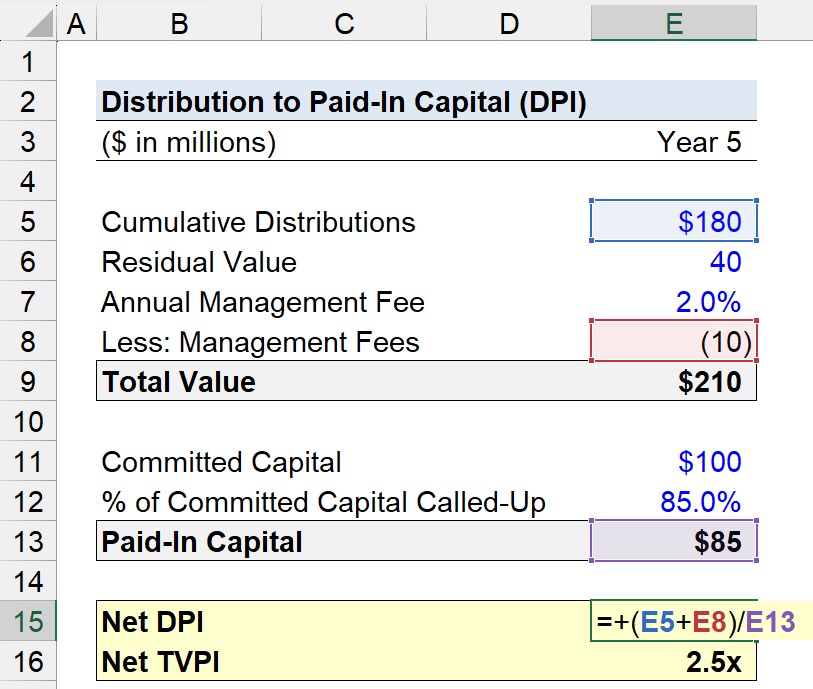
Therefore, the net DPI comes out to approximately 2.0x.
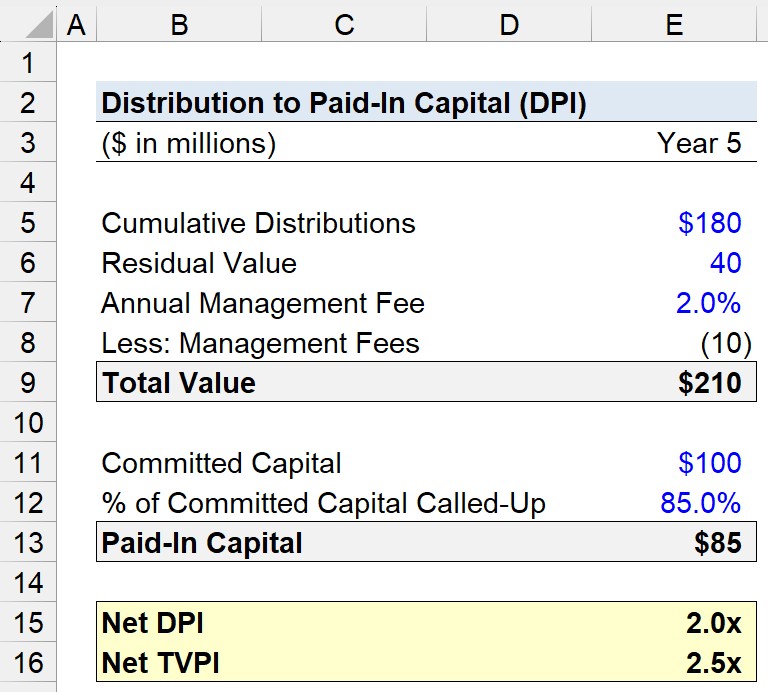
In contrast, calculating the net TVPI is conceptually similar, but the notable difference is the inclusion of the residual value – which we’ll assume to be $40 million.


No comments yet.