What are ETFs?
Exchange Traded Funds (ETFs) are publicly-traded securities that tracks a specific index, sector, commodity (e.g. gold), or an underlying collection of assets.

Exchange Traded Funds (ETFs) are publicly-traded securities that tracks a specific index, sector, commodity (e.g. gold), or an underlying collection of assets.
ETFs can be thought of as marketable securities that track the price of assets within a basket of grouped assets, which enables investing in the broader market, sector, region, or asset class.
The value of an ETF is directly a function of the price performance of the collection of assets contained within the index.
The goal of ETFs is not to outperform the broader market nor the underlying index – although it is possible for certain ETFs to “beat the market” – but rather, most ETFs just attempt to replicate the performance of the assets being tracked.
The various types of ETFs include the following:
Learn how institutional investors identify high-potential undervalued stocks. Enrollment is open for the upcoming cohort.
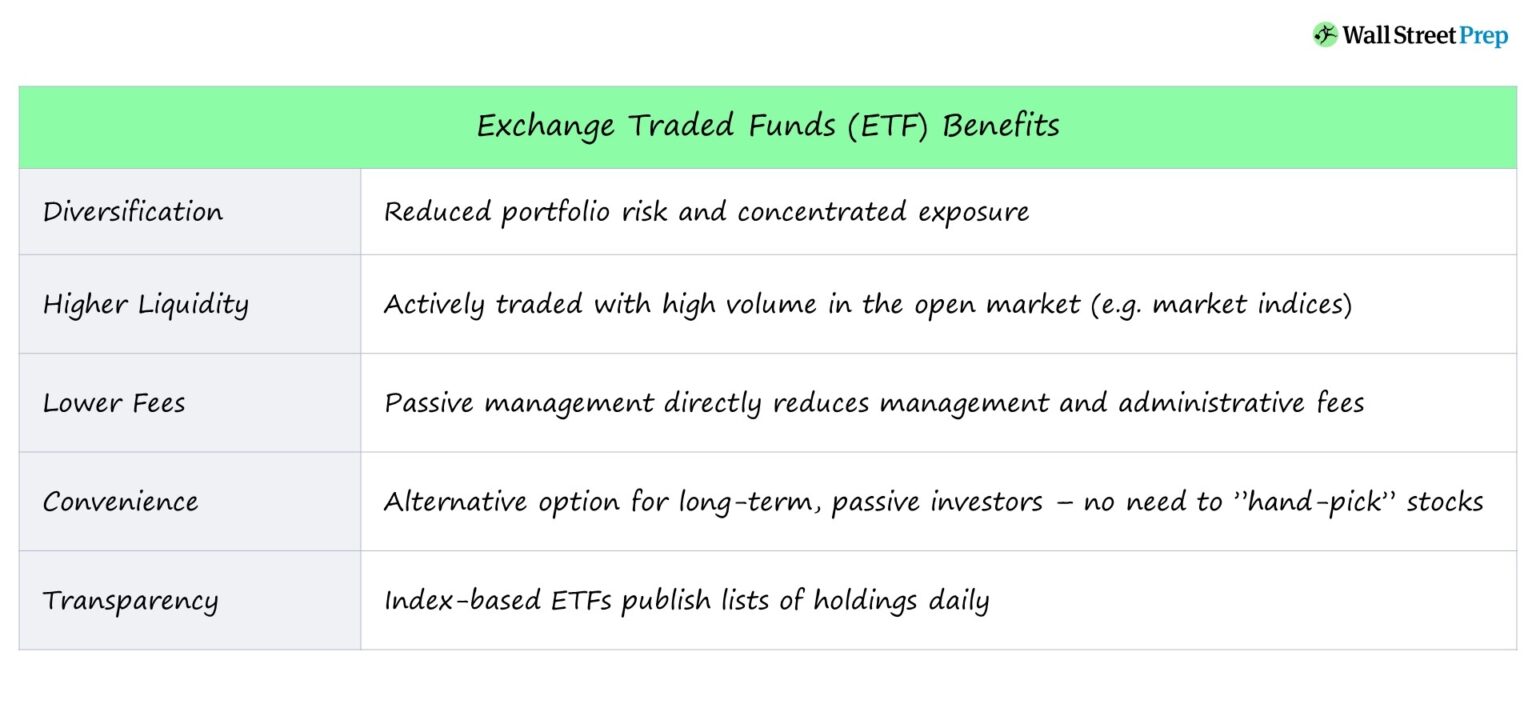
There are numerous benefits to ETF investors:
An ETF is structured similarly to a mutual fund as both funds contain a mixture of assets and represent methods for investors to diversify.
However, an ETF is listed on a public exchange and can be traded on the secondary market similar to stocks, unlike mutual funds.
For mutual funds, trades are executed only once per day after the markets close.
With that said, ETFs have higher liquidity because they trade continuously when the market is open.
Another noteworthy difference between an ETF and a mutual fund is that mutual funds are actively managed by a fund manager that adjusts the holdings (i.e. buy and sell assets) as appropriate to increase investor profits.
On the other hand, ETFs are passively managed since they track a specific index for the most part – although there are exceptions as we’ll discuss later.
Because ETFs are tied to a particular index, their performance is subject to the market and investor sentiment as opposed to the investment acumen and discretionary asset allocation decisions of an active manager.
In the U.S., examples of ETFs with large followings include:
One of the more mainstream thematic ETFs has been Ark Invest’s offerings, which rose in popularity after placing considerable bets on innovative technologies such as FinTech, AI, and 3D printing.
For instance, Ark Invest’s flagship Disruptive Innovation ETF has the following investment focus:
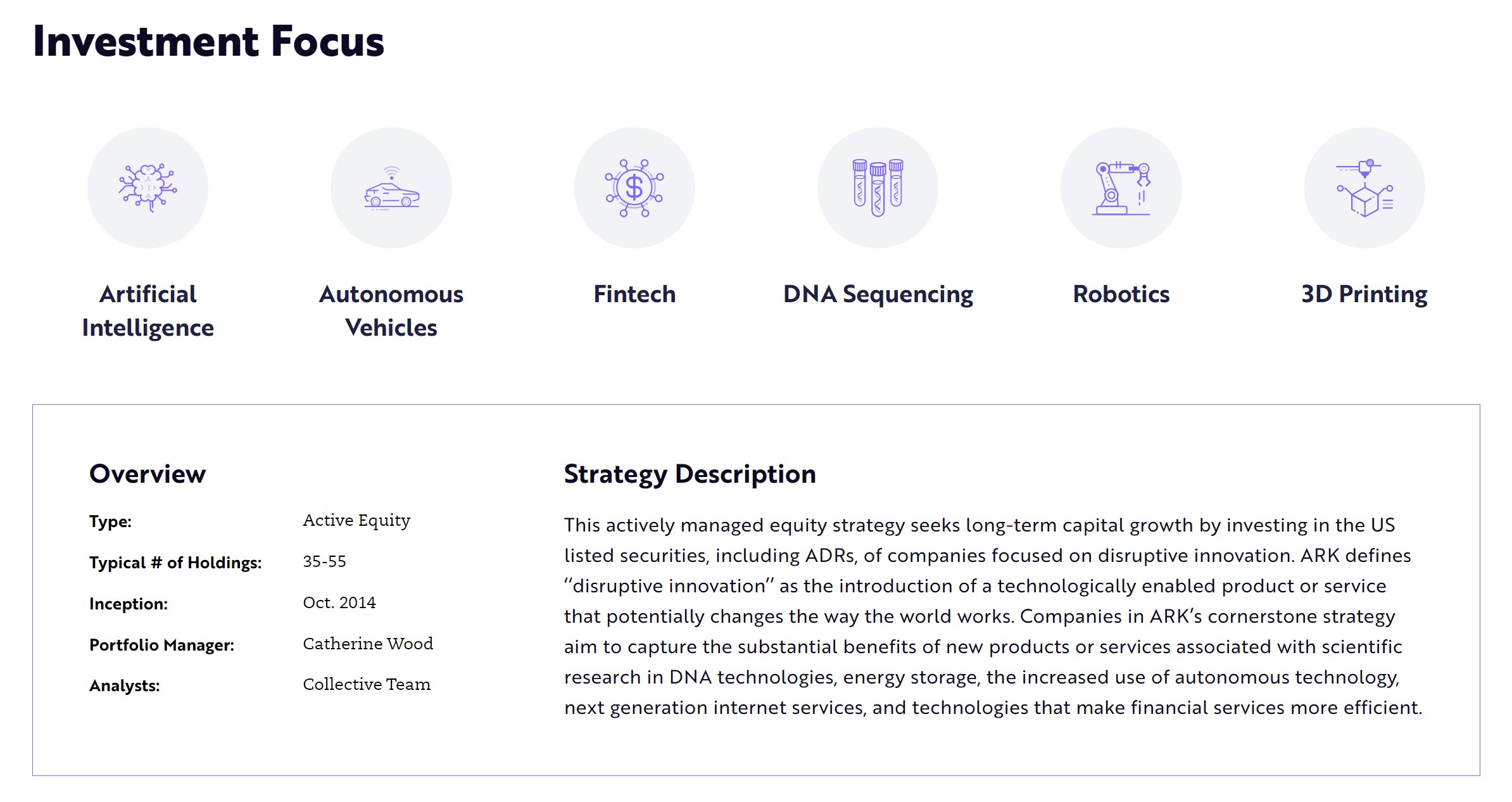
Disruptive Innovation ETF Investment Focus (Source: Ark Invest)
Examples of other specialty ETF products by Ark Invest include:
Unlike other ETFs that track the broader market indices, these thematic ETFs blend passive investing with active management because each fund targets specific trends with the potential to disrupt entire industries.
However, the downside to thematic ETFs comprised of high-growth equities is that despite the possibility for higher returns – the portfolio is less diversified and more susceptible to volatility (and losses) – as confirmed by the underperformance of Ark ETFs in 2021.


No comments yet.