What is a Zero Coupon Bond?
A Zero Coupon Bond is priced at a discount to its face (par) value with no periodic interest payments from the date of issuance until maturity.

A Zero Coupon Bond is priced at a discount to its face (par) value with no periodic interest payments from the date of issuance until maturity.
Zero coupon bonds, also known as “discount bonds,” are a form of debt sold by the issuer at a price lower than the face (par) value that is repaid at maturity.
Zero coupon bonds are debt obligations structured without any required interest payments (i.e. the “coupons”) during the lending period, as implied by the name. Instead, the difference between the face value and price of the bond could be thought of as the interest earned.
Once a zero-coupon bond matures and “comes due,” the investor receives one lump sum payment inclusive of two components:
As a quick review, a bond quote is the current price at which a bond is trading, expressed as a percentage of the par value.
For example, a bond priced at $900 with a par value of $1,000 is trading at 90% of its face value, which would be quoted as “90”.
Unlike zero-coupon bonds, traditional coupon bonds with regular interest payments come with the following benefits:
In contrast, for zero-coupon bonds, the difference between the face value and the bond's purchase price represents the bondholder's return.
Due to the absence of coupon payments, zero-coupon bonds are purchased at steep discounts from their face value, as the next section will explain more in-depth.
The return to the investor of a zero-coupon bond is equal to the difference between the face value of the bond and its purchase price.
In exchange for providing the capital in the first place and agreeing not to be paid interest, the purchase price for a zero-coupon is less than its face value.
The discount on the purchase price is tied to the “time value of money,” as the rate of return must be sufficient to compensate for the potential risk of capital loss.
On the date of maturity – when the zero-coupon bond “comes due” – the bondholder is entitled to receive a lump-sum payment equal to the initial investment amount plus the accrued interest.
Therefore, zero-coupon bonds consist of just two cash flows:
Generally, zero-coupon bonds have maturities of around 10+ years, which is why a substantial portion of the investor base has longer-term expected holding periods.
Remember, the profit to the investor is not realized until maturity, which is when the bond is redeemed for its full face value, so the length of the holding period must align with the investor's goals.
Zero-coupon bonds are often perceived as long-term investments, although one of the most common examples is a “T-Bill,” a short-term investment.
U.S. Treasury Bills (or T-Bills) are short-term zero-coupon bonds (< 1 year) issued by the U.S. government.
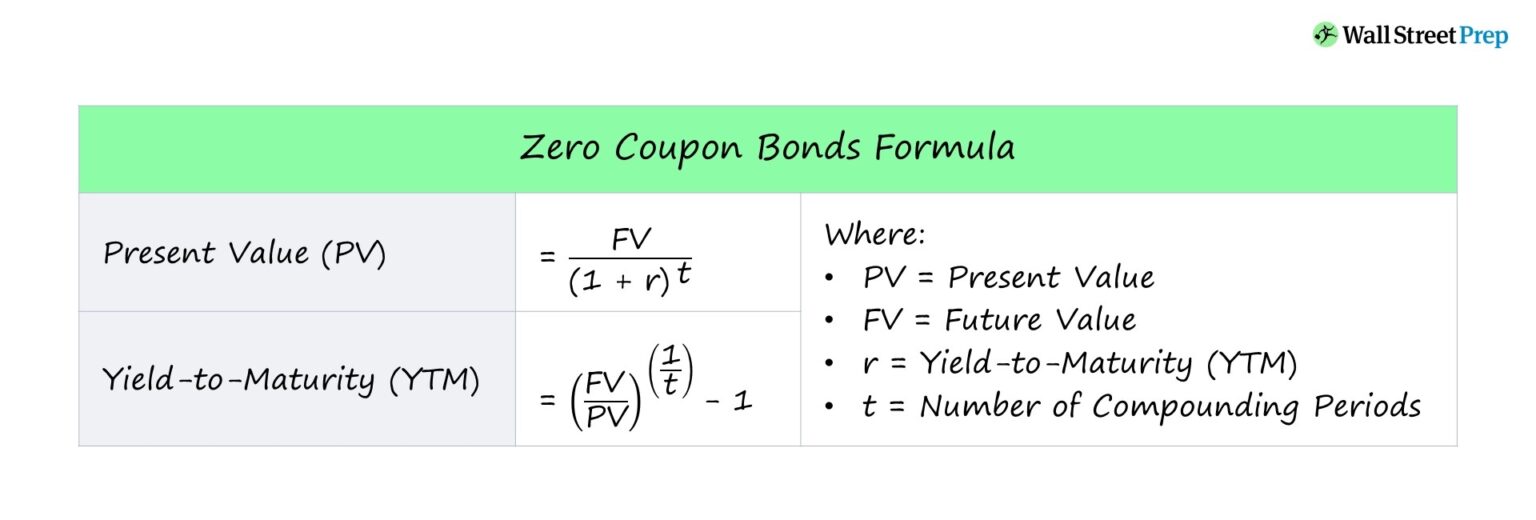
To calculate the price of a zero-coupon bond—i.e. the present value (PV)—the first step is to find the bond's future value (FV), which is most frequently $1,000.
The next step is to add the yield-to-maturity (YTM) to one, and then raise it to the power of the number of compounding periods.
If the zero-coupon bond compounds semi-annually, the number of years until maturity must be multiplied by two to reach the total number of compounding periods (t).
Where:
The yield-to-maturity (YTM) is the rate of return received if an investor purchases a bond and proceeds to hold onto it until maturity.
In the context of zero-coupon bonds, the YTM is the discount rate (r) that sets the present value (PV) of the bond's cash flows equal to the current market price.
To calculate the yield-to-maturity (YTM) on a zero-coupon bond, first divide the face value (FV) of the bond by the present value (PV).
The result is then raised to the power of one divided by the number of compounding periods.
Formula
- Yield-to-Maturity (YTM) = (FV / PV) ^ (1 / t) – 1
One drawback to zero-coupon bonds is their pricing sensitivity based on prevailing market interest rate conditions.
Bond prices and interest rates have an “inverse” relationship with one another:
The prices of zero-coupon bonds tend to fluctuate based on the current interest rate environment (i.e. they are subject to greater volatility).
For instance, if interest rates rose, then the zero-coupon bond becomes less attractive from a returns perspective.
The bond price must decrease until its yield matches that of comparable debt securities, which reduces the returns to the bondholder.
Even though the bondholder technically does not receive interest from the zero-coupon bond, so-called “phantom income” is subject to taxes under the IRS.
However, certain issuances can avoid being taxed, such as zero-coupon municipal bonds and Treasury STRIPS.
We'll now move on to a modeling exercise in Excel, which you can access by filling out the form below.

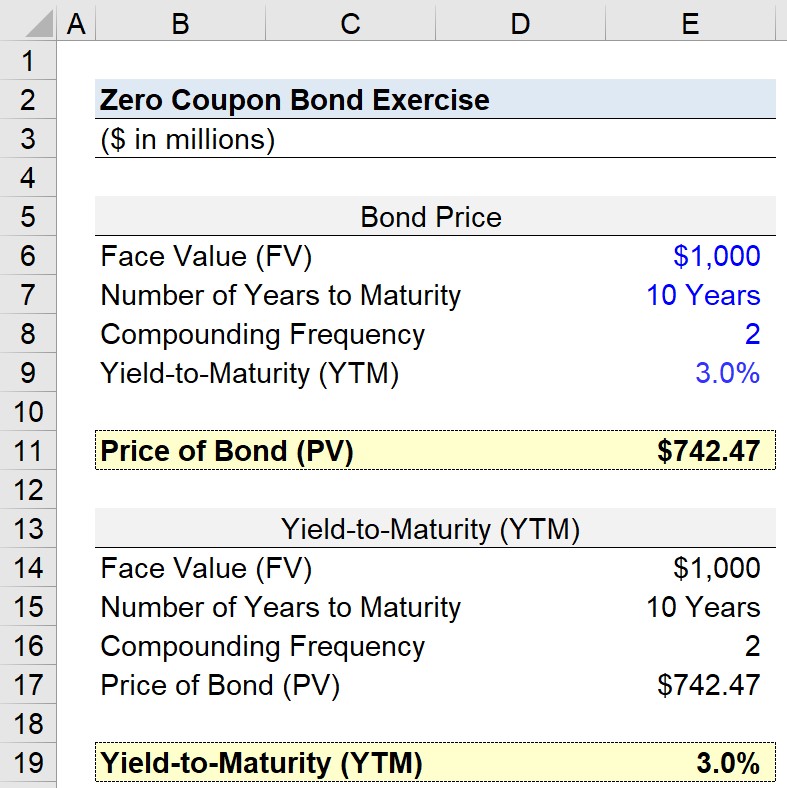
In our illustrative scenario, suppose you're considering purchasing a zero-coupon bond with the following assumptions.
Given those assumptions, the question is: “What price are you willing to pay for the bond?”
If we input the provided figures into the present value (PV) formula, we get the following:
The price of the bond is $742.47, which is the estimated maximum amount that you can pay for the bond and still meet your required rate of return.
In our next section, we'll work backward to calculate the yield-to-maturity (YTM) of the bond using the same assumptions as before.
We can enter the inputs into the YTM formula, since we already have the necessary inputs:
The 3.0% yield-to-maturity (YTM) matches the stated assumption from the earlier section, confirming our formulas are correct.
Wall Street Prep’s globally recognized certification program prepares trainees with the skills they need to succeed as a Fixed Income Trader on either the Buy Side or Sell Side.


No comments yet.