What are Treasury Inflation-Protected Securities (TIPS)?
Treasury Inflation-Protected Securities (TIPS) are designed to be indexed to changes in inflation as a form of risk protection from the adverse effects of rising consumer prices.

Treasury Inflation-Protected Securities (TIPS) are designed to be indexed to changes in inflation as a form of risk protection from the adverse effects of rising consumer prices.
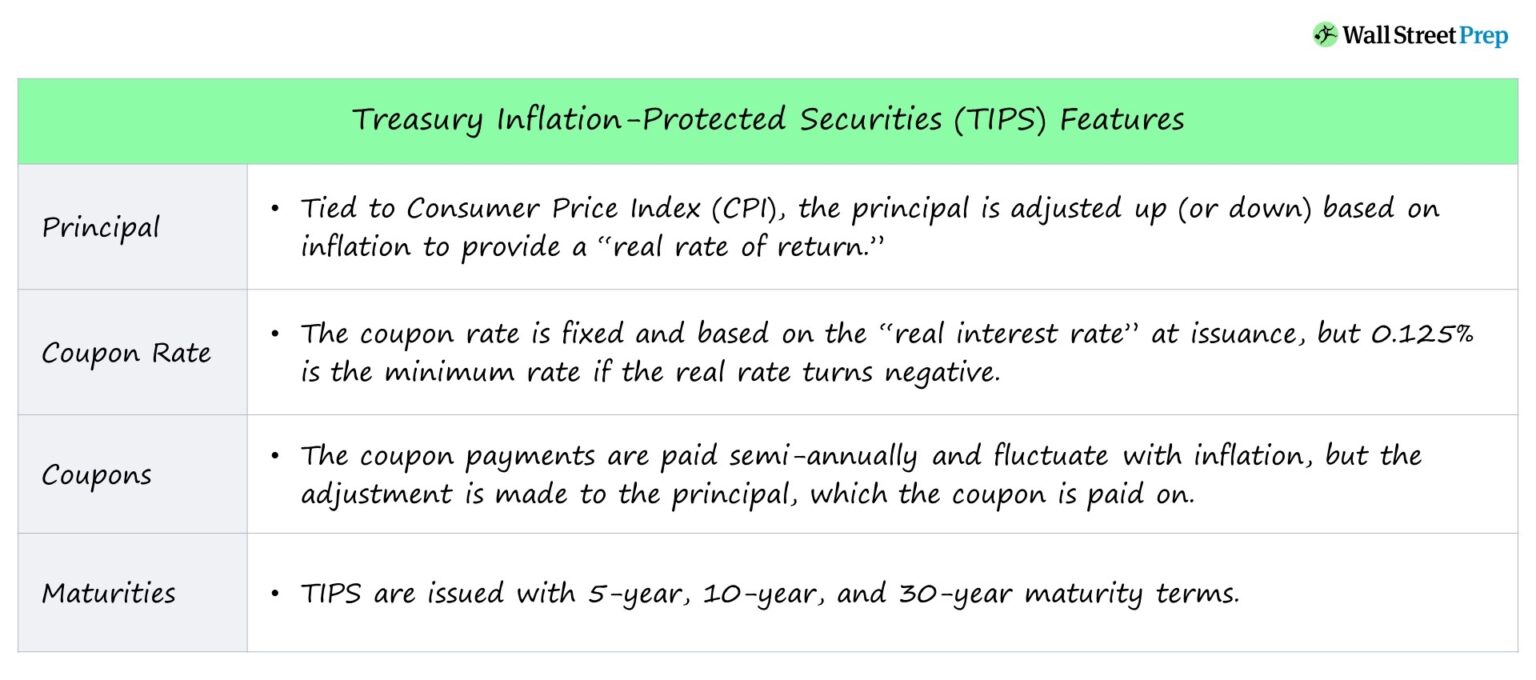
Treasury Inflation-Protected Securities, or “TIPS,” were introduced in the U.S. in 1997 to offer bonds specifically structured to reduce inflation risk.
Since TIPS are indexed to an inflationary gauge – the Consumer Price Index (CPI) – the funds of bondholders are protected against declining purchasing power, i.e. the value of one monetary unit expressed in terms of the goods/services it could purchase.
Treasury inflation-protected securities, or “TIPS”, are a form of inflation-protected bonds issued by the U.S. Treasury.
The face value (FV) of TIPS is tied to the consumer price index (CPI) and adjusts in accordance with inflation.
The U.S. Treasury issues interest on the adjusted face value (FV) of the bond
Therefore, the stream of interest payments received by the borrower increases if the inflation rate rises.
Once the TIPS reach maturity, the bondholder receives the original face value (PV) and the cumulative inflation-related adjustments since the date of original issuance.
Learn how institutional investors identify high-potential undervalued stocks. Enrollment is open for the upcoming cohort.
As a trade-off for inflation risk protection, TIPS are priced at lower interest rates than comparable issuances by the U.S. government.
After the principal is adjusted, future interest payments are paid based on the post-adjustment par value, so if inflation were to continue rising, the interest also gradually rises in tandem.
On the maturity date, the investor receives the principal plus the accrued inflation adjustments.
The U.S. government guarantees that the inflation-adjusted principal at maturity will not be less than the bond’s original par value.
TIPS combat inflation risk that can erode the yield on fixed-income bonds with a fixed interest rate that remains constant for the entire borrowing term.
For example, if CPI rises by 2% and a corporate bond pays 5% in annual coupons, the real return is 3%, which is the adverse effect that TIPS attempt to protect investors from.
The formula for the nominal and real rates is shown below.
The pricing on TIPS is contingent on the breakeven inflation rate, which is defined as the difference between the yield on TIPS and nominal Treasury bonds.
Said differently, the breakeven inflation rate is the CPI inflation rate – adjusted to an annualized basis – that causes the yield on TIPS to equal that of comparable Treasury issuances.
One misconception is that the yield on TIPS is perfectly correlated to changes in inflation rates.
TIPS bondholders only profit from inflation if the reported inflation exceeds the market's anticipated views on future inflation.
In fact, TIPS can reduce in value not just if inflation remains low or close to non-existent – but even if predictions for inflationary risk turn out to be true.
Why? The market has already priced in current inflation expectations, so for inflation to improve yields on TIPS, inflation must be greater than what had been expected.
TIPS are exempt from local and state income taxes, while interest payments on TIPS are subject to federal income taxes.
According to the IRS, adjustments to the principal of TIPS are deemed taxable income, despite investors not profiting until the bond reaches maturity (or is sold).
Therefore, positive adjustments to the TIPS principal are subject to federal tax in the year of occurrence, despite the investor not yet receiving the monetary profit (i.e. “phantom income tax").
Certain retirement accounts, ETFs, and mutual funds can defer taxes, which many investors opt into in order to bypass the immediate tax implications.
TIPS are backed by the “full faith and credit” of the U.S. government, making them safe, risk-free investments, as the government could theoretically print money to avoid defaulting.
But while TIPS have less default risk due to backing from the U.S. government, TIPS are vulnerable to interest rate risk. For example, if interest rates increased in a low inflation environment, TIPS prices would decline.
Due to the benefit of having a principal amount that is adjusted for inflation, the interest rate on TIPS is priced lower than for comparable fixed-income instruments, causing TIPS to be suboptimal for yields.
Even if the CPI declines significantly, the TIPS principal cannot decrease below the original par value – however, interest payments would decline since they are paid on the adjusted principal.
TIPS have historically been one of the least volatile asset classes with minimal correlation to inflation and other asset classes (e.g. equities, commodities, real estate).
As a result, TIPS are considered a useful hedge against inflation risk and for portfolio diversification.

Asset Class Correlation to TIPS (Source: State Street)
The final drawback to TIPS is the limited liquidity for a Treasury security, i.e. there is lower trading activity in the secondary markets.
Still, the TIPS secondary market is active, just not as active relative to that of traditional government issuances.


No comments yet.