What is Secondary Market?
The Secondary Market is a platform where investors actively purchase and sell existing securities (post-issuance), such as stocks and bonds, amongst themselves rather than with the issuing entity.

The Secondary Market is a platform where investors actively purchase and sell existing securities (post-issuance), such as stocks and bonds, amongst themselves rather than with the issuing entity.
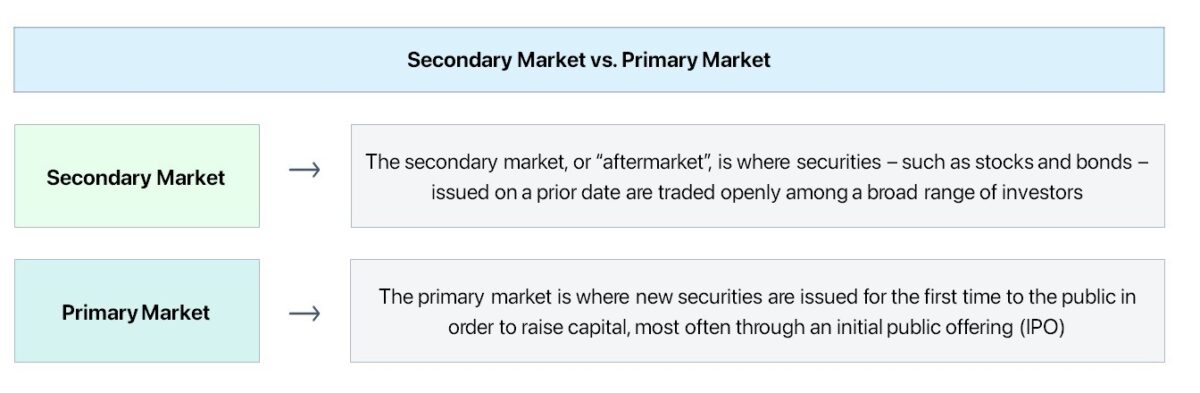
The secondary market, or “aftermarket”, is where existing securities such as stocks, bonds, and derivatives are traded among a broad range of investors, without the direct involvement of the issuer.
The secondary market, as implied by the name, facilitates transactions of securities post-issuance in the primary market, i.e. the securities traded are those previously bought in the initial sale.
Market participants can buy and sell existing securities (from prior issuances) currently under their ownership in the secondary market, so there is more discretion with regard to setting the price to offer to buyers in the open markets.
Unlike the primary market, the participants in the secondary markets purchase and sell securities with each other rather than with the issuer.
In practice, the term “secondary” market is most often in reference to the stock exchange, in which the shares of publicly traded companies (post-IPO) are bought and sold by investors.
In the secondary market, investors actively trade among themselves on the major indices, such as the New York Stock Exchange (NYSE), NASDAQ, S&P 500, and other global exchanges.
Learn how institutional investors identify high-potential undervalued stocks. Enrollment is open for the upcoming cohort.
Secondary markets serve several important functions within the financial system.
| Function | Description |
|---|---|
| Market Liquidity |
|
| Price Discovery (“Efficient Market”) |
|
| Portfolio Diversification |
|
The secondary markets function as a platform where securities issued on a prior date can be bought and sold among investors, including retail investors and institutional investors like hedge funds and mutual funds.
The process of transactions on the secondary markets is as follows.
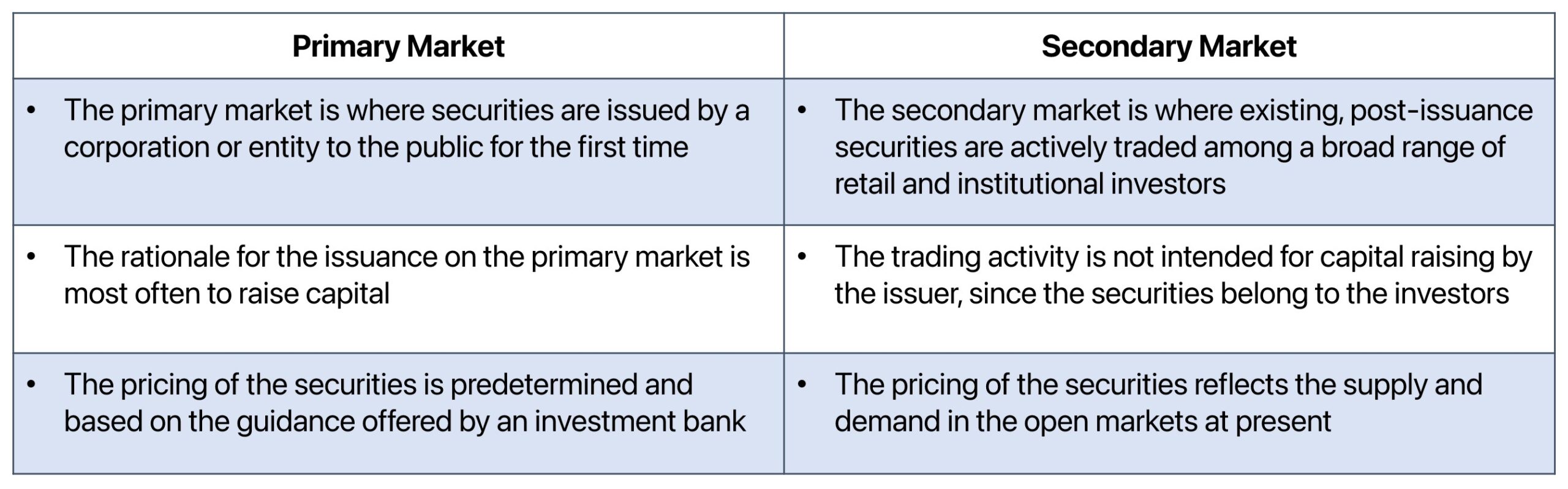
The primary market and the secondary market are two distinct parts of the financial market:
There are various types of secondary markets, each catering to a specific type of financial securities.


No comments yet.