What is a Treasury Bond?
A Treasury Bond, or “T-Bond”, is a fixed income security issued and backed by the full faith and credit of the U.S. government.

A Treasury Bond, or “T-Bond”, is a fixed income security issued and backed by the full faith and credit of the U.S. government.
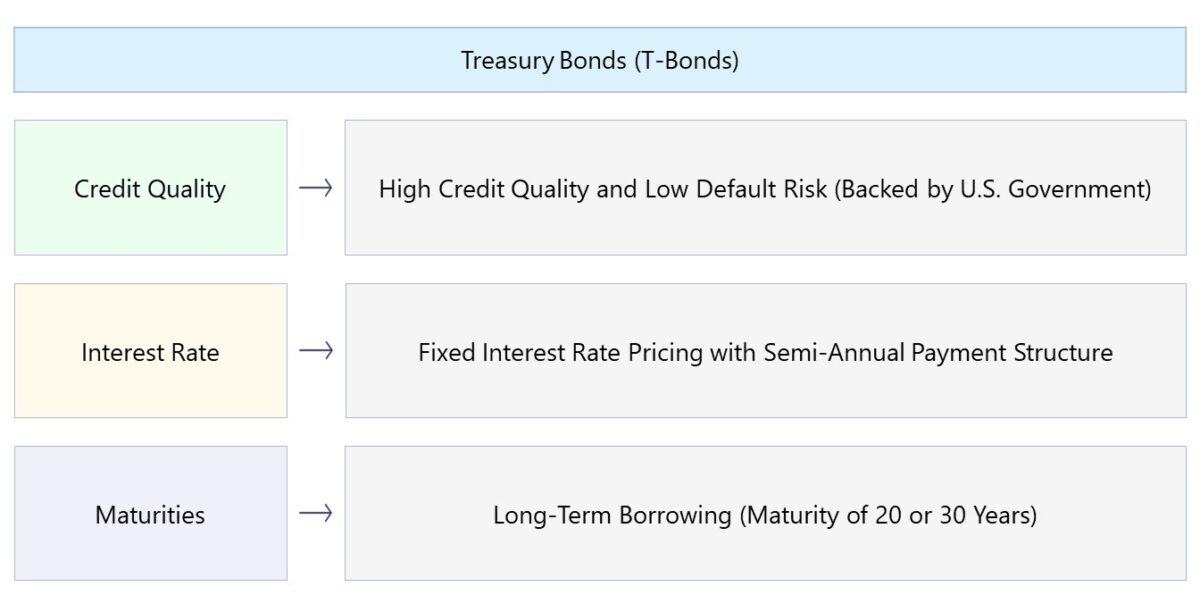
Treasury bonds (T-bonds) are long-term debt securities issued by the U.S. Treasury Department with maturities of either 20 or 30 years.
The appeal of T-bonds to investors is that these debt obligations are as close to being “risk-free” as possible.
In the unlikely event that the U.S. government does default on its debt obligations, the government could hypothetically print more money, which coincides with the federal government's ability to adjust the tax rate as deemed necessary and the perceived strength of the U.S. economy.
Therefore, Treasuries such as the T-bond are perceived as low credit risk, “safe haven” securities, since the issuances are backed by the U.S. government.
The downside, however, is that the lower credit risk and chance of default results in lower yields on Treasury bonds relative to other comparable bonds in the market, such as corporate bonds.
The trade-off in risk and return can still be worth it for many investors, however, since not all market participants possess the same investment objectives and appetite for risk.
The list below briefly describes the most notable characteristics of Treasury bonds:
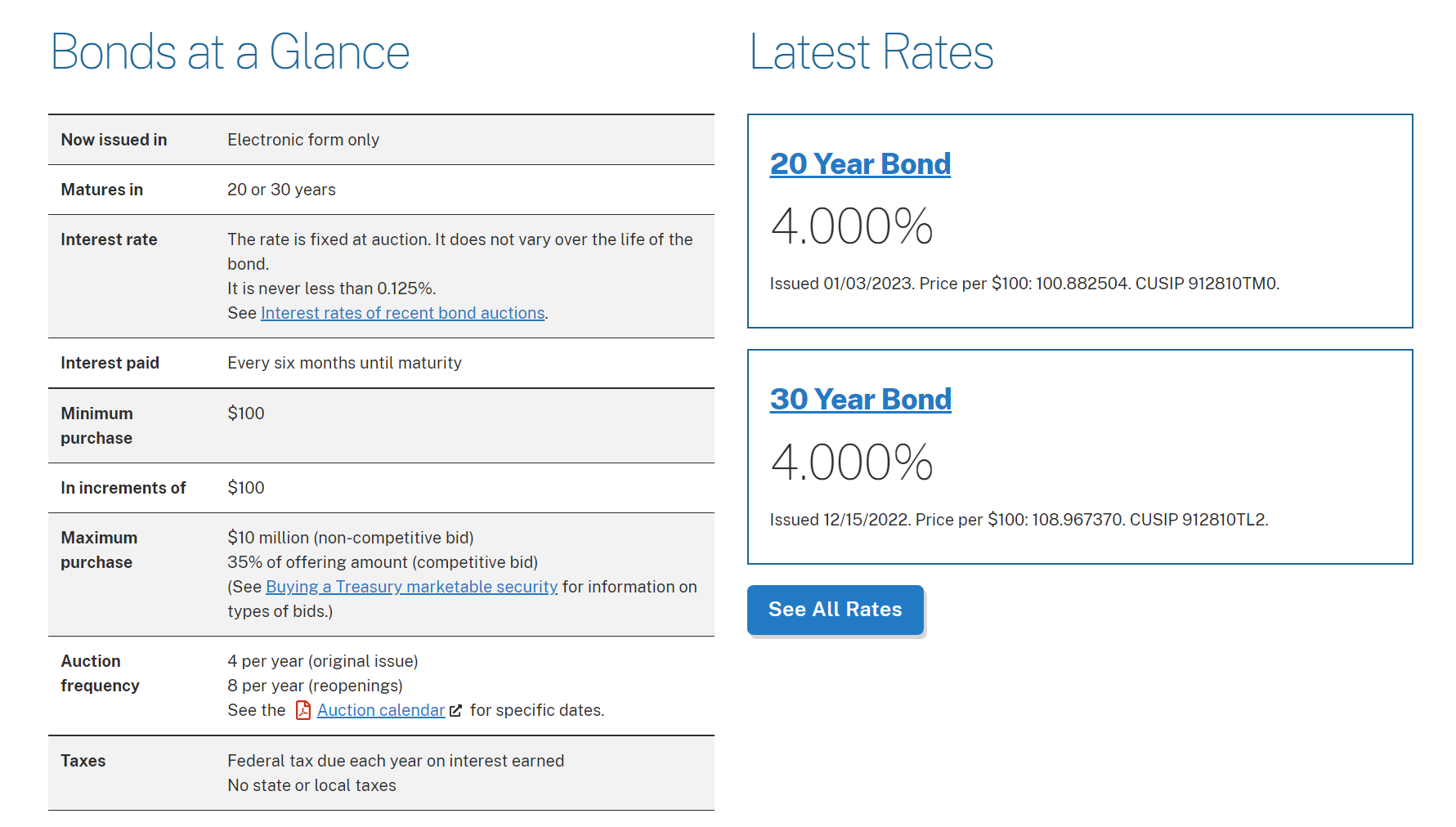
Treasury Bonds at a Glance (Source: TreasuryDirect)
Learn how institutional investors identify high-potential undervalued stocks. Enrollment is open for the upcoming cohort.
Like most fixed-income securities, T-bonds periodically issue interest payments to the bondholder until the bond reaches maturity.
Since the interest rate pricing is fixed rather than floating, i.e. variable pricing, the interest payments do not fluctuate over the course of the bond’s tenor.
The following chart shows the historical 3-year yield on a 30-year Treasury bond from 2020 to 2022.
The plummet in yield is evident around the initial outbreak of the COVID-19 pandemic, followed by the gradual rise in rates as the Fed started to implement policies to fight rising inflation.
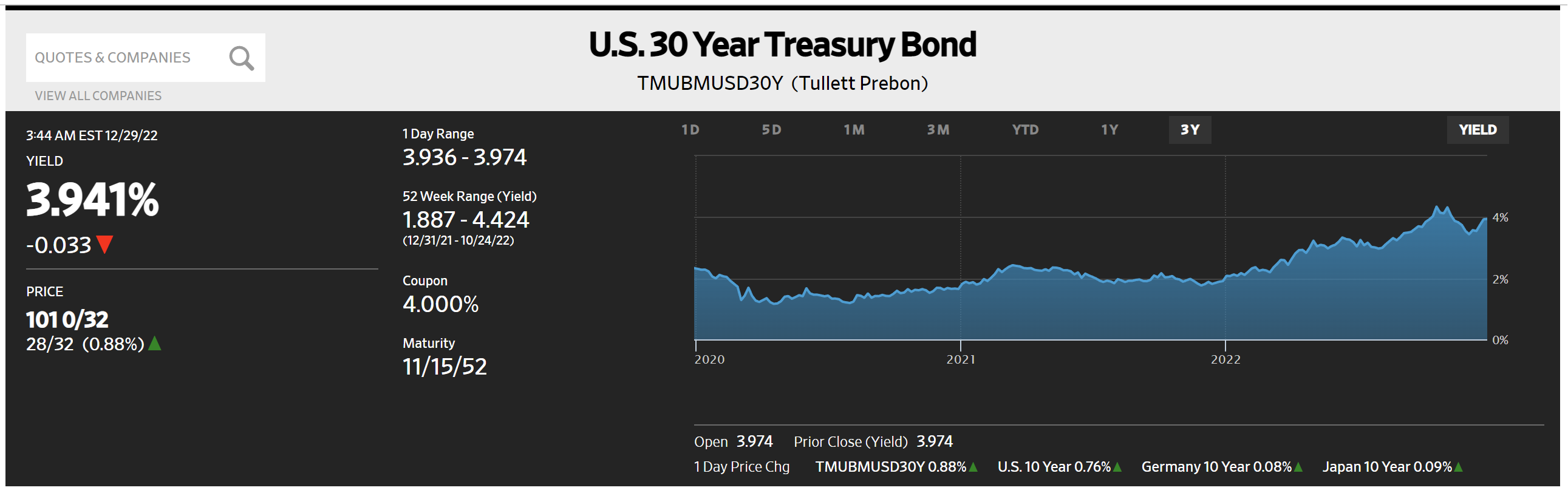
30-Year Treasury Bond Yield (Source: Wall Street Journal)
Other than T-bonds, two other closely related Treasury offerings are treasury notes (T-notes) and treasury bills (T-bills), which are each differentiated by their maturities.
Out of the three, T-bonds carry the longest maturities and offer the highest interest rate, since the longer borrowing term coincides with more uncertainty (and risk).
| Treasuries | Maturities |
|---|---|
| Treasury Bills (T-Bills) |
|
| Treasury Notes (T-Notes) |
|
| Treasury Bonds (T-Bonds) |
|
For all of these offerings, the backing by the U.S. government (and thus the low credit risk) is the key factor that appeals to retail and institutional investors.
Treasuries generally become less attractive if interest rates are very low and during periods of high inflation (or if the market is worried about an inflationary spike).
In addition, all three Treasuries are traded in a highly liquid secondary market, i.e. there is significant trading volume with active buyers and sellers.
However, the 10-year T-note tends to garner the most attention, as its yield is most often used as the risk-free rate assumption in valuation models, such as for the discounted cash flow model (DCF).
Treasury bonds can be purchased directly from the U.S. Treasury or indirectly from financial institutions, such as banks and brokerages.
T-bonds can be bid on at regularly held auctions via the TreasuryDirect site, which occur 4x per year, on the first Wednesday of February, May, August, and November.
The tentative schedule with the dates of upcoming auctions can be viewed on the TreasuryDirect site.
Treasury securities like T-bonds can also be purchased through a bank or brokerage, with the drawback of additional charged fees.
Otherwise, an investor can also gain exposure to Treasury bonds through mutual funds and exchange-traded funds (ETFs) with portfolios containing T-bonds.
Only the federal tax rate is applied to the interest income earned on T-bonds, as the income is exempt from taxation at the state and local level.
The price at which the Treasury bond was sold is also another consideration.
Given the purchase price, an investor must consider that the net gain earned in excess of the original principal can be treated as taxable income.
For instance, if a T-bond is purchased at a discounted price relative to the market price in the secondary markets, the profit earned on the date of maturity is subject to taxation (and can be treated as a capital gain). Or in the case of an original issue discount (OID), the gain on the OID can be treated as a different type of income, which is specific to different jurisdictions.
That said, it is recommended that investors consult with a certified tax accountant before investing in Treasuries, as various individual factors could influence the amount of taxes owed.
While Treasury bonds carry minimal risk in terms of credit quality and the chance of default by the issuer, there is still some exposure to external risks that can affect investor returns.
In particular, inflation risk and interest rate risk pertain more to treasury bonds—compared to T-bills and T-notes—because of the longer maturities of T-bonds, as so much can change in the global economy and financial markets across a 20 to 30 year time horizon.


No comments yet.