What is Property Value?
The Property Value is the estimated fair market value (FMV) of a real estate property, such as a commercial office building, as of the present date.

The Property Value is the estimated fair market value (FMV) of a real estate property, such as a commercial office building, as of the present date.
The property value of a real estate asset, such as a commercial building or office space, is the estimated price at which a property can be sold in the open markets.
Broadly put, the estimated market value ascribed to a specific property is determined by the market demand and supply available at the present date.
If the market supply remains constant while market demand increases, the property values in the market should expect to rise, all else being equal.
Therefore, property values constantly fluctuate based on the current balance between market demand and supply, among other factors such as the interest rate environment (i.e. the cost of borrowing).
For a property value estimate to hold weight, the property must have been marketed transparently – i.e. via non-deceptive marketing or concealing material information influential on the fair value of a property – such as leaking ceilings or damages.
The two parties involved in the real estate transaction – the buyer and the seller – must have both acted with knowledge of all material information regarding the property, without compulsion and formally agreed to the sale on their own accord.


If a homeowner is abruptly forced to sell their property to avoid defaulting on a business loan unrelated to the property itself, the “fire sale” nature of the transaction (and expedited process) causes the sale price to not reflect the true fair value of the property.
The buyer in the transaction, in all likelihood, purchased the property at a steep bargain, at the expense of the seller, akin to distressed asset sales in corporate restructuring.
In practice, there are various appraisal methods to determine the valuation of a property.
The following table outlines the most notable appraisal methods used by practitioners:
| CRE Appraisal Method | Description |
|---|---|
| Sales Comparison Approach |
|
| Income Approach – Direct Capitalization Method |
|
| Income Approach – Gross Rent Multiplier (GRM) |
|
| Cost Approach – Replacement Cost Method |
|
| DCF Analysis |
|
Irrespective of the methods used to estimate the value of a given property, an independent 3rd party appraisal is often recommended for larger-sized real estate projects, alike a fairness opinion in M&A, to ensure the price paid is reasonable.
The certified appraiser is hired to provide an independent property valuation, mitigating the risk of potential mispricing caused by a potential conflict of interest (or any inherent bias).
The appraiser conducts an in-person inspection of the property, including diligence on the surrounding location, market trends, and comparable properties.
In recent times, automated tech-based platforms, such as Zillow and Redfin, have emerged that can estimate the price of properties.
Yet, these pricing quotes are not meant to replace a formally recognized appraisal. Instead, the estimated property values are more akin to a "quick comps" analysis and should not be taken at face value, although the algorithms have unquestionably improved in accuracy in recent years.

“How Accurate is the Zestimate?” (Source: Zillow)
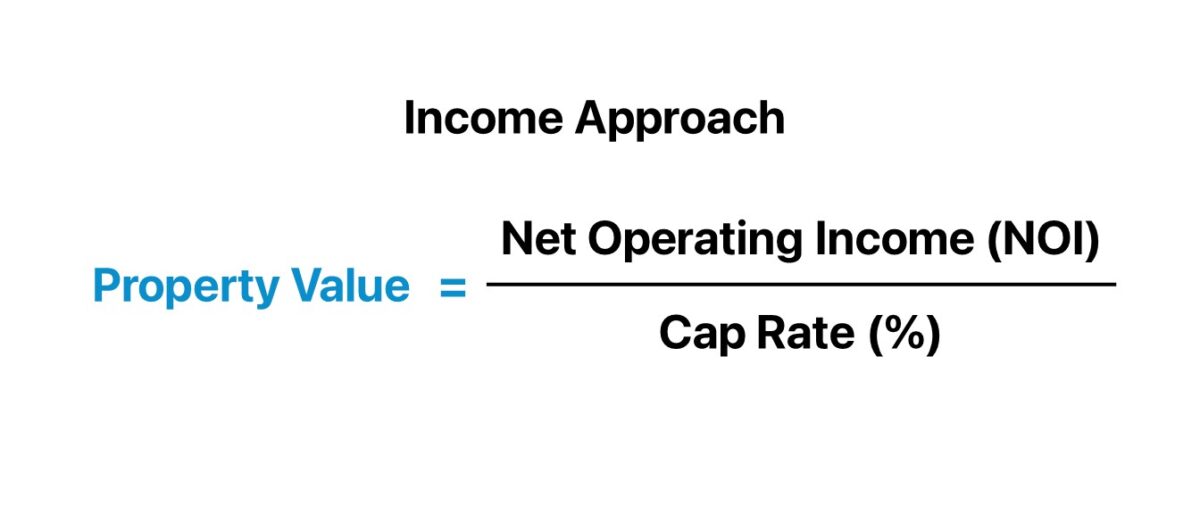
Under the income approach, or “capitalization approach” – the focus of our post on conducting a commercial real estate (CRE) appraisal – the property value formula is as follows.
Where:
The cap rate (%) component is determined based on the risk-return profile of the property and other factors, such as comparable properties and current market conditions.
Therefore, while the capitalization rate can be calculated using the following formula, the cap rate input in our property value formula is not a direct calculation, but rather at the discretion of the real estate investor.
But for general reference, the cap rate formula is as follows.
The appropriate cap rate to apply in the valuation of a given property is derived from comps analysis, i.e. the investor analyzes the cap rates of comparable properties.
Generally speaking, a higher cap rate implies there is more risk attributable to undertaking a certain real estate project, which coincides with a lower property value because investors in the market require a higher potential yield to compensate for the incremental risk of an investment.
The other income approach – the gross rent multiplier (GRM) method – uses the following formula.
Unlike the capitalization approach, the GRM method uses the property’s annualized gross rental income, rather than the net operating income (NOI).
That said, the operating expenses incurred by the property – e.g. property taxes, insurance, repairs or renovations, and utility bills – are neglected.
Like the cap rate, the multiplier applied is based on performing diligence on the property and comps analysis.
Level up your real estate investing career. Enrollment is open for the upcoming Wharton Certificate Program cohort.
We’ll now move to a modeling exercise, which you can access by filling out the form below.

Suppose a real estate investment firm is considering a potential acquisition of a commercial office building.
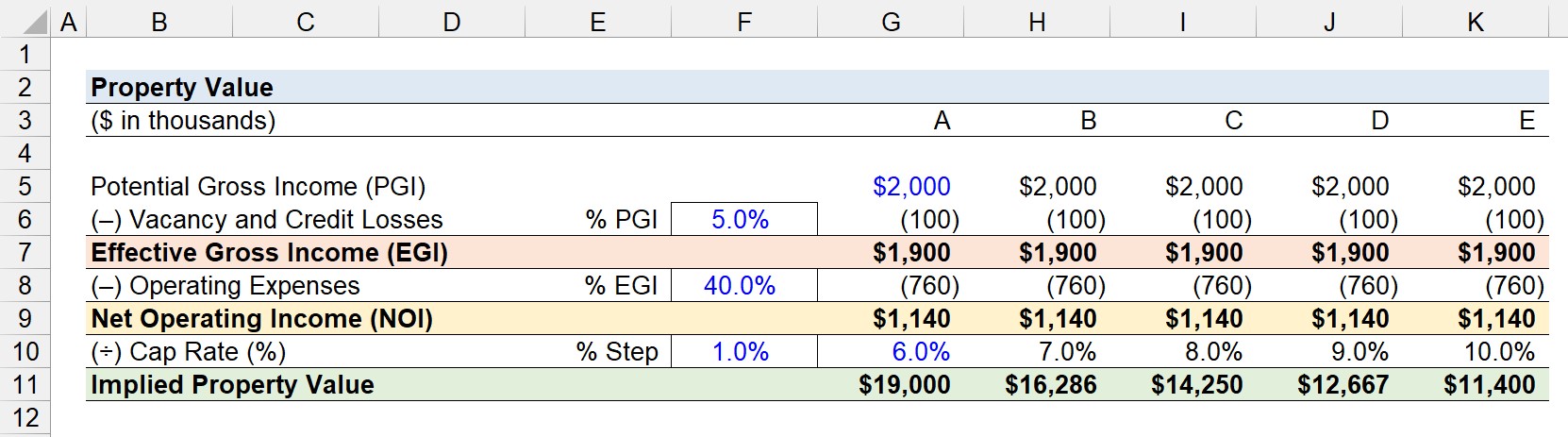
If acquired, the property expects to generate $2 million in potential gross income (PGI), with vacancy and credit losses expected to be 5.0% of PGI.
Given those figures, we can determine the effective gross income (EGI) by subtracting the expected vacancy and credit losses from the property’s potential gross income (PGI), which is $1.9 million in our scenario.
The next step is the calculate the property’s net operating income (NOI) by subtracting its effective gross income (EGI) from its operating expenses.
For our hypothetical scenario, we’ll assume the property’s direct operating expenses are 40% of EGI.
The commercial building’s net operating income (NOI) is the difference between its effective gross income (EGI) and operating expenses, which is approximately $1.14 million here.
Note: In more complex real estate financial models – most often for commercial properties – the “Replacement Reserves” is a common line item that further reduces the net operating income (NOI) metric.
The only remaining assumption necessary to perform a property valuation using the income approach is the capitalization rate (or “cap rate”).
To restate from earlier, the cap rate applied is contingent on the fundamentals of the property and comparable properties in the same or adjacent market.
In our illustrative model, we’ll set up five different scenarios using a step function (+1.0%), in which the only difference is the cap rate.
The estimated property value under each scenario is calculated by dividing net operating income (NOI) by an appropriate cap rate derived from analysis of comparable properties and market analysis.
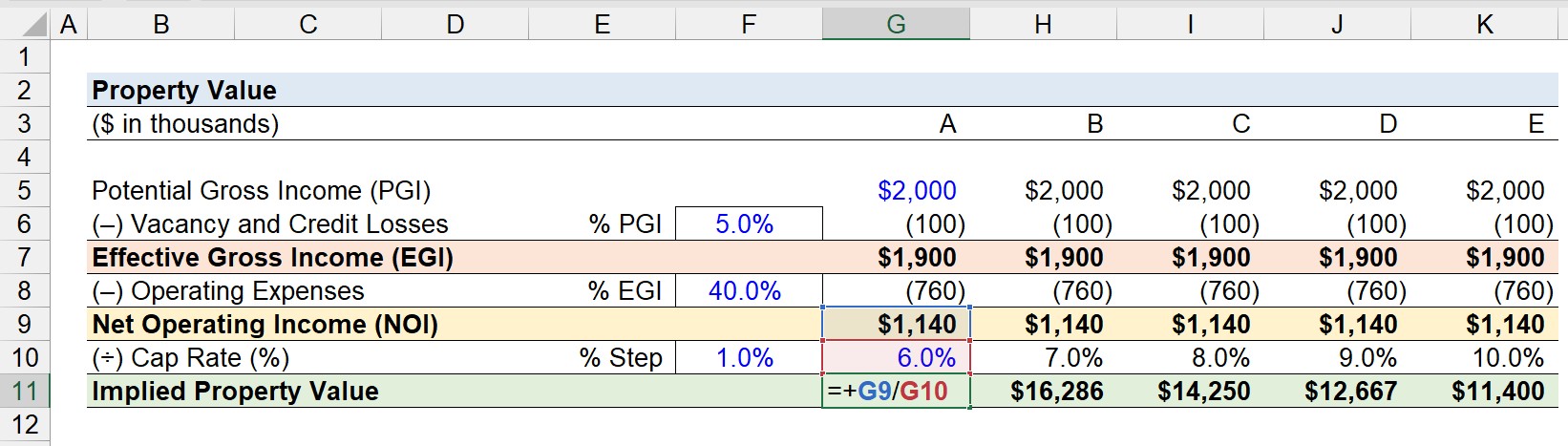
Once the NOI and cap rate figures are computed for each scenario, we arrive at the following property value estimates.
Therefore, our modeling exercise illustrates the fundamental relationship between the cap rate and property value estimates, where rising cap rates cause implied property prices to decline due to the higher risk profile.
The factors that influence the property value in a specific real estate market include the following:
Often, external factors at the macro level are the main catalyst for material changes in property prices in the real estate market, but internal factors can also contribute to pricing fluctuations.


No comments yet.