What is Equity Dividend Rate?
The Equity Dividend Rate (EDR) on a real estate property investment irepresents the ratio between the before-tax cash flows (BTCF) and the initial equity contribution, expressed as a percentage.

The Equity Dividend Rate (EDR) on a real estate property investment irepresents the ratio between the before-tax cash flows (BTCF) and the initial equity contribution, expressed as a percentage.
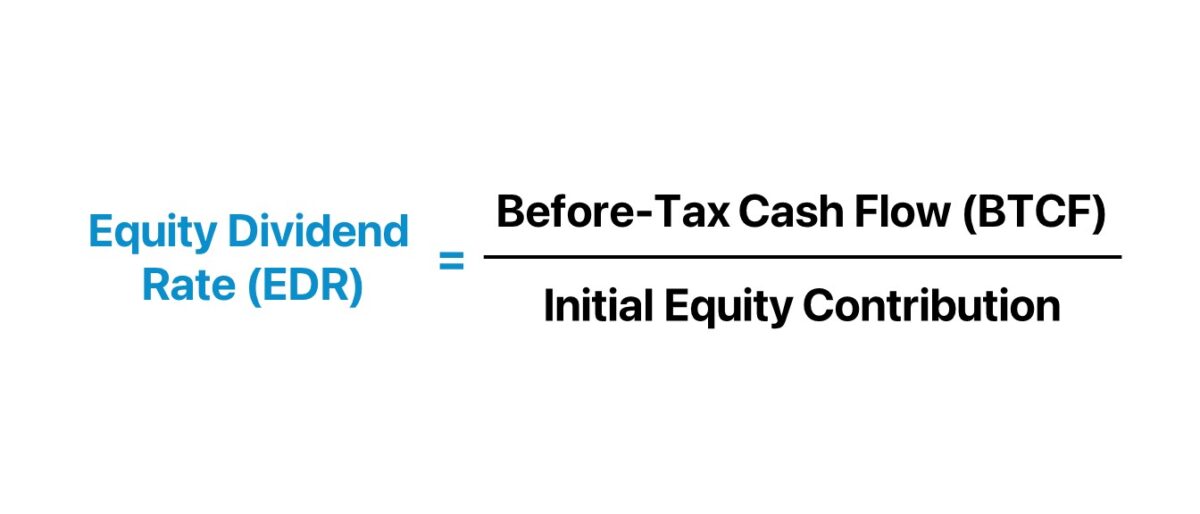
The equity dividend rate (EDR) is the annual return on the equity invested in a real estate property, and is calculated by comparing the property's before tax cash flow (BTCF) to the equity contribution.
The equity dividend rate – or more commonly referred to as the “cash on cash return” among industry practitioners – measures the yield earned on an equity investment on an annualized basis.
The process of calculating the equity dividend rate requires two inputs: the before-tax cash flow and the initial equity contribution.
Since the cash flow metric is reduced by financing costs, like mortgage payments and interest, the implied return is on a levered basis, i.e. attributable to solely the equity investor.
Therefore, the equity dividend rate measures the annual cash yield on the equity component of the property investment, rather than the return to all stakeholders.
Why? The distribution of proceeds must strictly abide by the liquidation preference, in which the placement of a stakeholder in the capital stack determines the order of repayment (and returns).
On the topic of timing, the before-tax cash flow (BTCF) metric must be presented on a post-stabilization basis, i.e. when the rental property is operating near its expected occupancy rate with pricing in line with the market rate.
For instance, a real estate development project can require years (or often even more than a decade) before the property is fully developed and starts to generate rental income on behalf of the owner.


The formula to calculate the equity dividend rate (EDR) is the ratio between the before-tax cash flow and initial equity contribution, expressed as a percentage.
Where:
The equity dividend rate is ordinarily expressed as a percentage to make comparisons of the cash yield of different properties easier – thus, multiply the output by 100 to convert the figure into percentage form.
Note: While the before-tax cash flow (BTCF) is a pre-tax metric – as implied by the name – property taxes are deducted because those are considered the operating costs of a property. The tax excluded from the metric are in reference to the income taxes paid to the federal government (IRS).
Level up your real estate investing career. Enrollment is open for the upcoming Wharton Certificate Program cohort.
The difference between the capitalization rate (or “cap rate”) and equity dividend rate is as follows.
We’ll now move on to a modeling exercise, which you can access by filling out the form below.

Suppose a commercial real estate (CRE) investment firm acquired an office building property, which will soon be stabilized and operational.
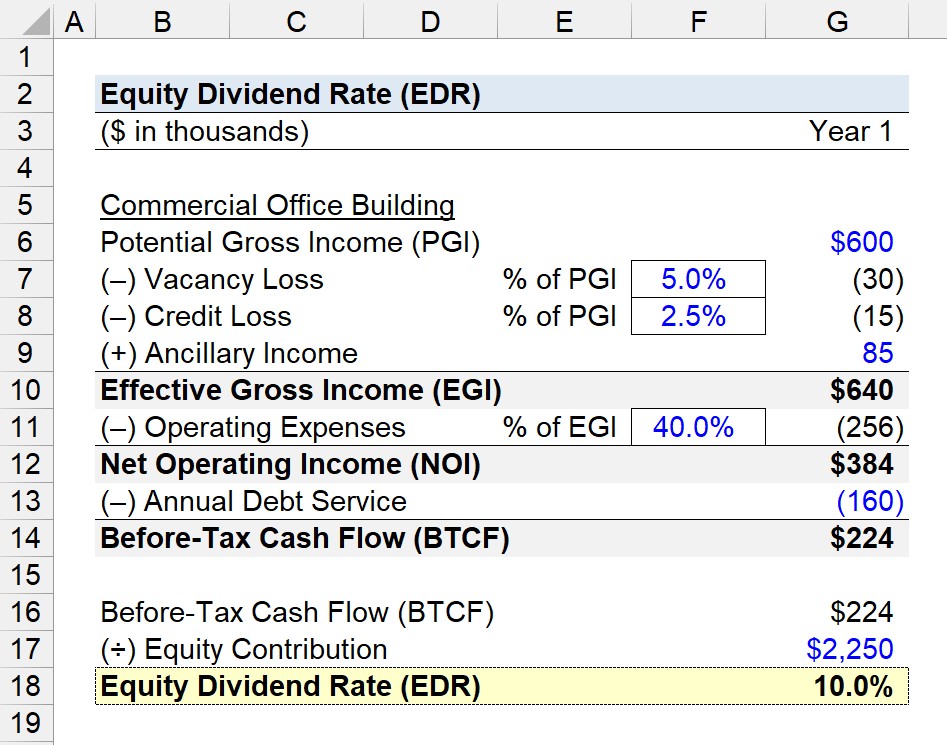
The pro forma forecast of the commercial office building in Year 1 is as follows.
Commercial Building – Pro Forma Operating Data
In the first part of our exercise, we must determine the stabilized net operating income (NOI) of the commercial office building.
The vacancy and credit losses are approximately $45k in total, which we determined by multiplying each assumption by the potential gross income (PGI).
Once potential gross income (PGI) is adjusted by the vacancy and credit losses and ancillary income, the effective gross income (EGI) comes out to be $640k.
The net operating income (NOI) is calculated by subtracting direct property-level operating expenses from the effective gross income (EGI).
If we assume that the operating expenses are 40% of the effective gross income (EGI), the net operating income (NOI) of the commercial building is $384k.
The before-tax cash flow (BTCF) can now be calculated by deducting the property’s annual debt service – assumed to be $160k here – from the stabilized NOI, which results in $224k.
Now that the before-tax cash flow (BTCF) is determined, the only remaining step is to divide the metric by the equity contribution, which we’ll assume was $2.25 million on the date of entry.
In closing, the equity dividend rate (EDR) on the commercial office property is 10.0%, implying the annual yield earned on the cash investment produced a return of $0.10 per dollar in cash invested.


No comments yet.