What is Before-Tax Cash Flow?
The Before-Tax Cash Flow (BTCF) is the rental income generated by a property prior to the deduction of income taxes.

The Before-Tax Cash Flow (BTCF) is the rental income generated by a property prior to the deduction of income taxes.
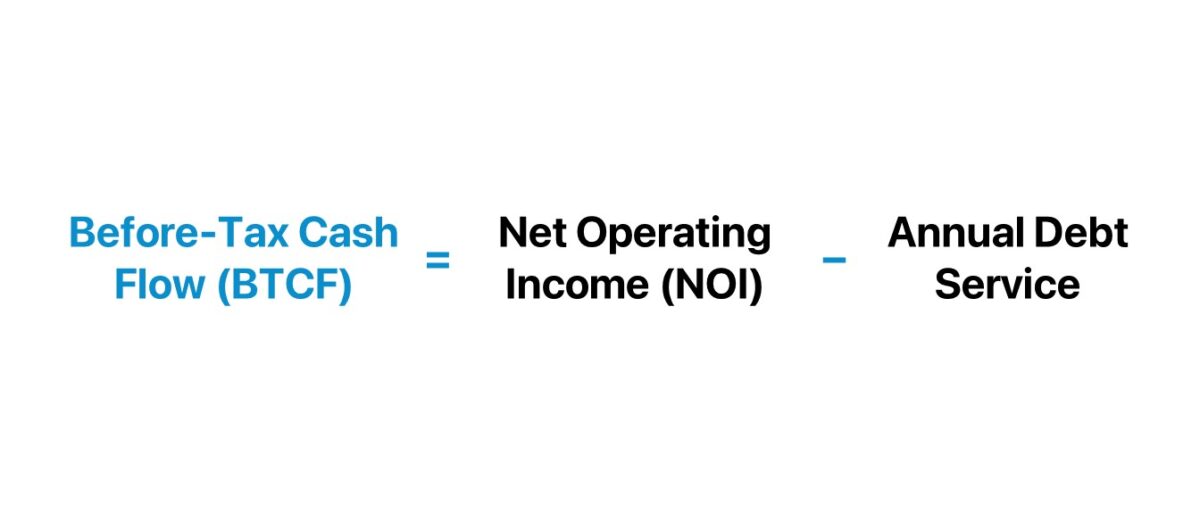
The before-tax cash flow (BTCF) is a real estate metric that measures the remaining pre-tax profit of a rental property, right after meeting its annual debt service.
Therefore, the before-tax cash flow – or “pre-tax cash flow” – is a levered cash flow metric, since the debt costs, such as mortgage payments, are accounted for.
The before-tax cash flow (BTCF) of a property can be determined by subtracting its annual debt service (ADS), such as mortgage payments, from its stabilized net operating income (NOI).
The process of calculating the before-tax cash flow for a given property investment is a four-step process:


While the before-tax income (BTCF) is above the income tax liability on a real estate pro forma model (and thus, not yet taxed), property taxes are subtracted from BTCF because those costs represent operating items in the real estate sector.
The formula to calculate the before-tax cash flow (BTCF) is the difference between the net operating income (NOI) of a property and the annual debt service.
Where:
In practice, one of the main use cases of the BTCF metric is to serve as the cash flow metric to calculate the cash on cash return.
The cash on cash return, or “cash yield”, is calculated as the ratio between the before-tax cash flow and initial equity contribution.
The cash on cash return is thus the yield earned on the original cash contribution paid by the real estate investor, i.e. the down payment.
Level up your real estate investing career. Enrollment is open for the upcoming Wharton Certificate Program cohort.
We’ll now move to a modeling exercise, which you can access by filling out the form below.

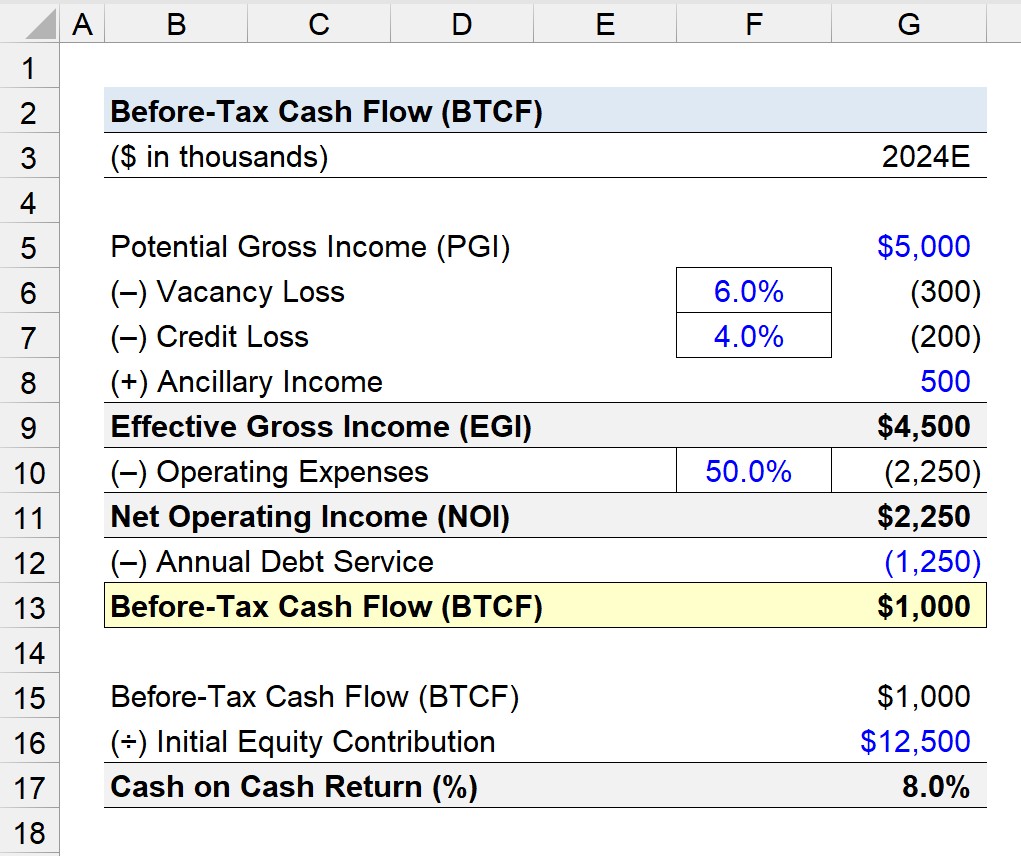
Suppose we’re tasked with calculating the before-tax cash flow (BTCF) of a commercial property in 2024.
Year 1 Pro Forma (2024E)
Therefore, the effective gross income (EGI) of the property in 2024 is expected to be $4.5 million.
From the effective gross income (EGI), we'll subtract operating expenses, which we'll assume to be 50% of EGI, resulting in a net operating income (NOI) of $2.25 million.
The before-tax cash flow (BTCF) can be determined by deducting the annual debt service (ADS), which we'll assume to be $1.25 million, from the stabilized NOI.
Given the net operating income (NOI) at stabilization and annual debt service (ADS), the difference is $1 million, which represents the property's before-tax cash flow (BTCF).
In conclusion, we'll wrap up our quick exercise in Excel by estimating the cash-on-cash return on the real estate investor's equity investment.
If we assume that the initial equity contribution was $12.5 million, the implied cash-on-cash return is 8.0%.


No comments yet.