What is Cash on Cash Return?
The Cash on Cash Return compares a real estate investment property’s annual pre-tax cash flow to the initial equity contribution.

The Cash on Cash Return compares a real estate investment property’s annual pre-tax cash flow to the initial equity contribution.
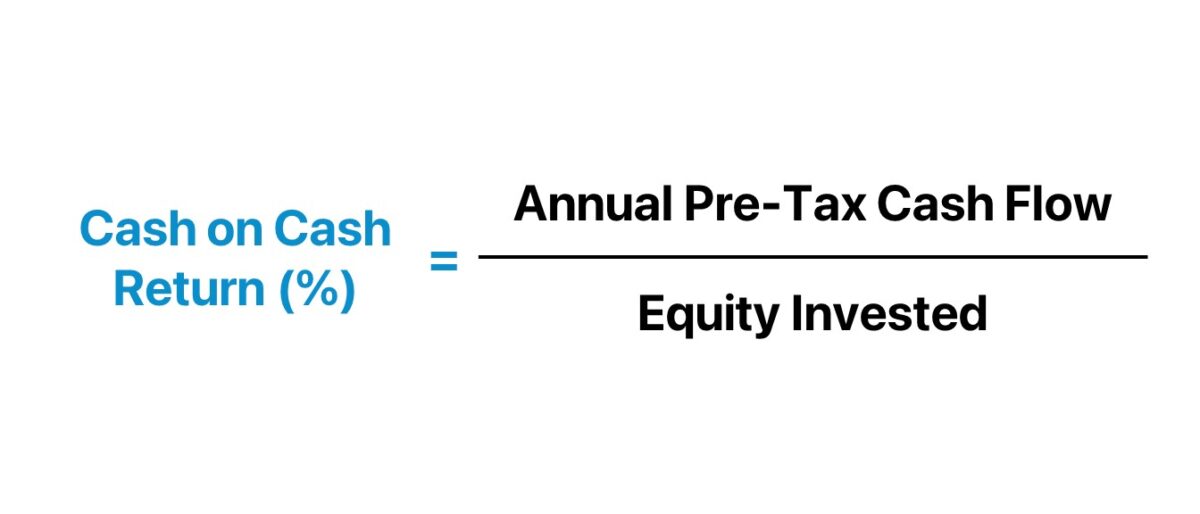
The cash on cash return, or “cash yield”, measures a real estate investor’s annual pre-tax earnings on a property relative to the initial amount spent to purchase the property itself.
The cash on cash return is calculated as the ratio between the annual pre-tax cash flow and invested equity:
In practice, the cash-on-cash return metric estimates the annual yield received by an investor on a specific property relative to the amount paid in the corresponding year, e.g. the mortgage payments.
Since the cash yield factors in costs like mortgage payments, the effects of financing costs are part of the implied return.


The formula for calculating the cash-on-cash return involves taking the annual pre-tax cash flow and dividing it by the initial cash investment (i.e., the equity contribution).
While the annual cash flow is before taxes, the metric is calculated post-financing, so the annual cash flow is a “levered” metric.
The cash yield is expressed as a percentage, which makes comparisons across different property investment opportunities easier.
However, the context in which the investment was completed, such as the location, date, and real estate market conditions, must all be taken into account.
Common examples of expenses that are factored into the cash flow metric are the following:
Level up your real estate investing career. Enrollment is open for the upcoming Wharton Certificate Program cohort.
The difference between the cash-on-cash return and the cap rate is as follows.
The cap rate is calculated by dividing the annual net operating income (NOI) by the market value of the property, while the cash on cash return is determined by dividing the levered pre-tax cash flow by the equity contribution.
In short, the denominator in the cap rate formula is the market value of the property – i.e., the fair value of the property at present – while the denominator in the cash-on-cash return formula is the equity contribution by the investor.
By now, we understand that the cash on cash return (or cash yield) measures the annual pre-tax cash flow compared to the initial amount of cash invested.
In contrast, the return on investment (ROI) calculates the yield across the entire holding period, whereas the cash yield usually covers the current period (i.e., only one year).
The cash-on-cash return (CoC) can be considered the return over a short time frame, whereas the return on investment (ROI) is a cumulative returns metric.
Unlike the return on investment (ROI), the cash yield can increase (or decrease) periodically due to fluctuations in rental income, expenses, and other related external factors.
Another differentiation between the two metrics appears in the topic of debt service. The cash flow metric in the CoC return calculation is only reduced by the debt service in the current period.
However, the return on investment (ROI) metric considers the entirety of the debt obligations related to the property investment.
Hence, the cash yield metric is most applicable for real estate property investments funded by debt capital.
If debt financing was used as part of the transaction – which is usually the case in the commercial real estate market – then the actual cash return on the investment diverges from the return on investment (ROI).
There is not necessarily a universally “good” cash yield return that all real estate investors target, considering each investor sets their own return (and risk) targets.
Generally speaking, the real estate market consensus is that a forecasted cash-on-cash return between 8% and 12% is considered a worthwhile investment.
Market conditions are another factor that must be considered, as well as the type of properties (and geographical location) of the investments made.
For the reasons above, it is difficult to quantify a specific, universal return to target, as it is subjective and affected by numerous variables.
We’ll now move on to a modeling exercise, which you can access by filling out the form below.

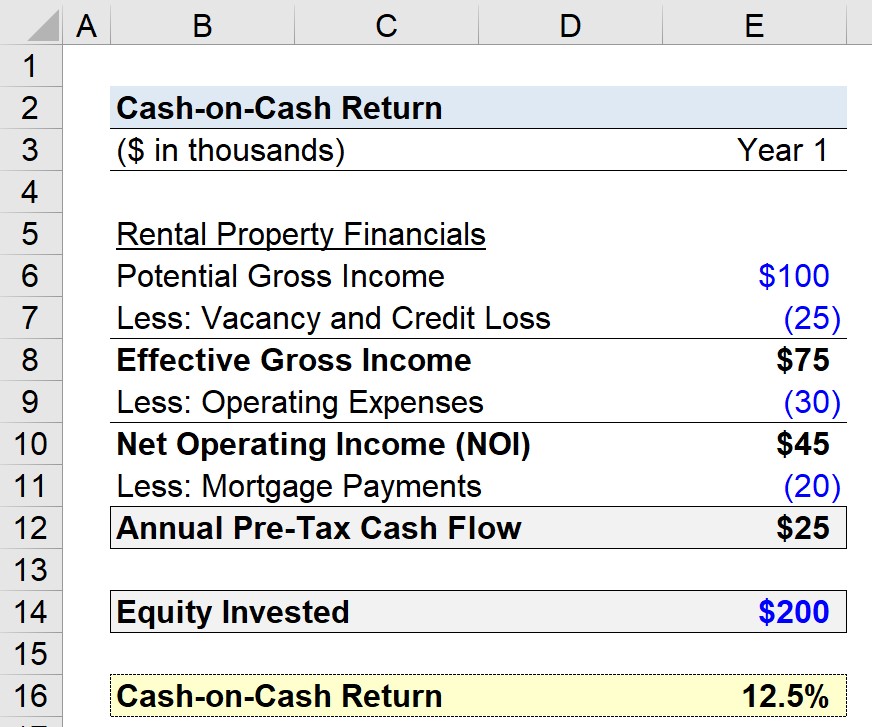
Suppose a commercial real estate investor purchased a rental property with a potential gross income of $100,000. But because of vacancies and credit losses, there is a deduction of $25,000.
The effective gross income (EGI) is thus $75,000.
In the next step, we’ll assume the operating expenses related to the property amounted to $30,000, so the net operating income (NOI) is $45,000.
We’ll now subtract the debt-related payments for the current year – i.e. the mortgage payments, such as interest and principal repayment – which we’ll assume to be $20,000.
By subtracting the rental property’s mortgage payments from its net operating income (NOI), we calculate the annual pre-tax cash flow as $25,000.
In the final section of our exercise, the only remaining assumption needed is the initial amount of equity invested, or $200k.
After dividing our annual pre-tax cash flow by the equity invested, the implied cash-on-cash return comes out to 12.5%.
In closing, the cash-on-cash return earned on the property investment is implied to yield 12.5% per year.


No comments yet.