What is Net Income Multiplier?
The Net Income Multiplier (NIM) is a real estate investing metric that compares the purchase price of a property to its annual net operating income (NOI).

The Net Income Multiplier (NIM) is a real estate investing metric that compares the purchase price of a property to its annual net operating income (NOI).
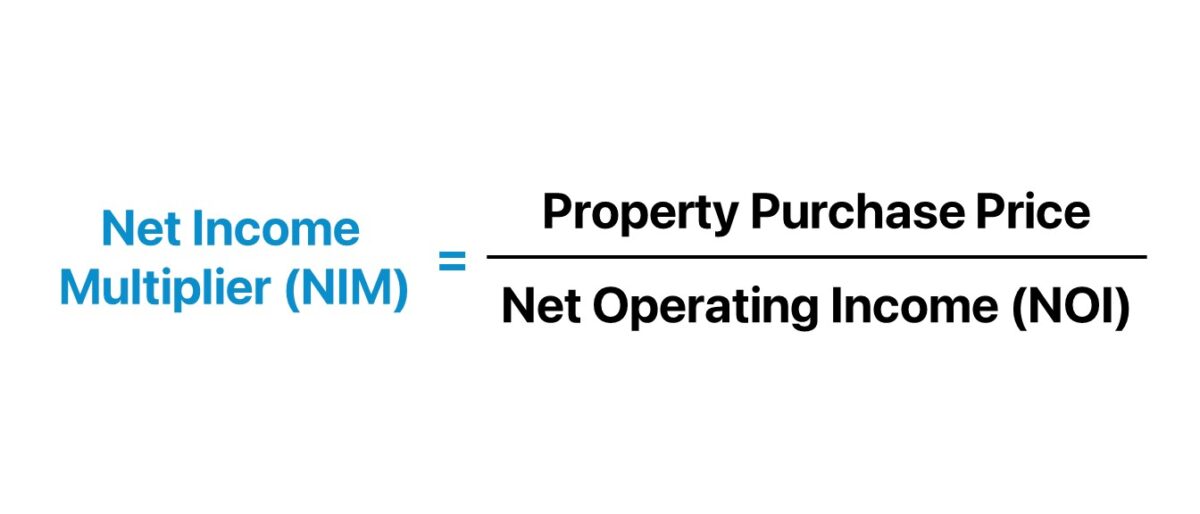
In the real estate industry, the net income multiplier (NIM) is an investing metric calculated as the ratio between the purchase price of a given property and its annual net operating income (NOI).
Similar to the gross rent multiplier (GRM), gross income multiplier (GIM), and the capitalization rate (or “cap rate”), the primary use-case of the net income multiplier (NIM) is for estimating the price of a property using a comps-derived multiplier.
For rental property investments, most of the income stream earned by the real estate investor is comprised of rent payments collected from tenants as part of a leasing arrangement.
Because the net income multiplier uses net operating income (NOI) in the denominator, the NIM method is a more practical approach to perform comps analysis on similar properties on a more “apples-to-apples” basis.
The process of calculating the net income multiplier (NIM) is a three-step process:


The formula to calculate the net income multiplier (NIM) consists of dividing the purchase price of a property by its net operating income (NOI).
Where:
Like the gross rent multiplier (GRM), the valuation of a property can be determined using the net income multiplier (NIM).
Given the net income multiplier (NIM), the value of a real estate property can be estimated as the product of the multiplier and the property’s net operating income.
Level up your real estate investing career. Enrollment is open for the upcoming Wharton Certificate Program cohort.
The distinction between the net income multiplier (NIM) and gross rent multiplier (GRM) is as follows.
The net income multiplier (NIM) measures the number of times higher the purchase price of a property fares versus the property’s net operating income (NOI).
In contrast, the cap rate – or “capitalization rate” – is a fundamental return metric used among real estate practitioners to estimate the potential yield on property investments.
The cap rate describes the relationship between the net operating income (NOI) of a property and its purchase price (or market value) while providing useful insights into the property’s income potential.
Conceptually, the net income multiplier (NIM) is the reciprocal of the cap rate – or, more specifically, the “going-in” cap rate.
Therefore, from the perspective of a real estate investor, a lower net income multiplier (NIM) – the reciprocal of the cap rate – is perceived to be more favorable to investors in terms of selecting a potential investment with an attractive risk-reward profile.
Why? The property’s annual net operating income (NOI) constitutes a higher percentage of the purchase price paid to acquire said property.
Note: The cap rate formula can use the market value of the property in the denominator rather than the purchase price, however, using the purchase price is more appropriate here for illustrative purposes.
We’ll now move to a modeling exercise, which you can access by filling out the form below.

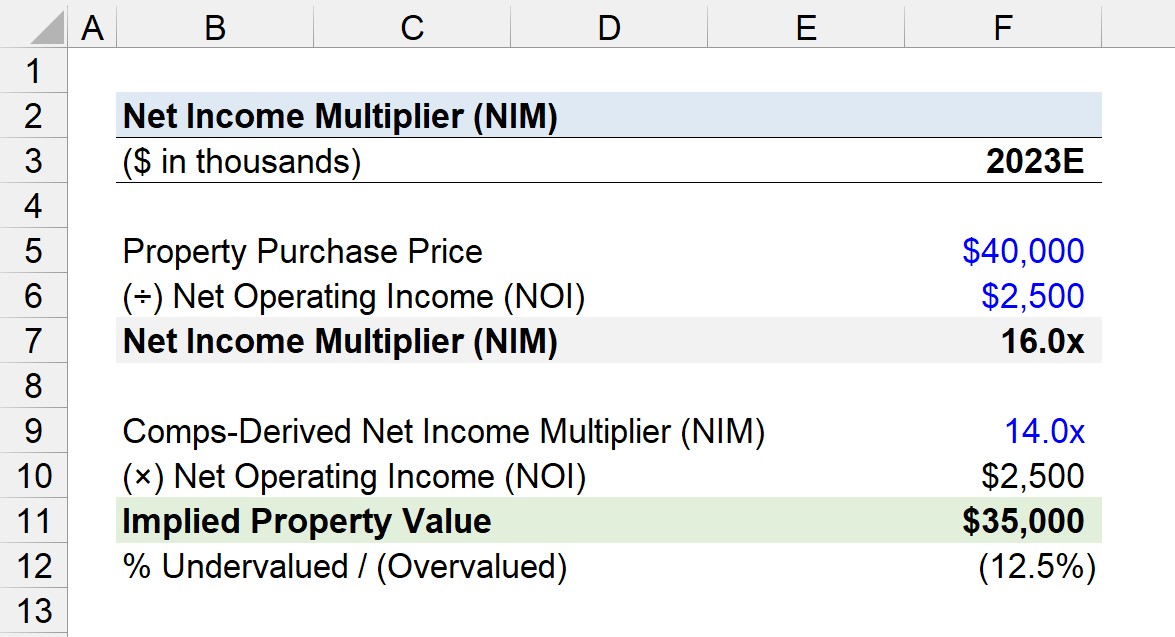
Suppose a commercial property building is currently on sale for $40 million.
In 2023, the building is anticipated to reach stabilization and generate $2.5 million in net operating income (NOI).
The net income multiplier can be determined by dividing the purchase price of the property by its NOI, which comes out to a net income multiplier of 16.0x.
In comparison, we’ll assume the comps-derived net income multiplier (NIM) of comparable properties is 14.0x, which is obtained via performing market research.
Upon applying the 14.0x net income multiplier by the property’s NOI, we arrive at an implied property value of $35 million, which suggests the current sale price is overvalued by approximately $5 million (or by 12.5%).


No comments yet.