What is Cost Approach?
The Cost Approach is a real estate appraisal method that estimates a property’s valuation based on the cost to replace or reconstruct the property, minus accumulated depreciation.

The Cost Approach is a real estate appraisal method that estimates a property’s valuation based on the cost to replace or reconstruct the property, minus accumulated depreciation.
The cost approach is among one of the three main approaches used in practice to appraise the value of real estate properties.
The two other valuation methods frequently used are the income approach and the sales comparison approach. Contrary to the other approaches, the cost approach is far less reliant on the active real estate market (and any data on comparable assets).
Simply put, the cost approach estimates the value of a property based on the total cost expected to be incurred under the hypothetical pretense that the property was destroyed and needed to be reconstructed.
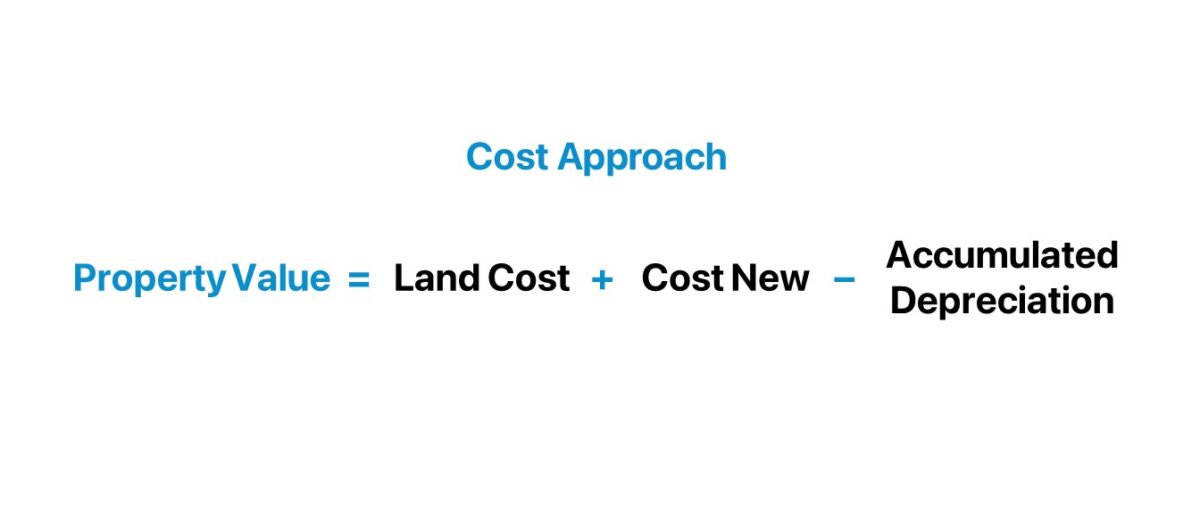
Therefore, the cost approach estimates the value of a property based on the value of the underlying land on which the property was constructed, the replacement (or reproduction) cost, and the accumulated depreciation of the improvements.
Briefly put, the question answered here is, “How much would it cost in total to reconstruct and rebuild the property from the ground up?”
The utility of the cost approach method stands out among the three main appraisal methods for properties when there is no (or very limited) market data on comparable properties. Hence, the cost approach is often the only viable option available in such instances.
The premise of the cost approach, or “replacement cost,” is the principle of substitution, which states that no rational investor should pay more for a property than the cost of constructing an equivalent substitute.
Estimating the property cost in this case is essentially determining the total spending required to rebuild the property from the ground up, which is then compared to the current asking price:


The steps to appraise the value of a property using the cost approach method are as follows.
Level up your real estate investing career. Enrollment is open for the upcoming Wharton Certificate Program cohort.
The formula for the cost approach method to perform a real estate appraisal is as follows.
Where:
To briefly elaborate on the “Cost New” input in the formula, there are two distinct definitions to take note of:
While the relative difference between the replacement and reproduction cost is marginal for modern, recently built properties, the difference in the cost can be material for historical, outdated properties, or unique real estate assets.
Further, there are three forms of depreciation recognized in real estate appraisals:
We’ll now move to a modeling exercise, which you can access by filling out the form below.

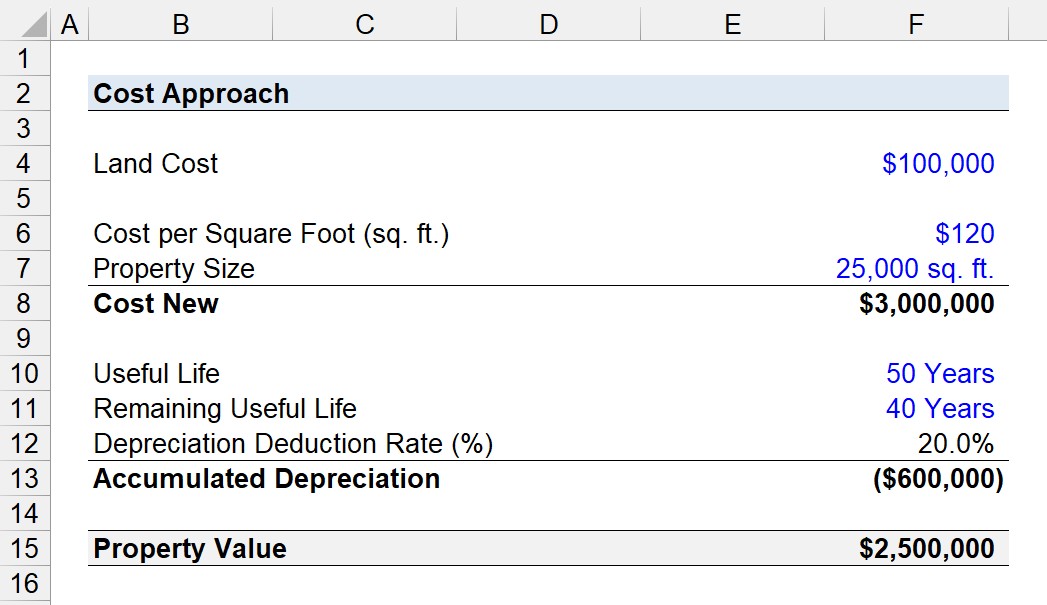
Suppose a real estate appraiser is tasked with estimating the value of a residential property using the cost approach.
Based on the data collected on land sales of comparable size and in a nearby location, the appraiser estimates the land on which the residential property stands to be currently worth around $100k.
Using the comparative unit method, a form of analysis to determine the cost of construction on a square footage basis (and with consideration toward the construction and material type, as well as quality), the appraiser prices the cost at $120 per sq. ft.
If we assume the building is $25k sq. ft. in total, the cost new is $3 million.
The economic useful life of the improvements is estimated to be 50 years with 40 years remaining.
The age-life method of depreciation, assuming straight-line depreciation and a salvage value of zero, implies that the improvements must be depreciated by 20.0%.
After applying the depreciation deduction of 20.0% to the cost new of $3 million, the accumulated depreciation amounts to $600k.
In closing, the final step is to add the land cost to the depreciation-adjusted cost new to arrive at $2.5 million for the value of the residential property per the cost approach.


No comments yet.