Yield on Cost (YoC)
Step-by-Step Guide to Understanding Yield on Cost (YoC)
How to Calculate Yield on Cost (YoC)
The yield on cost (YoC), often used interchangeably with the term “development yield,” is a real estate investing metric used to determine if the potential return is worth the cost of developing a property.
The yield on cost is frequently used as a benchmark by real estate investors to weigh the potential returns against the expected cost of a project, most frequently regarding property development investments.
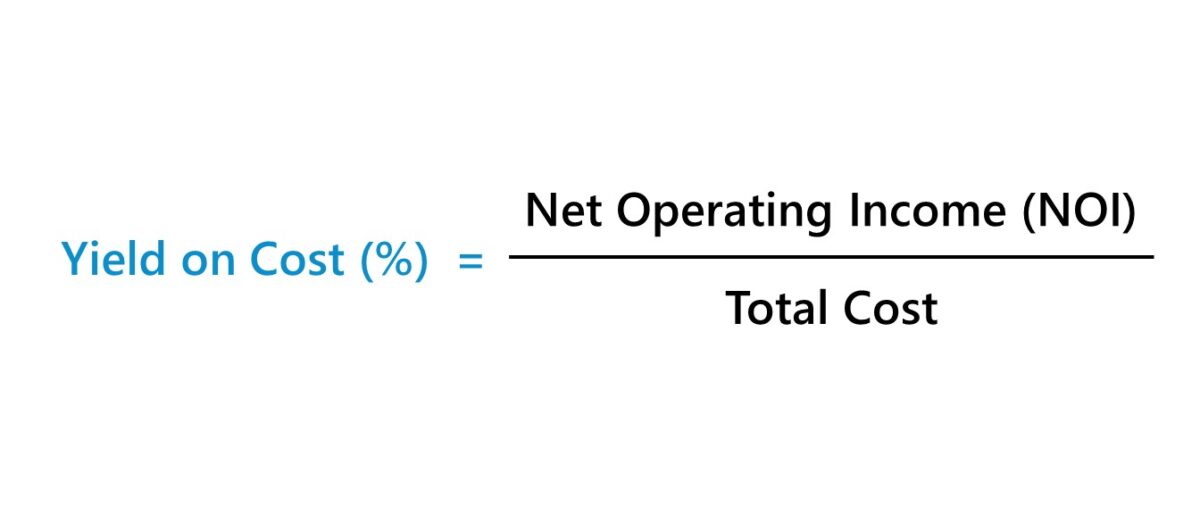
Since the yield on cost is the ratio between the potential reward to the risk, the metric is a practical method to confirm the expected return on investment exceeds the total cost incurred.
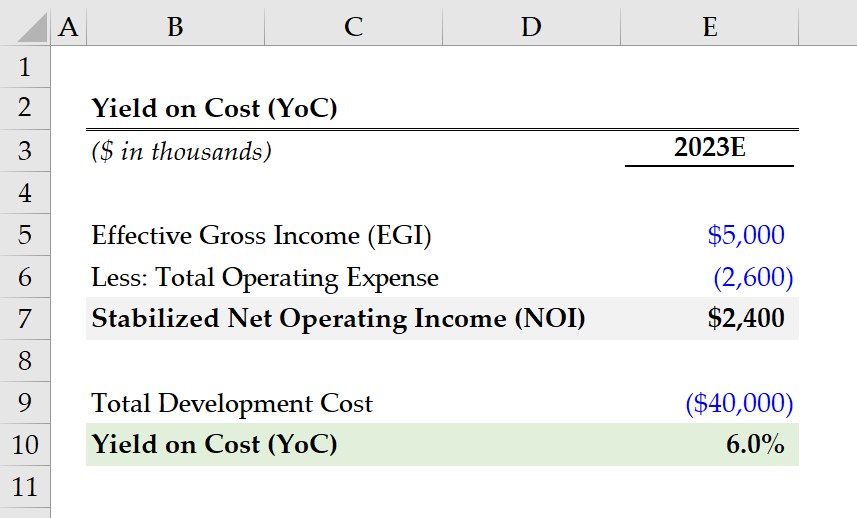
The pro forma annual return is the stabilized net operating income (NOI). In real estate finance, the NOI metric is by far one of the important measures to analyze the potential profitability of a property investment.
The NOI of a rental property can be determined by calculating the sum of the property’s total income (e.g. rental and ancillary income) minus operating expenses.
Net Operating Income (NOI) = (Rental Income + Ancillary Income) – Direct Operating Expenses
Specific to the context of computing the yield on cost of a property investment, note that the NOI is expressed on a pro forma basis.
Yield on Cost vs. Cap Rate: What is the Difference?
The capitalization rate (or “cap rate”) and yield on cost (YoC) are two of the more common metrics used by real estate investors to analyze property investments.
- Cap Rate → The cap rate is the ratio between the net operating income (NOI) and the fair market value (FMV) of a property.
- Yield on Cost (YoC) → In contrast, the yield on cost is the ratio between the net operating income (NOI) and the total development cost, rather than the market value of the property.
Given the distinction in the denominator – i.e. fair market value (FMV) vs. total development cost – the yield on cost can be interpreted as the forward-looking cap rate.
The cap rate and yield on cost are each pro forma metrics, but the latter carries more uncertainty (and thus risk), since the NOI must be stabilized, and the development work, such as construction, has not yet started in most cases.
Hence, another practical method to analyze a potential real estate investment is the development spread, which is the difference between the yield on cost (“going-in” cap rate) and market cap rate (“going-out” cap rate).






Love this breakdown! Phenomenal!
Thanks, and glad to hear it!
BB