What is Gross Income Multiplier?
The Gross Income Multiplier (GIM) is a real estate metric that compares the sale price of a property to its annual income.

The Gross Income Multiplier (GIM) is a real estate metric that compares the sale price of a property to its annual income.
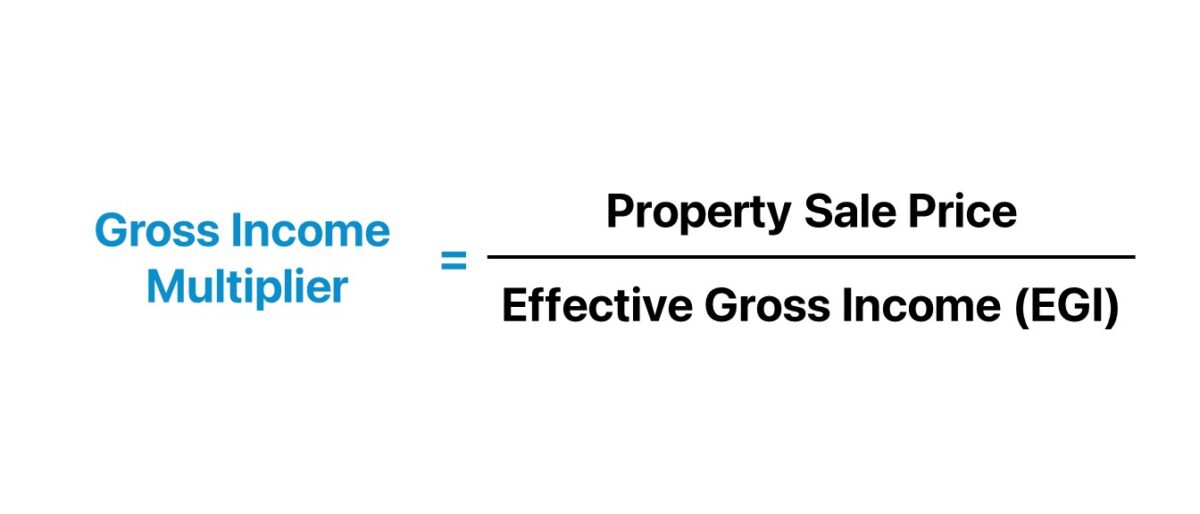
The gross income multiplier (GIM) is a real estate valuation metric used to estimate the value of property investments.
Formulaically, the gross income multiplier is the ratio between the sale price of a property and its gross annual income.
In practice, the primary use-case of the gross income multiplier (GIM) is to arrive at an approximate market value for rental properties, in which the gross income component stems predominately from rent payments.
For rental properties, the investor recoups the initial project cost and earns a return from the income stream of rent payments collected from tenants.
The multiplier is used as a method to compare similar properties side-by-side, i.e. closer to an “apples-to-apples” comparison”.
The gross income multiplier calculation is a three-step process:
Note: The gross income metric must be annualized and presented on a stabilized basis.


The formula to calculate the gross income multiplier (GIM) metric divides the sale price of a property by its effective gross income (EGI).
Where:
The effective gross income (EGI) formula is the potential gross income (PGI), net of the credit and collection losses expected to be incurred by the property.
While the potential gross income (PGI) can be used as the income metric, the effective gross income (EGI) is perceived to be a more accurate measure of a property’s income potential.
Note: The gross income multiplier (GIM) in which the effective gross income (EGI) metric is used, rather than the potential gross income (PGI), is often referred to as the “Effective Gross Income Multiplier (EGIM)”.
Level up your real estate investing career. Enrollment is open for the upcoming Wharton Certificate Program cohort.
The terms “Gross Rent Multiplier” (GRM) and “Gross Income Multiplier” (GIM) are often used interchangeably, yet there is a minor distinction.
Note: Many practitioners refer to the two metrics interchangeably, so it is necessary to confirm the formula.
We’ll now move on to a modeling exercise, which you can access by filling out the form below.

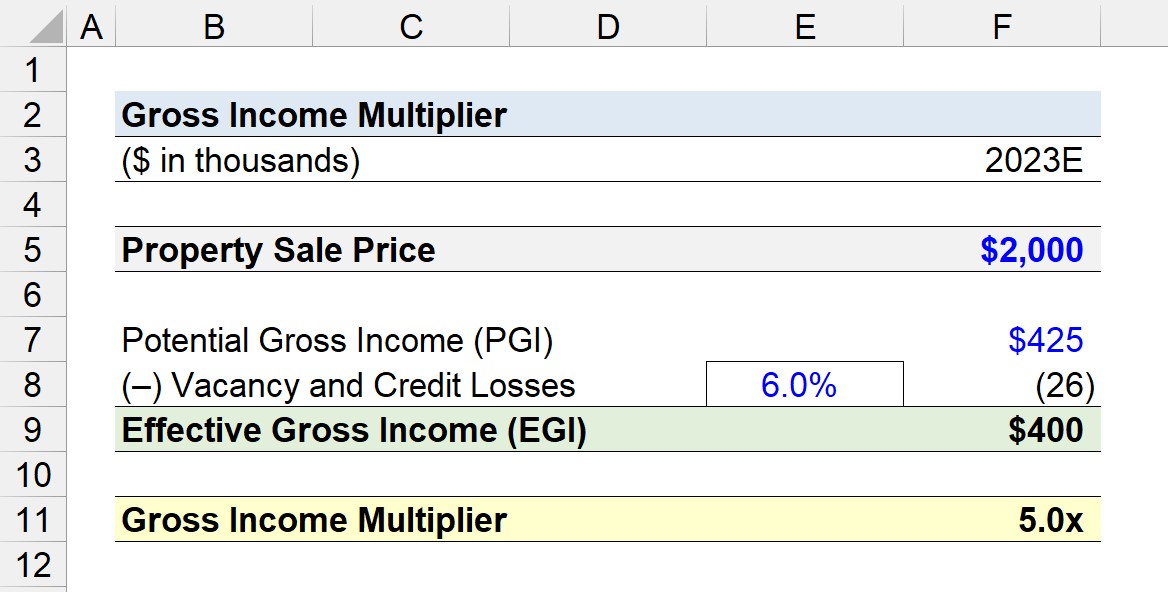
Suppose a commercial real estate (CRE) investor is considering the purchase of a commercial property currently listed for sale at $2 million.
Based on historical performance and market analysis, the commercial property is expected to generate $425k in effective gross income (EGI) in 2023 – which represents the first year in which the property is stabilized.
The $425k in effective gross income (EGI) was derived from the pro forma assumption that the vacancy and credit losses would be around 6.0% of the property's potential gross income (PGI).
The effective gross income (EGI) of the commercial property is $400k, which we'll insert into our formula to arrive at a gross income multiplier of 5.0x.
Given the gross income multiplier of 5.0x, the commercial property must continue to generate the current run rate of effective gross income ($400k) for approximately 5 years to recoup the original project cost, ignoring the operating expenses incurred while managing the property.


No comments yet.