What is Potential Gross Income?
Potential Gross Income (PGI) represents the hypothetical total earnings that could be realized on a real estate rental property, assuming a full occupancy rate and on-time rent collection.

Potential Gross Income (PGI) represents the hypothetical total earnings that could be realized on a real estate rental property, assuming a full occupancy rate and on-time rent collection.
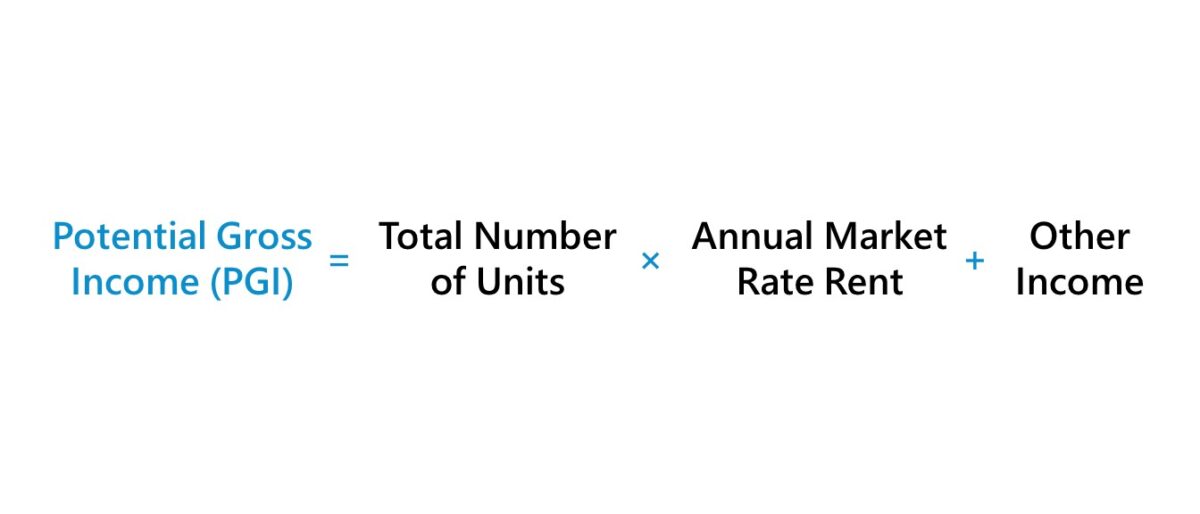
The potential gross income (PGI), or “gross potential income”, is a real estate investing metric that estimates the maximum income that could be derived from a rental property.
The potential gross income is a pro-forma metric with two implicit assumptions, which are an occupancy rate of 100% and on-time rent collection.
The potential gross income is the hypothetical total income that can be received by the property owner if all units are fully occupied at the current market rate, and if there are no issues collecting rent payments from tenants.
Therefore, the potential gross income (PGI) matters to real estate investors because it represents the total earnings potential of a rental property investment.
The other sources of income – aside from rental income – must also be included in the calculation, such as the fees charged to tenants for use of on-premise amenities, laundry or dry cleaning services, parking permits, storage units, and pet fees.


Under the specific pretense of underwriting in real estate, the income of a property is separated into two categories:
The potential gross income (PGI) is the starting point to calculate the effective gross income (EGI), the estimated income that a property can generate after factoring in the costs incurred related to vacancy and credit losses.
Since effective gross income (EGI) deducts the costs attributable to vacancy and credit losses, the EGI will be the lesser of the two.
The formula to calculate the potential gross income is as follows.
Where:
Of course, a full occupancy rate and no collection losses is an unrealistic set of assumptions; hence the potential gross income is then adjusted to determine the effective gross income.
Level up your real estate investing career. Enrollment is open for the upcoming Wharton Certificate Program cohort.
We’ll now move on to a modeling exercise, which you can access by filling out the form below.

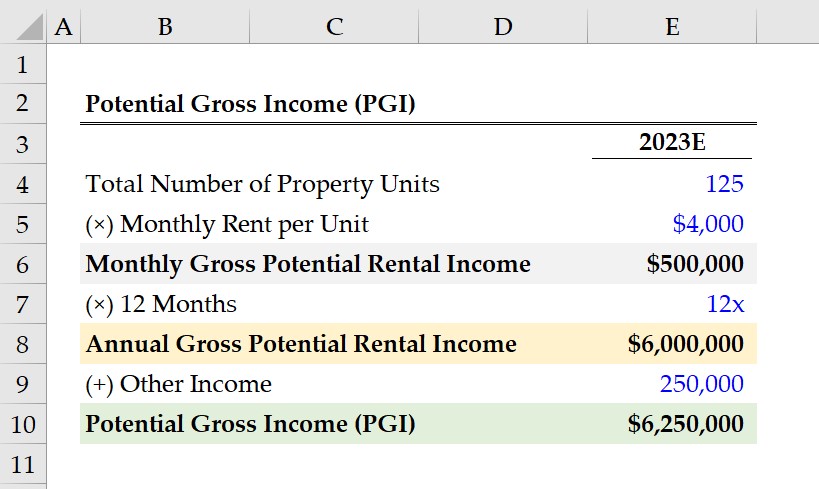
Suppose a real estate property owner is estimating the potential gross income (PGI) of a rental property investment in 2023.
There are 125 units available for rent in the residential building, while the monthly rent per unit at the current market rate is $4k each month.
The product of the property’s total number of units and market-rate rent is the gross potential rental income that the property can generate on a monthly basis, which comes out to $500k.
Our next step is to convert the monthly gross potential rental income of $500k into an annualized figure, which we’ll determine by multiplying by 12 to arrive at $6 million as the annual gross potential rental income.
Because of the full occupancy rate and on-time rent collection assumptions, there is no need for any adjustments pertaining to vacancy and credit losses.
In the final step, we must add any other sources of income to our gross potential rental income, which we’ll assume is $250,000 for the entire year.
Said differently, around $167 is extracted from the property's tenants per month on top of rent.
In conclusion, the sum of the annual gross rental income and other income amounts to $6.25 million, which represents the rental property’s potential gross income (PGI) in 2023.


No comments yet.