What is Tenant Improvement?
A Tenant Improvement (TI) is a structural modification made to a property to better meet the custom preferences of a particular tenant.

A Tenant Improvement (TI) is a structural modification made to a property to better meet the custom preferences of a particular tenant.
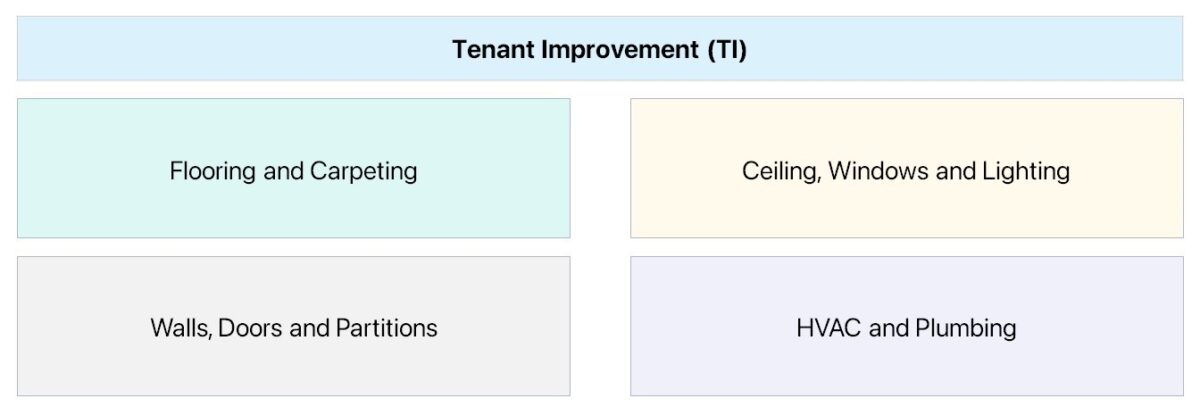
Tenant improvements (TI) describe the changes made to a property by the landlord as part of a lease agreement.
Tenant improvements, otherwise referred to as “leasehold improvements” or “build-outs” are most common in the commercial real estate market (CRE), where long-dated leases are the norm.
Why? Customization is often necessary in commercial real estate (CRE) since the property must meet specific business requirements of the tenant.
The improvements to the property, which can come in the form of repairs, renovations, and more, are intended to configure a property to better suit the custom needs of a specific tenant.
If a high-quality tenant is unlikely to default, then the rent payments are perceived as a reliable source of long-term income with minimal downside risk.
The incremental costs incurred by the property owner that pertain to the improvements are an investment that are expected to pay off over time, while improving the likelihood of tenant retention, i.e. reducing the risk of tenant turnover.


The criteria to qualify as a tenant improvement (TI) are as follows.
The most common examples of tenant improvements include improving and/or changing the following:
However, certain miscellaneous costs that do not meet the criterion include the following expenses:
Level up your real estate investing career. Enrollment is open for the upcoming Wharton Certificate Program cohort.
The difference between tenant improvements (TI) and building improvements is as follows.
For tenants of commercial properties, the decision to commit to a multi-year lease agreement is based on factors specific to their unique needs.
The core determinant of the requirements specific to each tenant boils down to the factors that ensure their operations can be run efficiently, without any constraints.
From the perspective of a property owner, securing commercial tenants requires understanding those specific needs – often retrieved via discussions – and negotiating an amicable solution in which both parties are satisfied.
In short, the property owner must be open to accommodating the requests of the tenants, or else the tenant is likely to sign a lease elsewhere.
But while the property customizations are technically meant to serve the best interests of a specific tenant, certain changes can still be beneficial across the long run, i.e. the improvements have a positive impact on the quality (and value) of the rental property or unit, despite being customized for a particular tenant.
Of course, structural changes to a property are permanent, so there must be a balance wherein the property still can be rented by other tenants at a later date. If the requested changes cause the market of potential tenants to drop off far too substantially, approval of the tenant improvements can be a costly error.
In commercial leases, the property owner (or landlord) is the party that pays for tenant improvements (TI) in most cases.
The formal terms are stated in the agreed-upon leasing agreement, where the negotiated tenant improvement allowance is outlined.
Simply put, tenant improvement allowances are an agreed-upon figure that the landlord agrees to pay the tenant, either directly or indirectly, for the property improvements.
For instance, the contract specifies whether the lessor or lessee will pay for the tenant improvements, including language around what will occur if the total cost of the property improvement exceeds the stated allowance.
In most cases, the tenant improvement allowance (TI) is expressed as either a fixed total dollar sum or on a per-square-foot (PSF) basis.


No comments yet.