What is the Average Daily Rate?
The Average Daily Rate (ADR) measures the average revenue generated per occupied room or rental unit, expressed on a per-day basis.

The Average Daily Rate (ADR) measures the average revenue generated per occupied room or rental unit, expressed on a per-day basis.
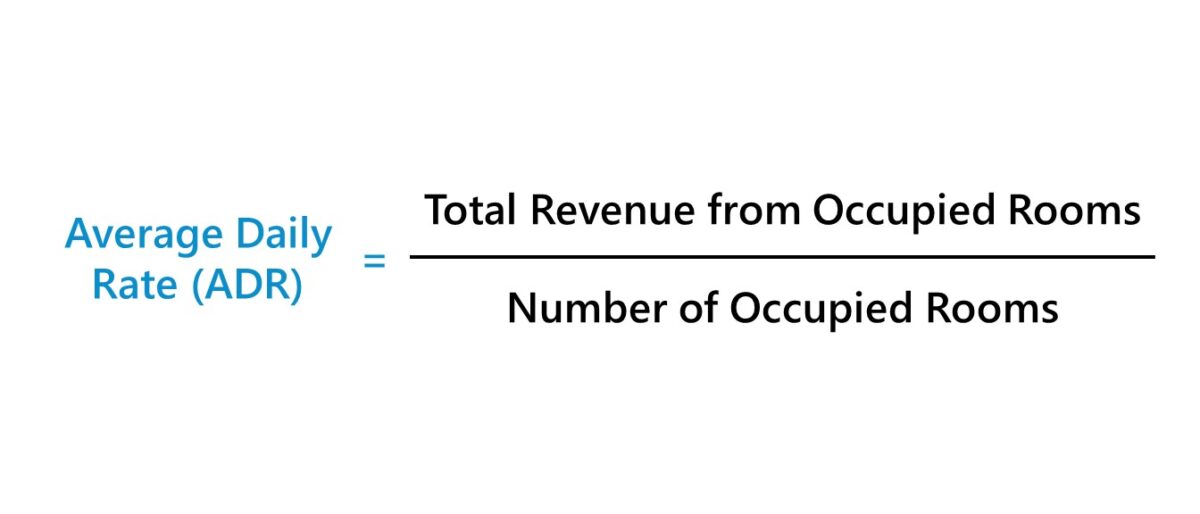
The average daily rate, or “ADR”, is a common metric in the hospitality sector and real estate market that measures the revenue production and profitability of short-term rental properties.
Frequently, the average daily rate (ADR) metric is tracked by property owners to closely monitor the performance of short-term rental properties.
The ADR metric is also a method to develop a more informed understanding of the seasonal trends and fluctuations in market demand that can affect their future revenue (i.e. “top line”).
The total revenue generated per day – which the average daily rate is an informative measure for – ultimately sets the limit on the property’s capacity for realizable profits.
In practice, the importance of the average daily rate (ADR) is tied to its role in guiding pricing strategy. The ADR is a practical metric for property owners to determine the effectiveness of their current pricing strategy (and if adjustments are necessary).
If the current revenue strategy seems to not be working – i.e. sales are trending downward – the property owner can make strategic decisions, such as offering more promotions or increasing prices to increase the revenue run rate going forward (and ensure internal profitability targets are met).


By comparing the current average daily rate (ADR) to the rates from historical periods (or between different comparable properties), the property owner can obtain a better sense of the relative performance of their properties.
If the average daily rate (ADR) is rising, the property is implied to generate more revenue, resulting in greater profit potential (and vice versa for a falling average daily rate).
However, there are limitations to using the average daily rate (ADR) metric, as the calculation neglects two factors:
Specific to the hospitality sector, the average daily rate (ADR) must be utilized in conjunction with other key performance indicators (KPIs), such as the occupancy rate and RevPAR (revenue per available room).
The usage of various hospitality KPIs, rather than relying on one metric by itself, contributes towards a more comprehensive understanding of a property’s long-term performance and more accurate forecast models.
In the hospitality sector, the average daily rate (ADR) can be determined by dividing the rental income on a particular date by the number of occupied rooms on a property.
For example, if a hotel brought in $50,000 in revenue on a specific date and 200 rooms were occupied, the ADR is $250.
The formula to calculate the average daily rate (ADR) in the real estate market is conceptually the same, aside from minor differences in terminology.
For example, if an Airbnb property owner brought in $5,000 in revenue on a specific date on ten rental properties, the ADR is $1,000.
Level up your real estate investing career. Enrollment is open for the upcoming Wharton Certificate Program cohort.
We’ll now move on to a modeling exercise, which you can access by filling out the form below.

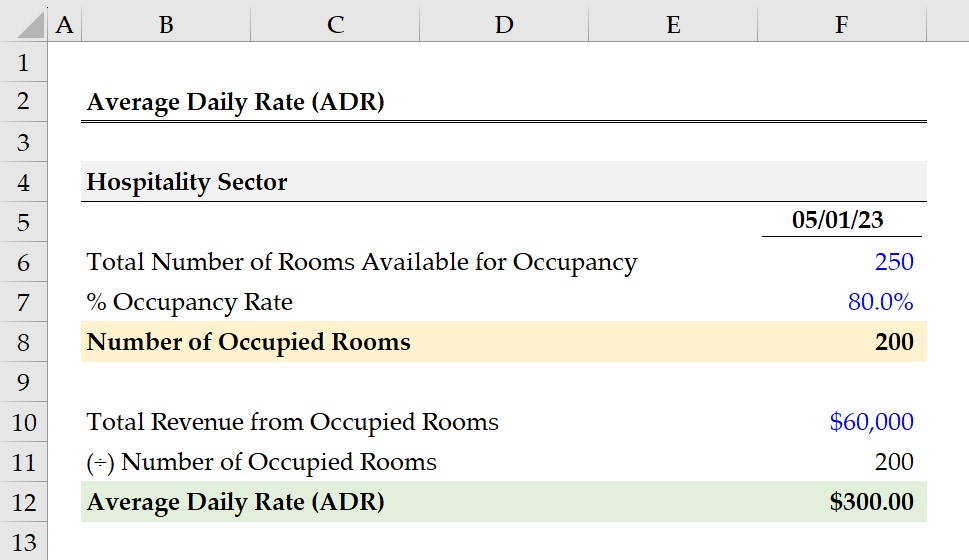
Suppose a hotel has a total of 250 rooms available for occupancy on May 1, 2023. On that particular date, the occupancy rate is expected to be 80.0% based on the number of confirmed bookings, inquiries to express interest, and the hotel's historical data.
The product of the total number of rooms available for occupancy and the occupancy rate is the number of occupied rooms, which comes out to 200 rooms.
Based on the pricing data per customer, the total revenue from the occupied rooms is estimated to be $60,000.
By dividing the total revenue from occupied rooms by the number of occupied rooms, we arrive at an average daily rate (ADR) of $300.
In our next exercise, we'll calculate the average daily rate (ADR) for a short-term real estate rental building.
The property owner rents out the building's units on a monthly basis to companies in need of a workspace, similar to the WeWork business model.
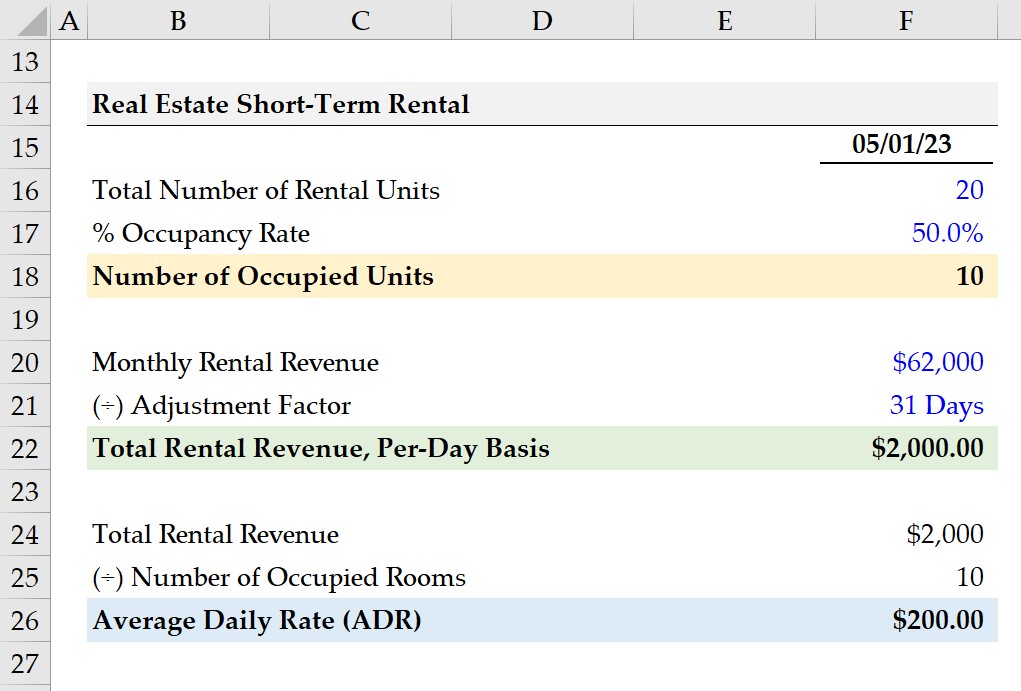
There are a total of 20 rental units in the building, and as of May 1, 2023, the confirmed occupancy rate is 50%.
By multiplying the total number of rental units by the occupancy rate, the number of occupied units for the month of May is 10, i.e. half of the rental units in the building are vacant.
The monthly rental revenue, inclusive of all tenants, is approximated to be $62,000. Since the average daily rate – as implied by the name – is on a per-day basis, our next step is to adjust the revenue amount by dividing it by the number of days in the month (31).
Therefore, on an individual tenant level, the total rental revenue per day amounts to $2,000.
In conclusion, the average daily rate (ADR) on the short-term rental property is $200.00, which we determined by dividing the total rental revenue per day by the number of occupied units.


No comments yet.