What is RevPAR?
RevPAR, or “revenue per available room”, measures the revenue each room available for occupancy in a hotel generates over a specified period of time.

RevPAR, or “revenue per available room”, measures the revenue each room available for occupancy in a hotel generates over a specified period of time.
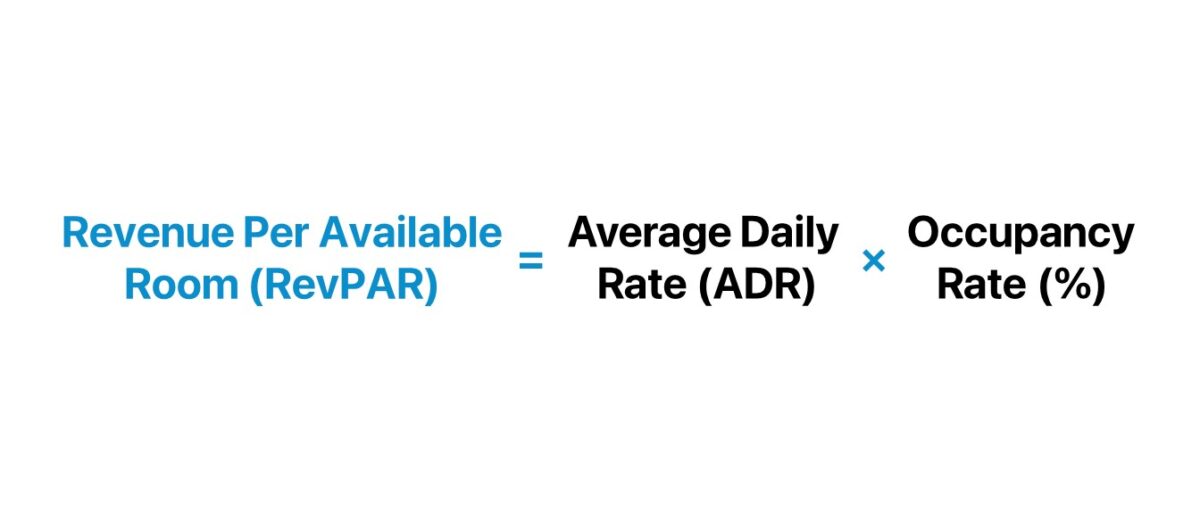
RevPAR stands for “Revenue Per Available Room” and is a common key performance indicator (KPI) closely tracked in the hospitality sector, particularly by hotels that offer lodging, accommodations and other services for travelers and tourists.
The revenue per available room (RevPar) metric can be calculated by dividing a hotel’s total room revenue by the product of the count of available rooms and the number of days being analyzed.
In practice, RevPar is among the most informative measures for hotel property owners because the metric provides insights on the effectiveness of the current revenue strategy with regard to setting pricing appropriately to optimize occupancy rates while maximizing revenue production.
In general, higher pricing tends to coincide with lower occupancy rates (and vice versa), i.e. the price elasticity of demand affects consumers behavior.
Therefore, a hotel with a higher RevPar is likely to benefit from either high occupancy rates or pricing power. But in rare instances, the hotel could reap benefits from high occupancy rates from favorable demand in the market, as well as high pricing rates.
The utility of tracking the RevPar metric – aside from monitoring the performance of current pricing strategies – also stems from understanding the market conditions (and future trends), including how to adjust pricing and implement other strategies to ensure internal revenue targets are met.


The formula to calculate revenue per available room (RevPAR) is the ratio between the total room revenue and the total number of available rooms.
For example, suppose a hotel had a total of 125 available rooms and brought in a total of $10,000 in room revenue the night prior. The revenue per available room (RevPar) is $80.
The RevPar metric can also be calculated by multiplying the average daily rate (ADR) by the occupancy rate.
Understanding what constitutes a “good” RevPAR for a given hotel property is contingent on various factors, including the hotel type (i.e. luxury, boutique, budget), the location (i.e. urban, suburban, rural), the current market conditions, seasonal patterns in travel and more.
While there is no set benchmark that hotels target, a higher RevPar relative to comparable hotel properties or versus historical periods is generally perceived positively.
To reiterate, the surrounding context truly matters here, and comparisons are only useful if the hotels being compared are similar (i.e. must be "apples to apples").
For instance, a high-end luxury hotel located in NYC would obviously have a much higher revenue per available room (RevPar) compared to a low-cost budget motel in a rural area.
Even if the average occupancy rates of the luxury hotel were much lower in comparison, substantially higher pricing can result in a higher RevPar, i.e., the luxury hotel owner can rely less on full occupancy rates to meet their revenue targets because of their above-market, “premium” rates.
RevPAR cannot be relied upon as a standalone metric since only the room revenue is taken into account, i.e. other revenue sources such as food and beverage services, spa services and other income sources are neglected.
We’ll now move on to a modeling exercise, which you can access by filling out the form below.

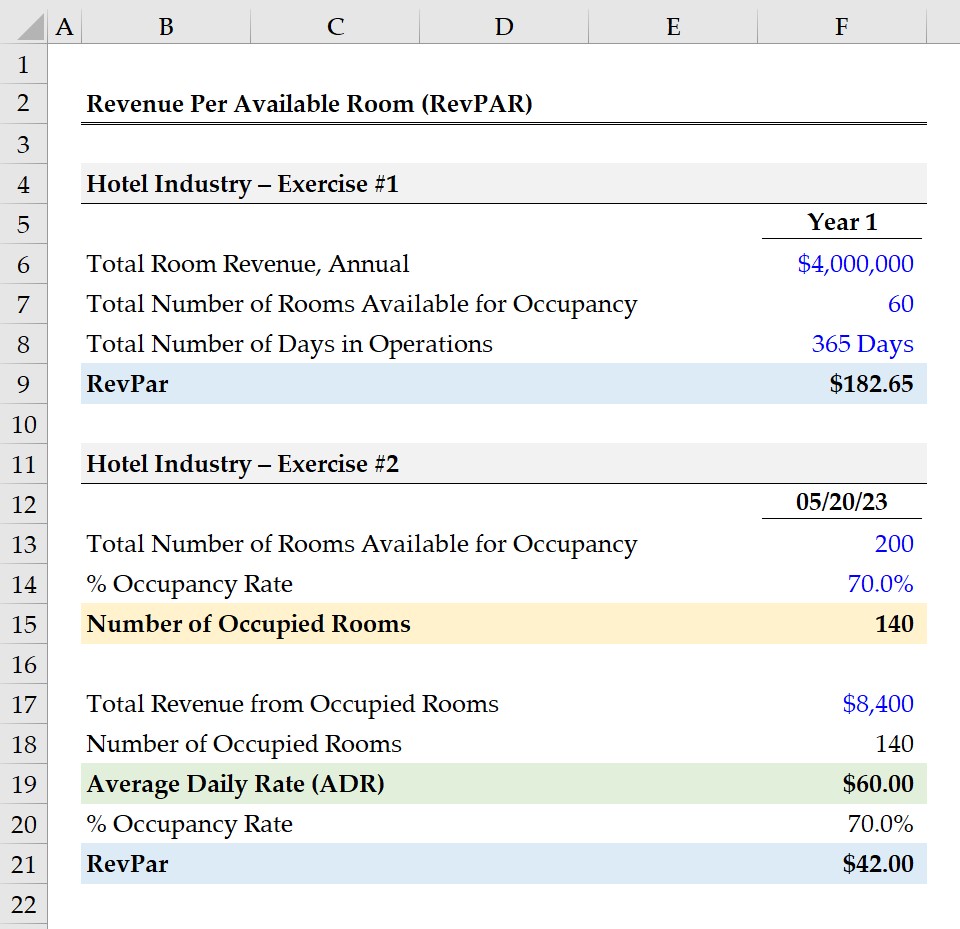
Suppose you’re tasked with calculating the revenue per available room (RevPar) of a hotel that generated a total of $4 million in revenue in the past year.
The total number of rooms available for occupancy is 60 rooms, while the total number of days that the hotel was operating out of the year was 365 days.
Given those assumptions, we can determine the RevPar of the hotel by dividing the total room revenue by the product of the number of rooms available for occupancy and the number of days in operations.
Upon entering our hotel assumptions into the revenue per available room (RevPar) formula, we arrive at a RevPar of $182.65 for our first exercise.
In the next section of our modeling exercise, we’ll calculate the revenue per available room (RevPar) of a hotel on a single date (05/20/2023) using the alternative method.
The hotel has a total of 200 rooms available for occupancy, with a 70% average occupancy rate, implying the number of occupied rooms was 140 rooms on this particular date.
The total revenue generated from the occupied rooms was $8,400 for the night, which we can divide by the number of occupied rooms to determine the average daily rate (ADR).
In conclusion, the implied RevPar under our second scenario is $42.00, which we determined by multiplying the average daily rate (ADR) by the occupancy rate.
Level up your real estate investing career. Enrollment is open for the upcoming Wharton Certificate Program cohort.


No comments yet.