What is Net Absorption?
Net Absorption measures the supply and demand in the commercial real estate market by tracking the change in tenant demand relative to the supply available in the market.

Net Absorption measures the supply and demand in the commercial real estate market by tracking the change in tenant demand relative to the supply available in the market.
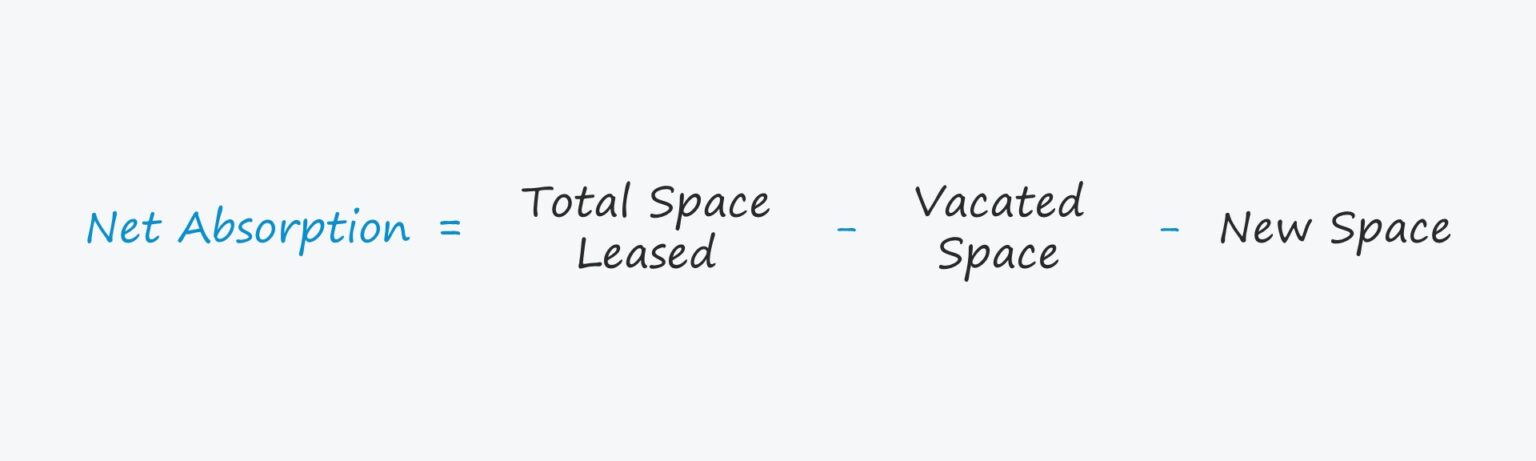
The net absorption metric, in real estate investing, is used to approximate the net change in tenant demand relative to supply.
The net absorption rate is the difference between three metrics tracked over a specified time frame, which are the following components:
The metric is determined by deducting the vacated square footage from the occupied square footage.
In particular, the metric is important to track in the commercial real estate (CRE) market to understand the current state of supply and demand, among other external factors that influence pricing levels.
Calculating net absorption is a three-step process:


The formula for calculating net absorption is as follows.
From the total leased space, the sum of square feet that became physically vacant and new space (i.e. new construction) are subtracted.
The figures in the formula are typically denoted in units of square feet (sq. ft).
The concept of absorption in real estate is a method used to gauge tenant demand in the current market. Most often, absorption is measured in units of square footage (sq. ft).
The two primary absorption metrics are calculated on a gross and net basis:
While the former represents the total amount of leased space, the latter captures the net change in demand relative to the supply in the market.
In the real estate market, tracking the net absorption provides useful insights regarding the current state of the market, especially to understand the market demand at present.
Level up your real estate investing career. Enrollment is open for the upcoming Wharton Certificate Program cohort.


No comments yet.