What is Gross Operating Income?
Gross Operating Income (GOI) in real estate is the total income generated by a property after deducting vacancy and credit losses.

Gross Operating Income (GOI) in real estate is the total income generated by a property after deducting vacancy and credit losses.
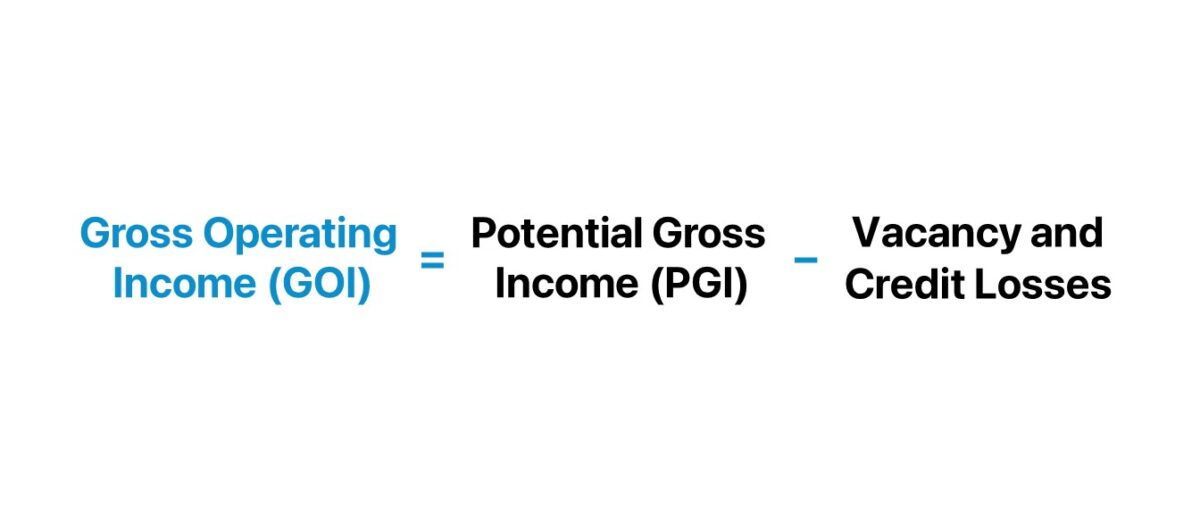
In real estate, the gross operating income (GOI) metric measures the income potential of a rental property net of losses related to vacancies and credit (collection) issues.
The gross operating income (GOI) is the total income expected to be collected per year.
The gross operating income (GOI) can be calculated using the following three-step process.
Thus, the gross operating income (GOI) is the potential gross income (PGI) of a rental property minus any vacancy and credit losses.
The gross operating income (GOI) is adjusted for vacancy and credit (collection) losses. However, the metric does reflect the profit potential of the property.
Why? The operating expenses incurred by the property owner or the real estate investor have not yet been deducted.
Therefore, the gross operating income (GOI) offers insights into the property’s cash flow profile and if enough is brought in to cover its operating expenses.


The gross operating income (GOI) and net operating income (NOI) are two closely related real estate metrics used to analyze potential or existing property investments.
The operating expenses incurred while running the property costs include the following:
However, the net operating income (NOI) metric does NOT deduct any financing costs (e.g. mortgage payments) or depreciation.
The relationship between gross operating income (GOI) and net operating income (NOI) boils down to the property’s operating expenses.
Unlike GOI, the NOI metric deducts operating expenses to provide a clearer picture of the true profitability of the property.
The following formula illustrates how net operating income (NOI) and gross operating income (GOI) are connected.
Understanding the gross operating income (GOI) metric is thereby important because GOI is a necessary input in the formula to compute net operating income (NOI).
Note: If analyzing net operating income (NOI) at the property level, only direct operating expenses are deducted.
The formula to calculate the gross operating income (GOI) is as follows:
Where:
The potential gross income (PGI) of a property will be composed of predominately rental income, i.e. the periodic rent payments received from tenants as part of a contractual rental agreement.
However, a property can generate income from other sources, as well, which must also be included in the calculation.
For instance, the most common sources of other income are payments for using premise amenities (e.g. gym), non-refundable tenant application fees, late fees on rent, pet fees, and various types of on-premise services (e.g. vending machines, laundry, parking permits, storage units).
Level up your real estate investing career. Enrollment is open for the upcoming Wharton Certificate Program cohort.
We’ll now move on to a modeling exercise, which you can access by filling out the form below.

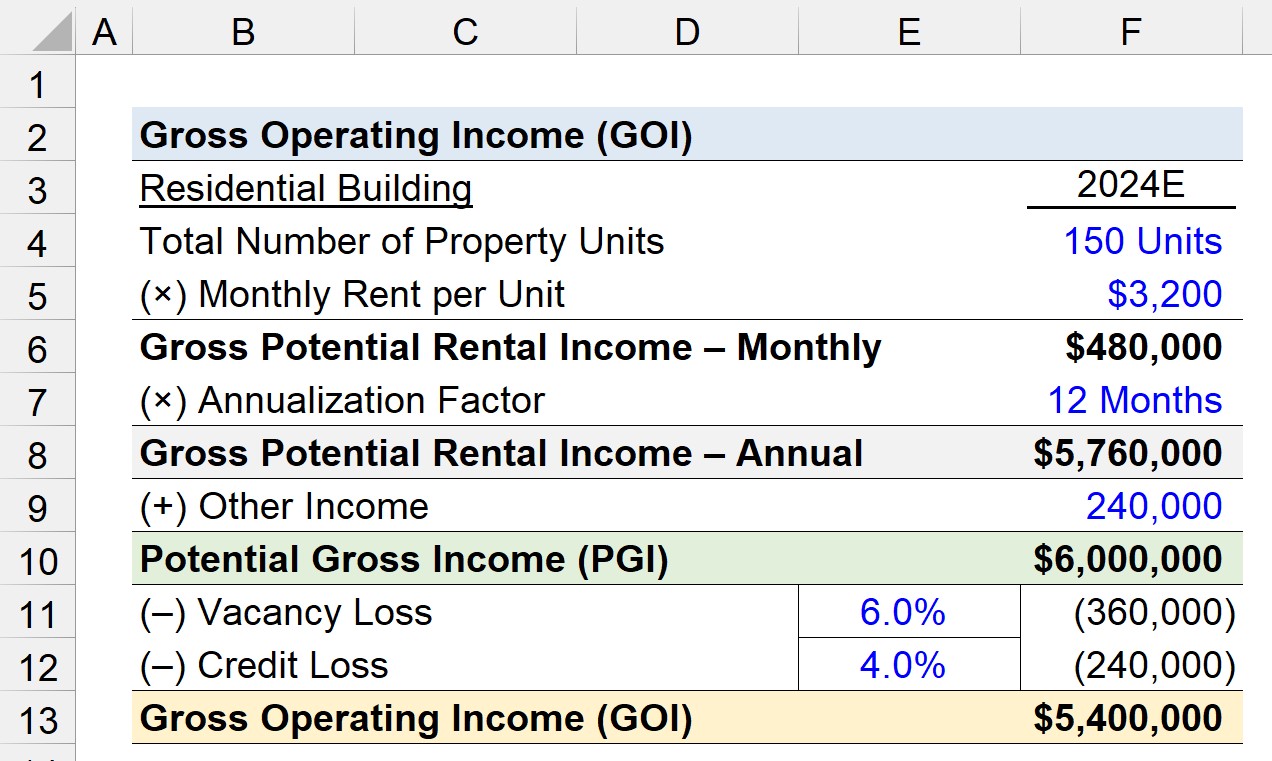
Suppose a real estate investor is calculating the gross operating income (GOI) of an existing property investment.
The property investment is a residential building with a total of 150 units, with the market rate rent estimated to be around $3,200 per unit.
The gross potential rental income per month is the product of the number of property units and monthly rent, which amounts to $480,000.
Since the gross operating income (GOI) is computed on an annual basis, we must annualize the prior figure by multiplying by 12.
Once converted, the annual gross potential rental income is $5.76 million.
From there, we must add any other sources of income, which we'll assume to be $240,000.
The sum of the rental income and other income – $6 million – represents the potential gross income (PGI) of the residential building.
In the final part of our exercise, we must adjust the building's potential gross income (PGI) by the vacancy loss and credit loss using the following set of assumptions.
The vacancy loss is projected to be $360k, while the credit loss is expected to be around $240k.
In conclusion, we can deduct the vacancy and credit losses from the property's potential gross income (PGI) to arrive at a gross operating income (GOI) of $5.4 million.


Can the terms EGI and GOI be used interchangeably?