What is Effective Gross Income?
The Effective Gross Income (EGI) is defined as the total potential revenue generated by a real estate rental property investment, net of any vacancy and credit losses.

The Effective Gross Income (EGI) is defined as the total potential revenue generated by a real estate rental property investment, net of any vacancy and credit losses.
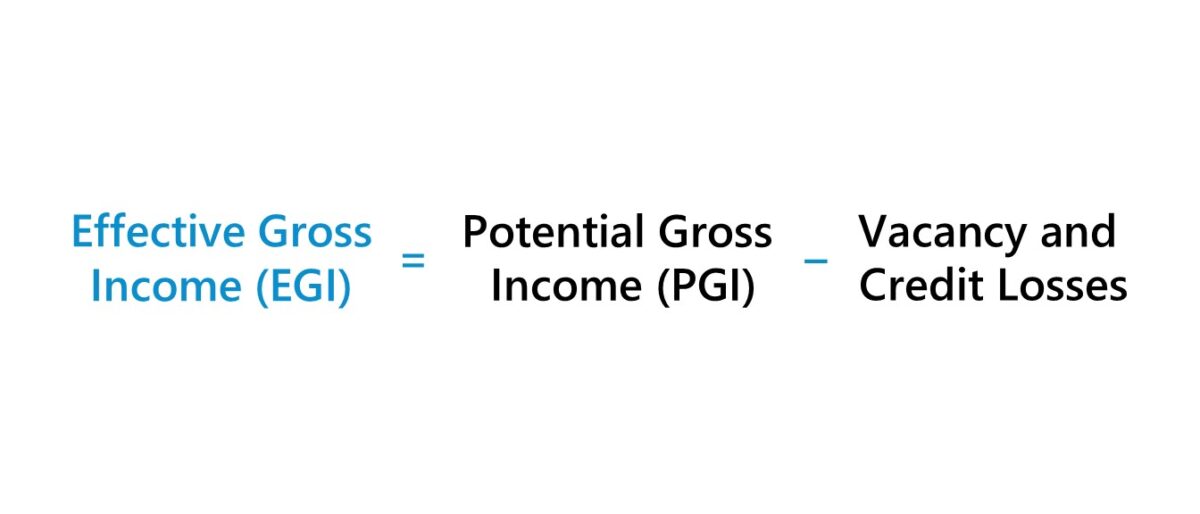
The effective gross income (EGI) is the sum of a real estate property's total potential income less any adjustments that pertain to vacancy and credit (collection) losses.
The effective gross income (EGI) metric – often used interchangeably with the term "effective gross revenue" (or EGR) – measures the approximate income that a property owner can earn on a rental property investment.
The EGI of a real estate property investment offers practical insights into whether enough positive cash flows can be brought in to cover its total operating expenses and be profitable.
The composition of the property's total potential income is, for the most part, rental income.
Once the gross potential income is determined, the next step is to deduct any incurred costs, such as vacancy costs and credit costs.


The formula to calculate the effective gross income (EGI) is as follows:
Where:
Level up your real estate investing career. Enrollment is open for the upcoming Wharton Certificate Program cohort.
Understanding the effective gross income (EGI) is necessary to estimate a real estate property's revenue-generating potential, namely because the EGI is part of the net operating income (NOI) calculation.
The net operating income (NOI) – widely perceived as the most important metric in the real estate industry – is relied on by investors to facilitate informed investment decisions.
The income component of the NOI formula is the effective gross income (EGI), rather than the potential gross income, i.e. post-adjustment for vacancy and credit losses.
We’ll now move on to a modeling exercise, which you can access by filling out the form below.

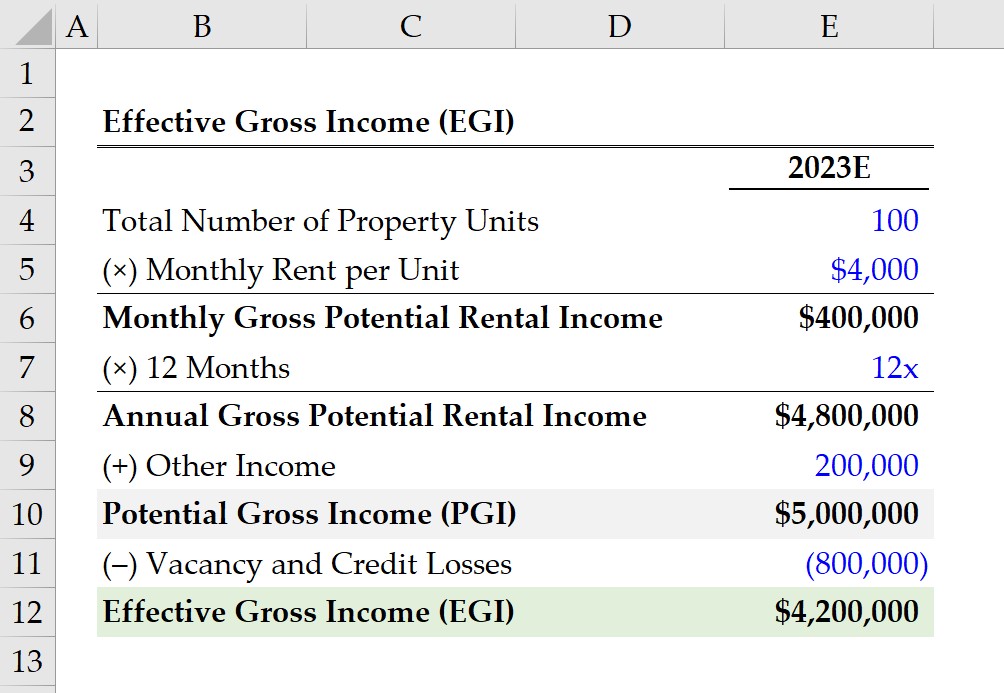
Suppose a real estate investor is attempting to estimate the effective gross income (EGI) of an existing property investment.
The property has a total of 100 units and the monthly rent per unit is $4k.
Therefore, the monthly gross potential rental income is $400k, which we determined by multiplying the total number of units by the monthly rent per unit. But the figure must be converted into an annual figure by multiplying it by 12 to arrive at $4.8 million for the annual gross potential rental income.
The next component of the potential gross income (PGI) is the other sources of income, which we'll assume is $200k per year.
The sum of the annual gross potential rental income and other income amounts to $5 million, which is the total income that could be generated by the property if there were no vacancy or credit losses, i.e. if the property were at a 100% occupancy rate and has no collection issues.
In the next section, we'll adjust our potential gross income (PGI) by the estimated costs attributable to vacancy and credit losses.
The total vacancy and credit costs are forecasted to be $800k, which the property owner determined based on historical data and performing market research, i.e. current state of the real estate market conditions (supply/demand).
In closing, our final step is to deduct the vacancy and credit losses from the potential gross income (PGI) of the property to arrive at a pro forma effective gross income (EGI) of $4.2 million.


No comments yet.