What is Vacancy Loss?
Vacancy Loss refers to the rental income lost by a property owner from unoccupied space, i.e. vacant units with no tenants.

Vacancy Loss refers to the rental income lost by a property owner from unoccupied space, i.e. vacant units with no tenants.

The vacancy loss refers to the rental income lost because of unoccupied units, where there are no tenants.
While there is a negative connotation, the vacancy loss metric can also be viewed as representing the potential rental income that could be earned in the future.
The process of calculating the real estate metric involves multiplying the vacancy assumption by the gross potential income generated by the property, i.e., the rental income if all units were occupied.
The resulting amount is the rental income lost by the unoccupied units.
When projecting the anticipated loss, assumptions are necessary regarding the conditions of the real estate market, tenant demand, property conditions (i.e., number of available space vs. unavailable space due to construction), and retention of existing tenants.
For property owners striving to reduce their vacancy loss, the following measures can be taken:


The formula for calculating vacancy loss is equal to the gross scheduled income (GSI) multiplied by the vacancy rate.
Where:
Level up your real estate investing career. Enrollment is open for the upcoming Wharton Certificate Program cohort.
We’ll now move to a modeling exercise, which you can access by filling out the form below.

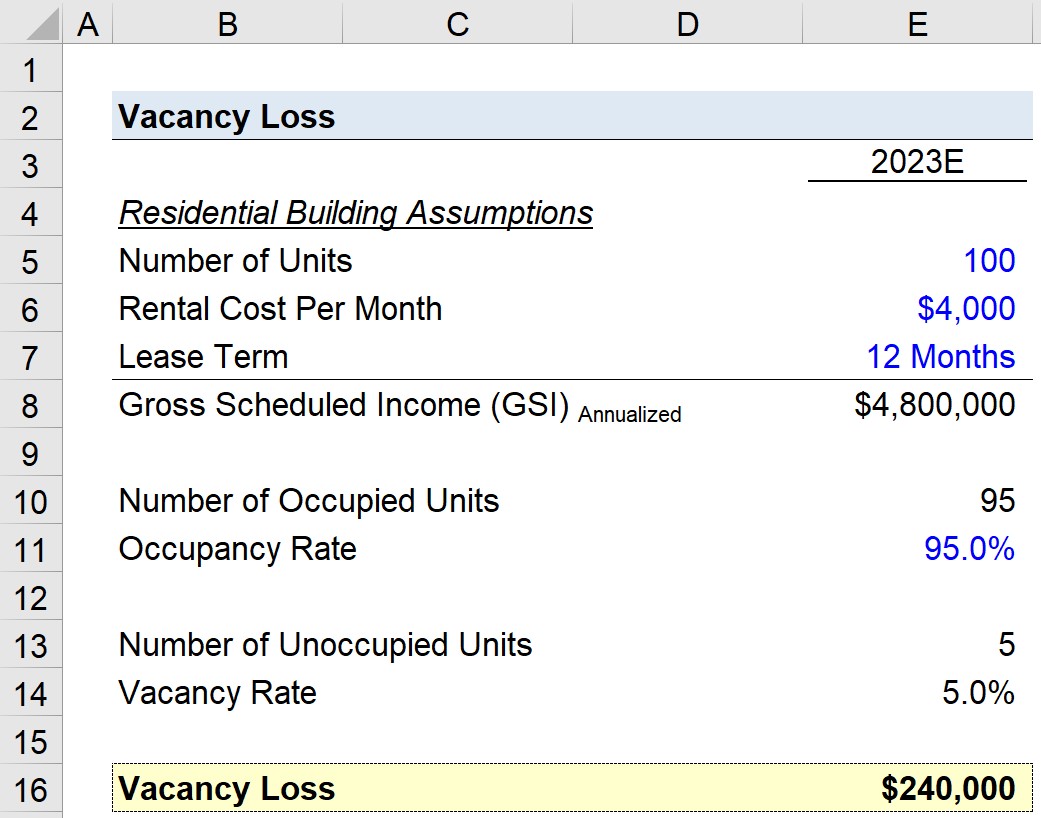
Suppose the property manager of a residential building is attempting to determine the expected vacancy loss in anticipation of the upcoming year, 2023.
The residential building has 100 units available for rent in total, with each unit priced at the same monthly rate of $4,000.
While an unrealistic scenario – for purposes of this exercise – we'll assume that all rental lease commitments are on a 12-month basis.
Given those assumptions, we can calculate the gross scheduled income (GSI) by multiplying all three assumptions.
The $4.8 million represents the total potential rental income assuming 100% occupancy, as well as no concessions or discounts that affect the net effective rent paid by tenants.
Next, we’ll assume that the occupancy rate as of the present date is 95%, meaning that 95 units have an existing tenant that has signed a lease and will be obligated to pay rent each month.
The vacancy rate equals one minus the occupancy rate, so the vacancy rate is 5.0%.
By multiplying the gross scheduled income (GSI) by the vacancy rate, we arrive at a vacancy loss of $240,000, which represents the rental income expected to be lost in 2023 unless those unoccupied units are filled.


No comments yet.