What are Lease Improvements?
Leasehold Improvements are expenditures that relate to the improvement of a leased property, which are amortized over either the lease term or the estimated useful life.

Leasehold Improvements are expenditures that relate to the improvement of a leased property, which are amortized over either the lease term or the estimated useful life.
A leased property can be altered by the tenant (lessee) or the property owner (lessor) in order to make it more suitable for fulfilling the tenant’s specific needs.
The costs of the leasehold improvements are paid by the tenant, who can use the improvements until the end of the lease agreement is reached. But once the lease expires, all the property – including the improvements made to date – would then belong to the landlord.
Notably, the approval of a tenant’s request for a leasehold improvement increases the property value, which directly affects a landlord's ability to raise future rents.
Since the property becomes more functional post-alteration, the property becomes more marketable to current (and potential future) tenants.
Property improvements increase the odds of an existing tenant remaining in place for a longer duration, even if the price were to increase (i.e. pricing power) because a customized property establishes an incentive for tenants to extend their stay.
If the request for leasehold improvements is denied, however, the tenant could resort to moving to a different property, especially if the change is necessary for them to utilize the property fully.

The most common examples of leasehold improvements include the following:
Level up your real estate investing career. Enrollment is open for the upcoming Wharton Certificate Program cohort.
To reiterate, leasehold improvements refer to alterations by a tenant to a rental property for the sake of customization.
The accounting rules that pertain to leasehold improvements are as follows.
Our next section will address the question of, "How does the depreciation of leasehold improvements work?"
For purposes of accounting, the costs of leasehold improvements are capitalized as a fixed asset and then amortized rather than depreciated, as the prior section mentioned.
Once implemented, the improvements are owned by the landlord on paper, even if the one benefiting directly is the renter, i.e. the asset is an intangible “right” of ownership.
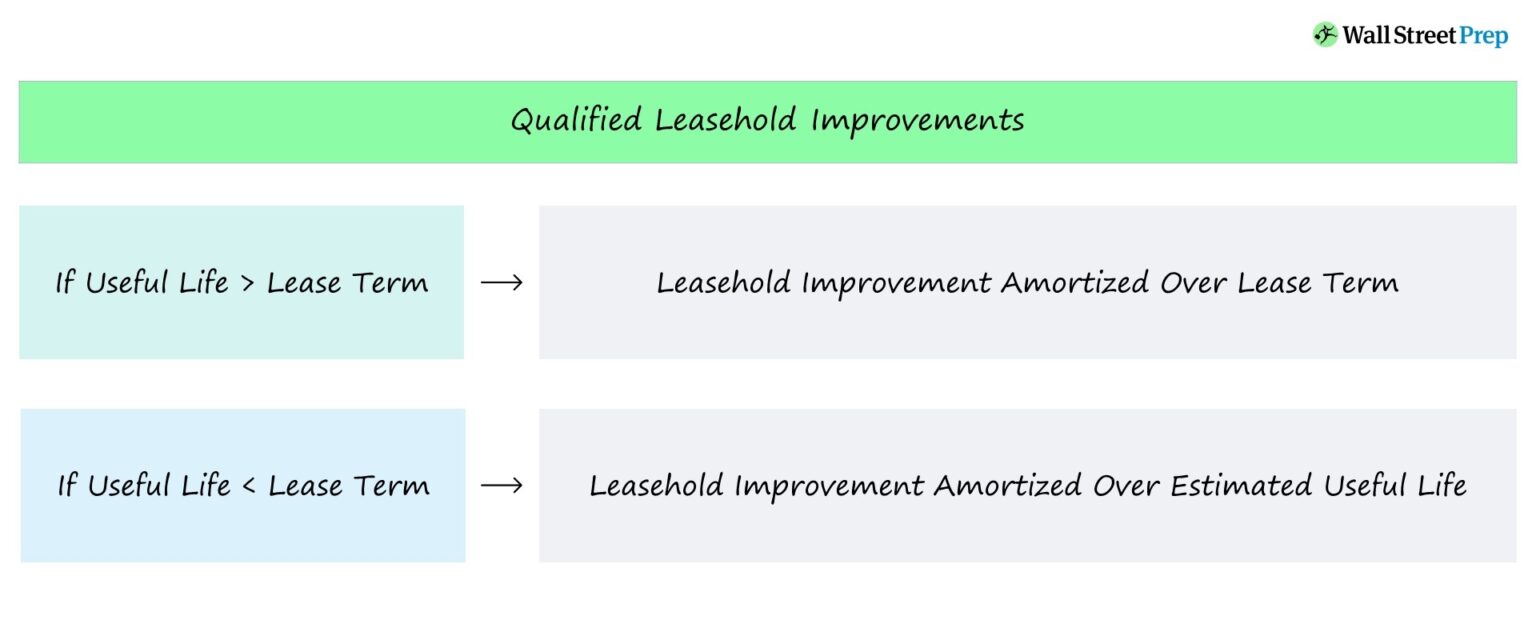
The improvements to leased properties are capitalized are then amortized over the shorter of the two:
The salvage value is assumed to be zero because ownership of the improvements returns to the lessor, not the lessee.
If the renewal of the lease (i.e. an extension by the tenant) is reasonably assured, the depreciation period can be covered to reach the end of the adjusted lease term (i.e. including any anticipated lease renewals), as long as the ending date is not beyond the useful life assumption.
While technically the cost is capitalized and amortized, it is acceptable to state it as "depreciation" as the difference in not meaningful. Conceptually, the two terms are intended for different types of assets (i.e. tangible vs. intangible) but are the same at their core.
Leasehold improvements are usually made to the interior of a property, such as the installation of new fixtures or the addition of equipment and furniture.
These sorts of modifications can occur in many commercial real estate locations, like offices, retail, and industrial spaces, mostly entailing changes to walls, ceilings, and flooring.
Note: The repairs related to ordinary “wear-and-tear” are not treated as leasehold improvements.
Suppose a tenant improved a leased office space immediately after moving in at the start of a ten-year lease.
If we assume that the qualified leasehold improvement costs a total of $200,000 and the useful life is estimated to be 40 years, the amortization expense is $20,000 per year.
The lease term (10 years) is less than the useful life (40 years), so the amortization period used is 10 years instead of 40 years.


No comments yet.