What is After Tax Cash Flow?
The After Tax Cash Flow is the residual income generated by a real estate property investment once tax obligations have been fulfilled.

The After Tax Cash Flow is the residual income generated by a real estate property investment once tax obligations have been fulfilled.
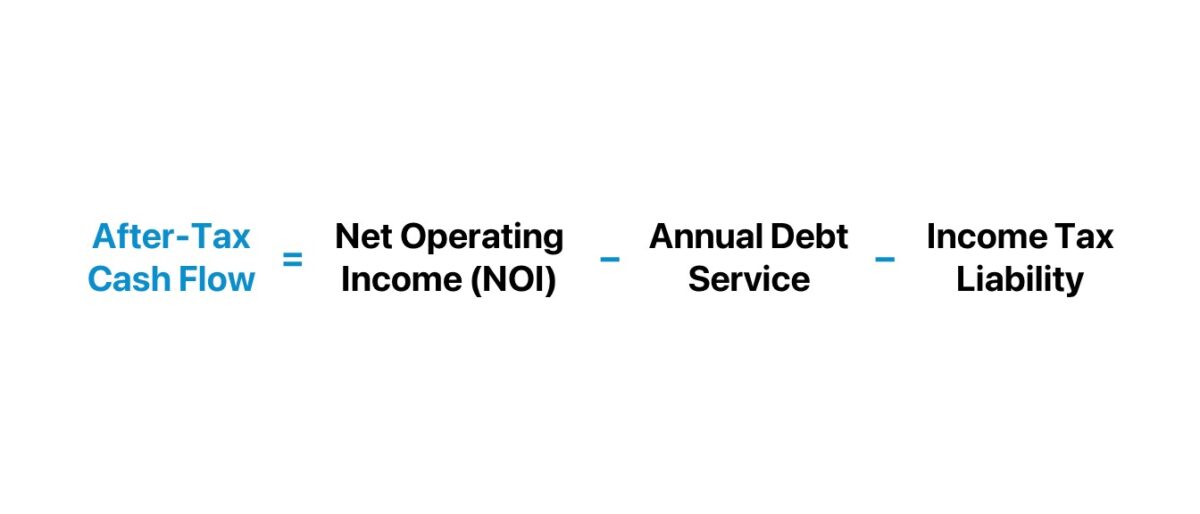
In commercial real estate (CRE) investing, the after-tax cash flow is a metric that measures the remaining income once a property’s operating expenses, debt service obligations, and income taxes (IRS) have been fulfilled.
The after-tax cash flow of a property investment can be categorized as an indicator of profitability, since the metric measures the discretionary income remaining after the annual income tax liability has been satisfied.
Therefore, the after-tax cash flow is determined by calculating the taxable income of a real estate property, and then subtracting the annual income tax provision.
The residual cash flow belongs to the real estate investor, since the obligations owed to third parties, such as the taxes owed to the Internal Revenue Service (IRS), have been met.
While the jurisdiction of the property and surrounding details can cause the tax obligation to shift, most taxpayers are permitted to apply certain deductions to their taxable income, most often mortgage interest payments and depreciation.
The process of calculating the after-tax cash flow metric is a three-step process:


The formula to calculate the after tax cash flow is as follows.
Where:
Level up your real estate investing career. Enrollment is open for the upcoming Wharton Certificate Program cohort.
We’ll now move to a modeling exercise, which you can access by filling out the form below.

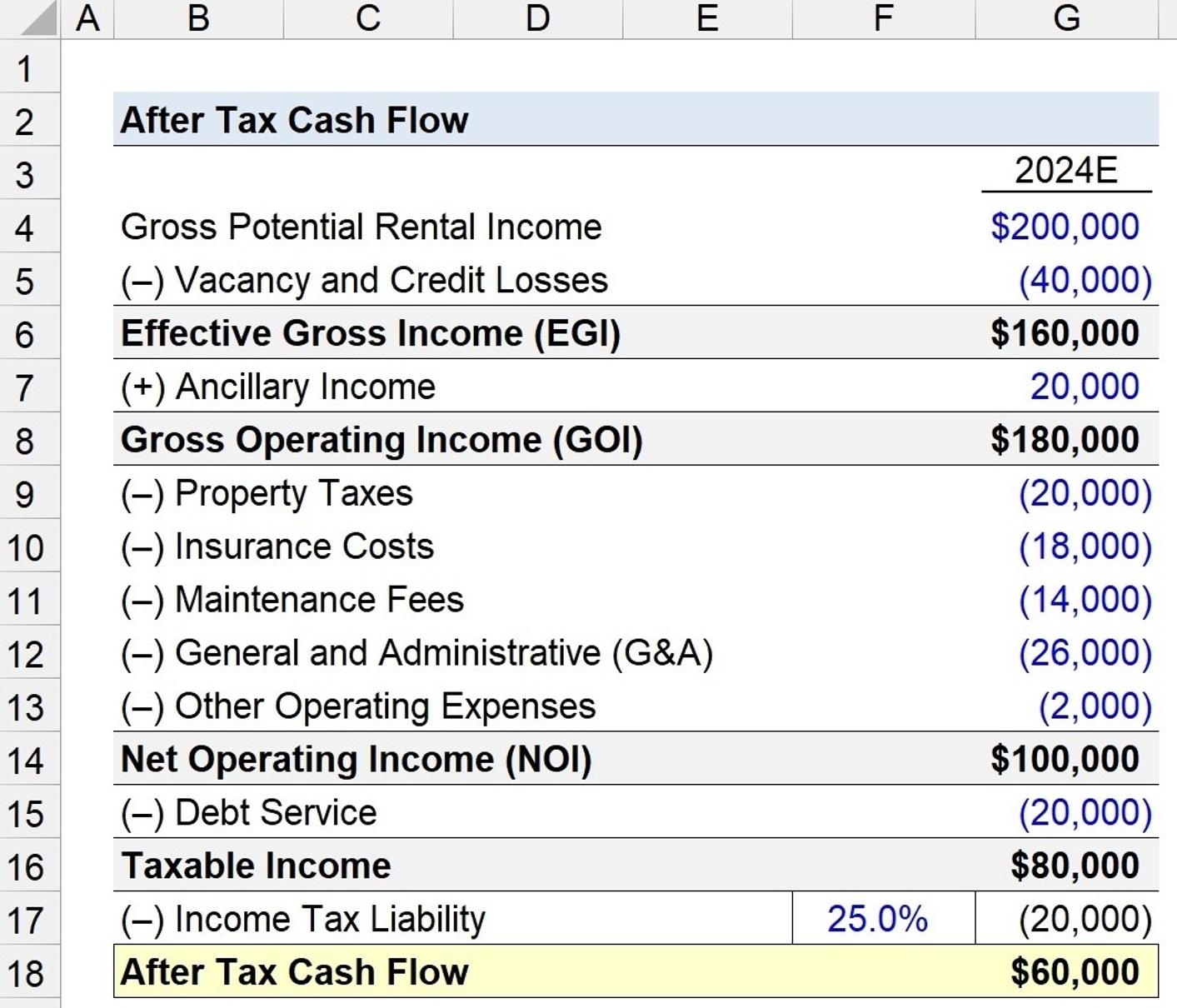
Suppose we're presented with the following pro forma operating performance of a real estate rental property to calculate the after-tax cash flow.
| Pro Forma Operating Performance | 2024E |
|---|---|
| Gross Potential Rental Income | $200,000 |
| (–) Vacancy and Credit Losses | ($40,000) |
| Effective Gross Income (EGI) | $160,000 |
| (+) Ancillary Income | $20,000 |
| Gross Operating Income (GOI) | $180,000 |
| (–) Property Taxes | ($20,000) |
| (–) Insurance Costs | ($18,000) |
| (–) Maintenance Fees | ($14,000) |
| (–) General and Administrative (G&A) | ($26,000) |
| (–) Other Operating Expenses | ($2,000) |
| Net Operating Income (NOI) | $100,000 |
In 2024, the property is forecast to generate $160k in effective gross income (EGI), $180k in gross operating income, and $100k in net operating income (NOI).
The next step is to deduct non-operating items, namely the annual debt service, which we'll assume is $20k.
The taxable income, or before-tax cash flow (BTCF), of the real estate property is $80k.
In the closing steps of our exercise, we'll subtract the income tax liability from the property's taxable income, assumed to be 25.0%, inclusive of all relevant non-operating taxes. The income tax liability is $20k, after multiplying the taxable income by the marginal tax rate.
In conclusion, the pro forma after-tax cash flow of our hypothetical property is $60k, upon subtracting its estimated income tax liability from its projected taxable income.


No comments yet.