The Vacancy Rate refers to the percentage of unoccupied units relative to the total number of rental units available at a property over a specified period.
An unoccupied unit does not generate any rental income for the property owner, so the vacancy rate is closely tracked among participants in the real estate market.
How to Calculate Vacancy Rate
The vacancy rate measures the proportion of rental units that are unoccupied at a particular time and quantifies the dollar amount of rental income lost from unoccupied units throughout a certain time frame.
The rate of vacancy is a key driver of revenue in the following industries:
Hospitality Industry (Hotels)
Apartment Complex
Healthcare Industry (Hospitals, Assisted Living Facilities)
Rental Platforms (Airbnb)
Because vacancy is directly tied to rental revenue, the metric can be used to assess historical performance and market behavior (i.e. seasonality, cyclicality), as well as forecast future demand.
Backward-looking historical data collected by a property manager or real estate investor can help determine pricing and marketing strategies going forward.
Real Estate Interview Guide | File Download Form
You’re logged in! Form submission not required. Access your file below.
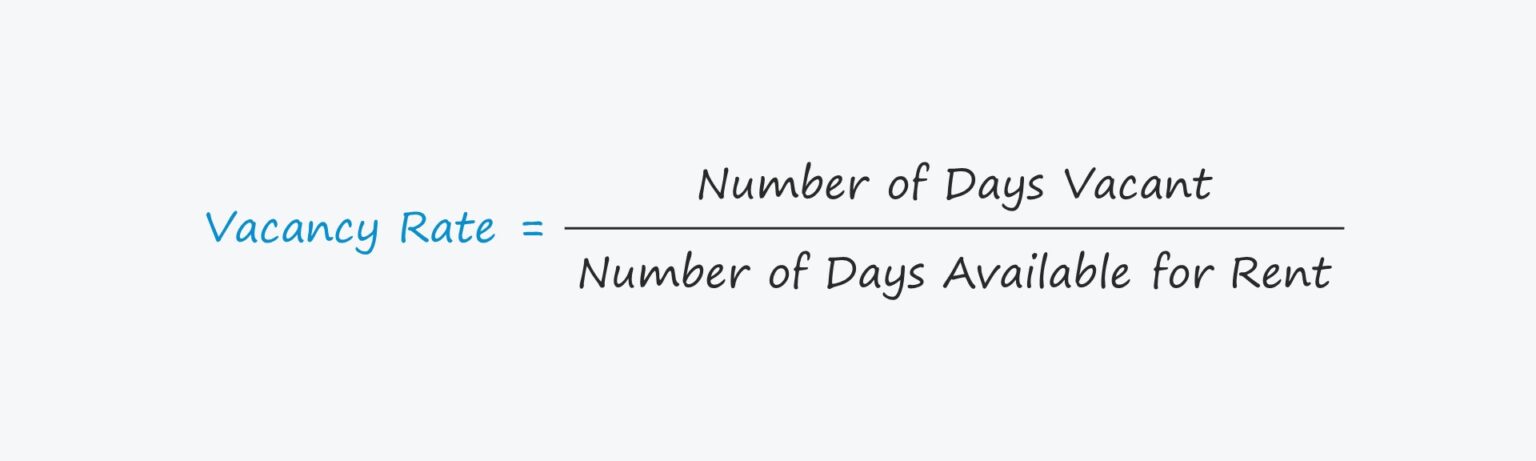
The formula for calculating the vacancy rate on a rental property is as follows.
Vacancy Rate (%) = Number of Days Vacant ÷ Total Number of Days Available for Rent
For example, if a single-family rental available for 365 days in a year was vacant for two months out of the twelve-month period, the rate of vacancy is 16.4% (60 Days ÷ 365 Days).
Continue Reading Below
The Wharton Online and Wall Street Prep Real Estate Investing & Analysis Certificate Program
Level up your real estate investing career. Enrollment is open for the upcoming Wharton Certificate Program cohort.
Vacancy Rate vs. Occupancy Rate: What is the Difference?
The vacancy rate is the inverse of the occupancy rate, so the formulas for calculating the occupancy rate on a particular date and annual basis are as follows.
Occupancy Rate, Single Date = Number of Occupied Rental Units ÷ Total Number of Available Rental Units
Occupancy Rate, Annual = Number of Days Occupied ÷ Total Number of Available for Rent
Moreover, the formula below is an alternative method to calculate the vacancy rate using the occupancy rate.
Vacancy Rate (%) = 1 – Occupancy Rate (%)
What is a Good Vacancy Rate?
To optimize operating efficiency and maximize rental income, properties should attempt to reduce their rate of vacancy over time, all else being equal.
Lower Vacancy Rate → Higher Rental Income
Higher Vacancy Rate → Lower Rental Income
While a higher occupancy rate is perceived as a positive sign if the underlying driver is related to increased demand from consumers, which allows the property owner to raise prices and become more profitable.
If the occupancy rate is increased by undercutting competitors' prices, the effect on revenue and profits could actually be negative.
For property owners with a diverse portfolio of rental properties, vacancy is an important consideration when comparing performance between properties.
Understanding if the demand among renters is rising around a certain location can enable the property owner to set prices appropriately to pocket more profits and capitalize on these trends.
In contrast, becoming aware that renters are shifting away from an area is typically a red flag, which can lead to convincing an owner to sell the property before it loses more value.
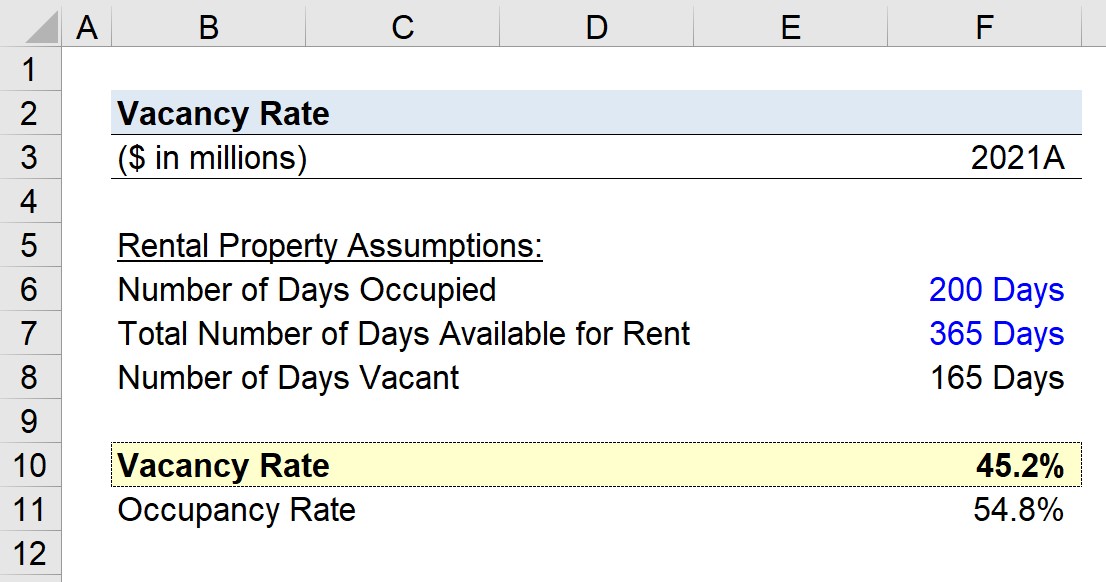
Vacancy Rate Calculator
We’ll now move to a modeling exercise, which you can access by filling out the form below.
Excel Template | File Download Form
You’re logged in! Form submission not required. Access your file below.






No comments yet.