What is Rental Yield?
The Rental Yield is a real estate metric that compares the rental income generated by a property to its fair market value, expressed as a percentage.

The Rental Yield is a real estate metric that compares the rental income generated by a property to its fair market value, expressed as a percentage.
In the real estate market, one of the factors used to measure the profitability of a property investment is the rental yield metric.
To calculate a property's rental yield, a real estate investor needs three inputs:
The rental yield of a property – calculated post-operating expenses – can be broken into the following steps:


There are two different types of rental yield metrics: 1) the gross rental yield and 2) the net rental yield.
The rental yield formula compares a property’s rental income to its property value.
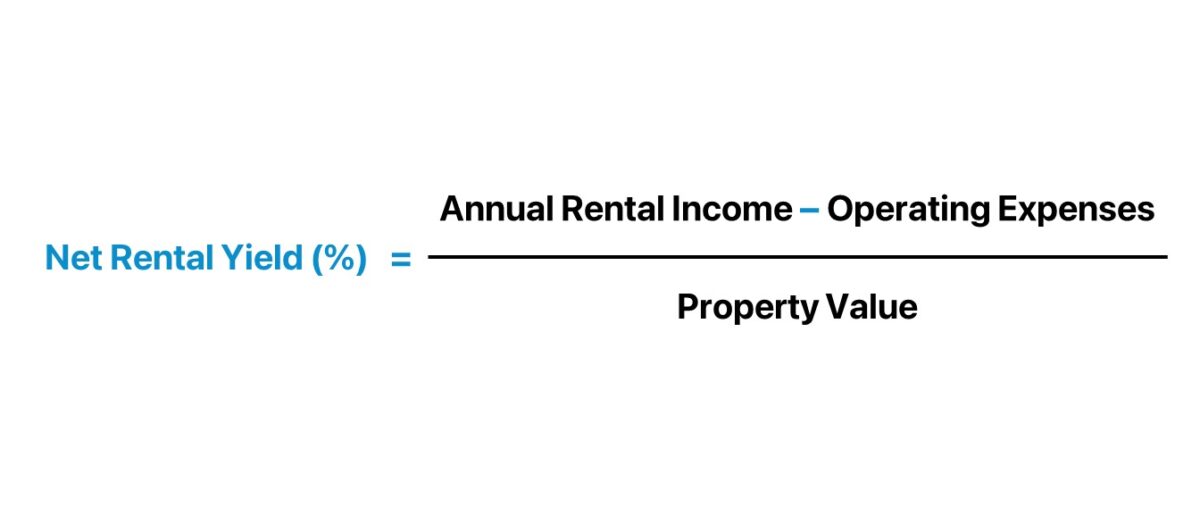
The formula to calculate the net rental yield – the more practical measure of profitability in the real estate market – is as follows.
Rental income must be expressed on an annual basis, whereas the property value is the property’s current market value.
The rental yield is expressed as a percentage for investors to better understand the income to expect relative to their property investment, including the real property’s profitability relative to comparable properties.
Like most real estate metrics, the rental yield cannot be used as a standalone measure to guide financial decisions.
However, the underlying pricing that drives the rental income, as well as factors such as location, vacancy rates and trends, are all taken into account by the rental yield.
Level up your real estate investing career. Enrollment is open for the upcoming Wharton Certificate Program cohort.
Suppose a rental property was to generate $25,000 in rent for the year, and the current market value is $400,000.
After dividing the annual rental income by the current market value of the property, the rental yield is 6.25%
The rental yield can also be calculated using the property cost rather than the property value.
The latter reflects the current fair value of the property, whereas the former is the fixed property purchase price on the date of initial purchase.
But while there is a mismatch in the timing of the metric if the purchase cost were to be used, the metric can still provide some useful insights on the property investment.
Similar to most standardized metrics, what constitutes a “good” rental yield is subjective and is based on the circumstances around comparable properties.
Comparable properties must be located near the target property, with a virtually identical risk/return profile, which is predicated on the property type and characteristics.
By obtaining a better understanding of a rental property’s current and pro forma profitability, a real estate investor can make more informed decisions where the odds of a more favorable outcome improve.
Generally speaking, a higher rental yield implies more profits and a better return on investment (ROI) in the property – all else being equal.
So, to reiterate, the rental yield that property owners should target depends on several factors such as location, property type and the current state of the market with regard to competition (supply vs. demand).
To provide a rough guideline and starting point, a rental yield between 5% to 8% is a decent starting point for most properties before delving into the other factors that must be considered.
For example, if the rental yield on a property is 8% and the purchase price is $200,000, we can rearrange the formula to determine the investor would expect to receive $16,000 in rental income per year, not inclusive of operating expenses or fees.
There are numerous factors – both internal (e.g. state of property conditions, current tenant) and external variables (e.g. market trends, interest rates) – that can impact the rental yield on a property either directly or indirectly, as in the case of the current interest rate environment.
However, the factors that tend to have the greatest impact on the yield are the following:
We’ll now move to a modeling exercise, which you can access by filling out the form below.

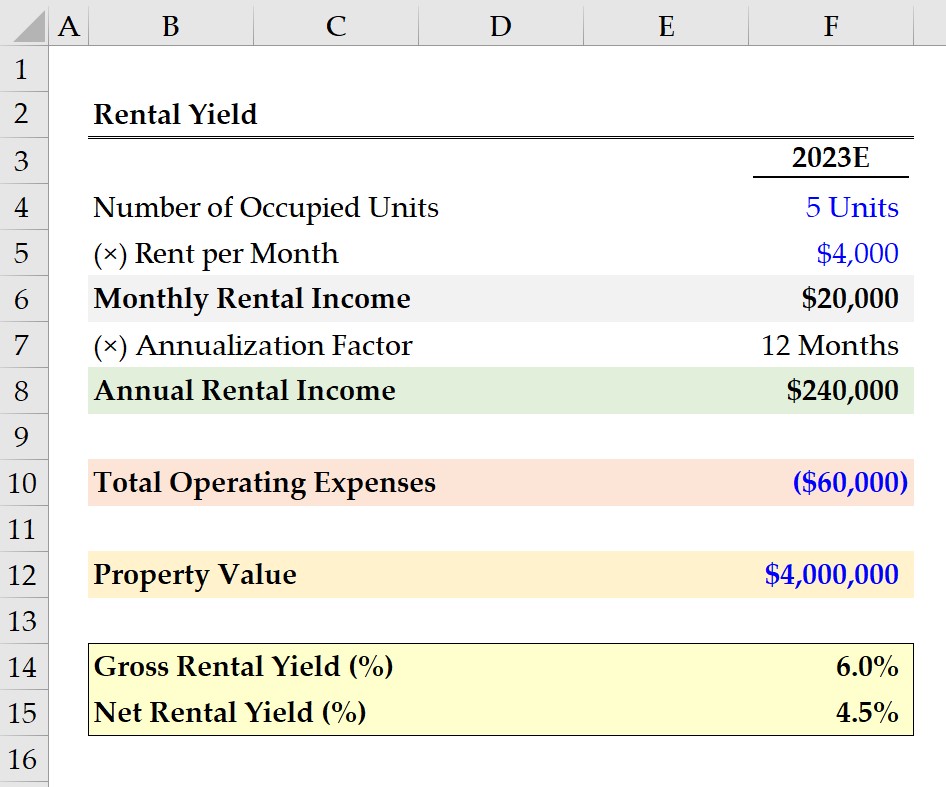
Suppose you’re tasked with calculating the rental yield on a commercial property with a current market value of $4 million and five units available for rent.
The rental building property, based on the existing leasing agreements and historical tenant data with regard to past defaults or collection (credit) issues, is projected to generate $240k in rental income in 2023.
The $240k in annual rental income was determined by multiplying the number of occupied units by the monthly rent – which we assumed to be $4k per tenant – followed by multiplying the $20k in monthly rental income by the annualization factor (12x).
As part of operating the property, the owner expects to incur a total of $60,000 in expenses, inclusive of property management fees, repairs, and vacancies. By subtracting the total operating expenses from the annual rental income, the net rental income is $180k.
Given those assumptions, we can quickly determine the gross rental yield by dividing the annual rental income on a gross basis by the property value, which comes out to 6.0%.
Since the return on a property investment should consider the associated expenses, our next step is to determine the net rental yield by dividing the annual rental income, net of total operating expenses, by the property value.
The net rental yield is 4.5%, which we arrived at by dividing the annual rental income, net ($180k) by the property value ($4 million).
In comparison, the percent differential between the gross and net rental yield is 2.5%.
In conclusion, the rental yield on the commercial property is implied to be 6.0% and 4.5% on a gross and net basis, respectively.


No comments yet.