What is Cap Rate Spread?
The Cap Rate Spread is the delta between the 10-year Treasury note yield and cap rates in the broader real estate market.

The Cap Rate Spread is the delta between the 10-year Treasury note yield and cap rates in the broader real estate market.
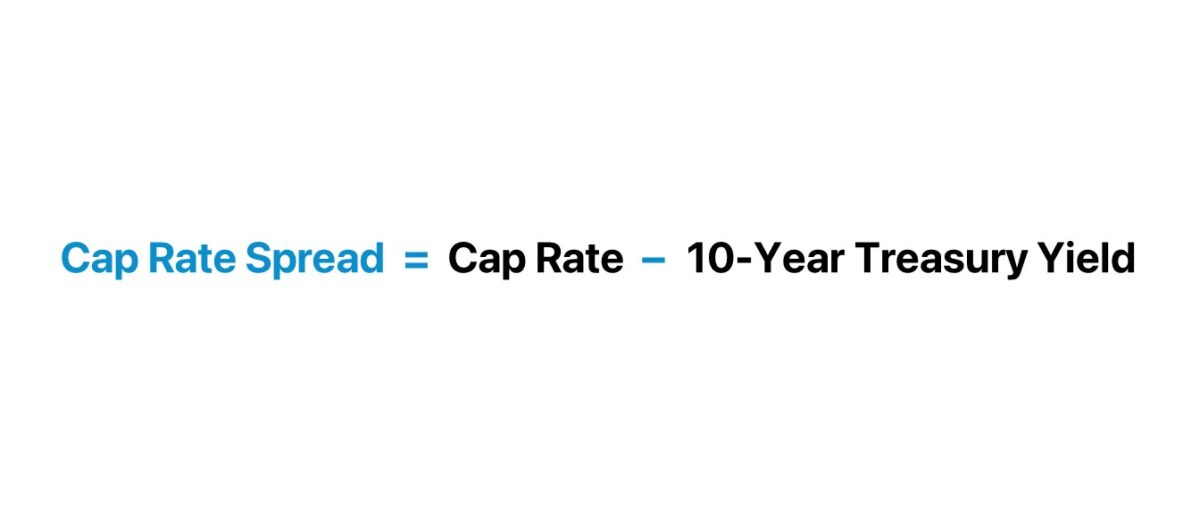
The cap rate spread is the percentage difference between the interest rate on the 10-year Treasury note and the cap rates of properties.
The spread reflects the incremental risk/return trade-off in purchasing a real estate property in lieu of a government bond.
A higher cap rate spread implies greater risk, while a lower cap rate spread indicates less risk.
The 10-year Treasury yield is therefore a proxy for risk in many industries, including real estate, to understand the current state of the economy and serve as a minimum rate of return hurdle for risky assets.
In the real estate market, the cap rate is a financial metric that represents the potential rate of return expected to be earned on a property investment.
The step-by-step process to calculate the cap rate spread is a straightforward process:
Technically, the cap rate of an individual property could be used, rather than the consolidated average cap rate. However, a broader analysis could be more practical for understanding the current state of external risks.
But since the cap rate spread is a comparison performed to grasp the market dynamics from a macro perspective, the cap rates should typically be analyzed in aggregate.


The formula to calculate the cap rate spread is as follows.
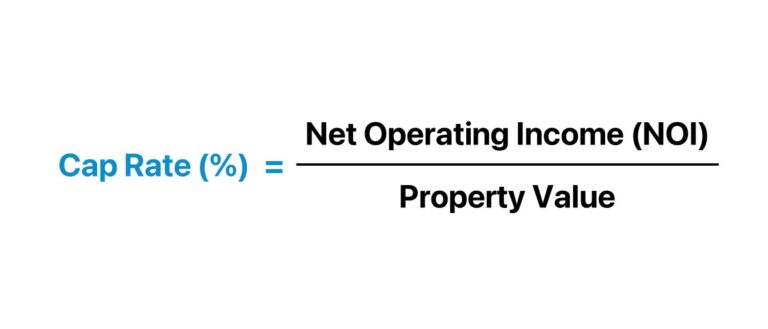
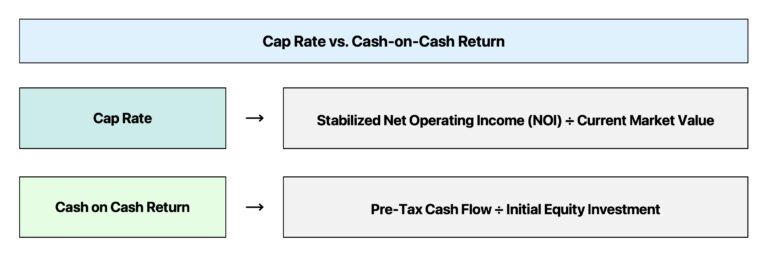
The formula to calculate the cap rate of a rental property, on an individual basis, divides the property’s net operating income (NOI) by its market value as of the present date.
On the other hand, the 10-year Treasury yield is readily available in all financial data platforms such as Bloomberg, as well as financial news sites like the Wall Street Journal (WSJ) and CNBC.
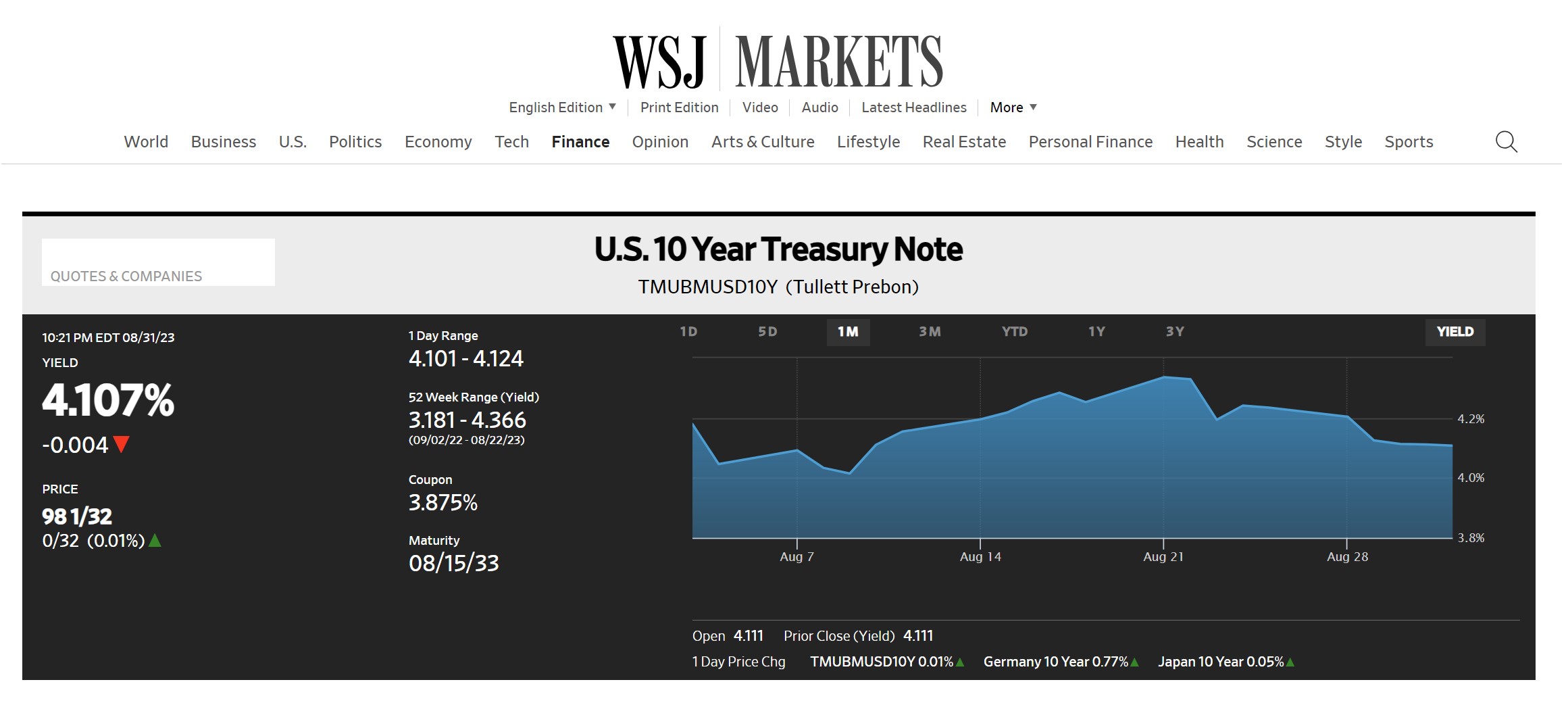
U.S. 10-Year Treasury Note (Source: Wall Street Journal)
Conceptually, the cap rate spread is comparable to measuring the default spread in the context of corporate finance.
For example, the equity risk premium (ERP) is the price of the risk associated with investing in the public equities market.
Therefore, the “premium” reflects the higher required rate of return demanded by investors to allocate capital towards stocks, instead of a theoretically risk-free investment.
The premium for investing in equities and bonds is termed the “equity risk premium” and “default spread”, respectively.
But rather than comparing the expected return on an equity security, or the yield on a corporate bond (or other financial security), to the risk-free rate, the cap rate is analyzed, as illustrated by the following formula.
The “Risk Premium” is the additional return that the property investor receives as compensation for undertaking the incremental risk in the real estate market.
Why? Investors expect to receive a reward for undertaking more risk. Otherwise, the decision to invest in risky securities with limited upside is not worth the trade-off, and it would be more reasonable to invest in government bonds instead.
Level up your real estate investing career. Enrollment is open for the upcoming Wharton Certificate Program cohort.
In the financial markets, the 10-year Treasury yield is a critical indicator of the current state of the economy and outlook on near-term economic conditions.
Since bond prices and yields are inversely related, negative sentiment among investors and fears of a coming recession cause capital to flow into risk-free government bonds.
The sudden rise in demand for U.S. government bonds as investors flock to allocate their capital to safer fixed-income issuances by the government is an increase in bond prices and a steep drop-off in yields.
Given that property investments are risky assets – contrary to government bonds backed by the “full faith and credit” of the U.S. government – the cap rate spread measures the difference between the cap rate of real estate properties and the yield on the 10-year Treasury note to function as an indicator of risk.
Historically, the cap rate spread has exhibited a tendency to expand in times of economic turmoil, while decreasing in periods of robust economic growth and stability.
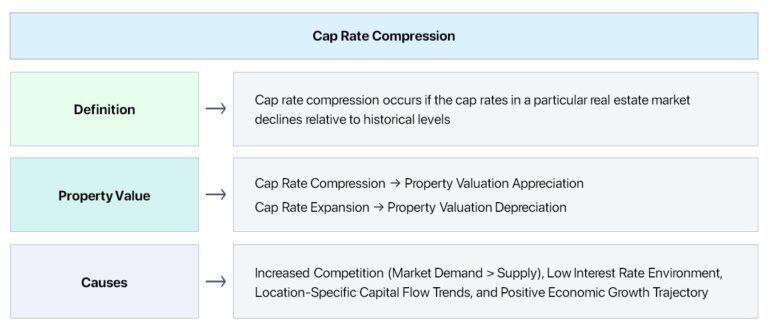
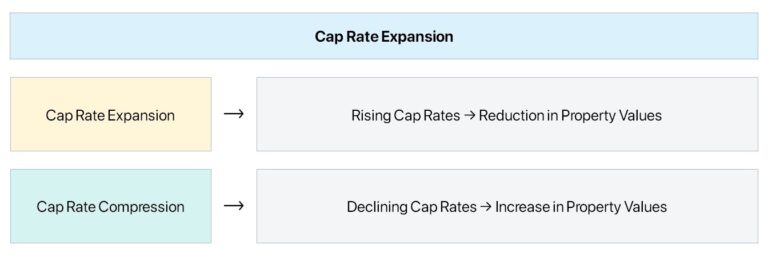
The periodic directional shifts in the market cap rates are described using the following two terms:
By closely monitoring the trends in the cap rate spread – i.e. tracking the constant fluctuations in the percentage increases and decreases – commercial real estate investors (CRE) and institutional lenders that underwrite commercial loans can develop a more in-depth understanding of the current macro conditions in the economy.
However, the movements in the cap rate spread by themselves are not sufficient to influence investment or lending decisions, akin to the inverted yield curve.
The volatility in the spread should instead be interpreted as a potential risk that the market is currently in a state of uncertainty. Because of that risk, the investor or underwriter should perform in-depth diligence to identify the underlying causes and figure out the best course of action in terms of mitigating risk.
The cap rate spread is an indicator of potential economic risk for real estate investors and loan underwriters, which can influence the operating performance of the property (i.e. the asset securing the loan).
One use case for determining the cap rate spread is to estimate the current stage of the market cycle.
Higher spreads coincide with a declining market and could be a red flag that the economic conditions and state of the market is at risk of worsening.
With regard to the implications of measuring the recent cap rate spread, investors might prefer a fixed interest rate structure if there is substantial market volatility.
Conversely, if the cap rate spread is low with minimal volatility, the investor might request an adjustable-rate loan, i.e. the interest rate pricing is variable.
For instance, the Federal Reserve (Fed) started to unwind its prior monetary policies and shrink its balance sheet around mid-2022 as the U.S. economy gradually normalized.
The issue? The Fed now had to combat the inflation caused by their aggressive monetary policies and quantitative easing (QE) amid the COVID-19 pandemic.
However, the release of concerning economics data pertaining to rising inflation (and the risk of hyperinflation) caused the Fed to quickly step in to prevent an economic crisis and collapse into a long-term recession.
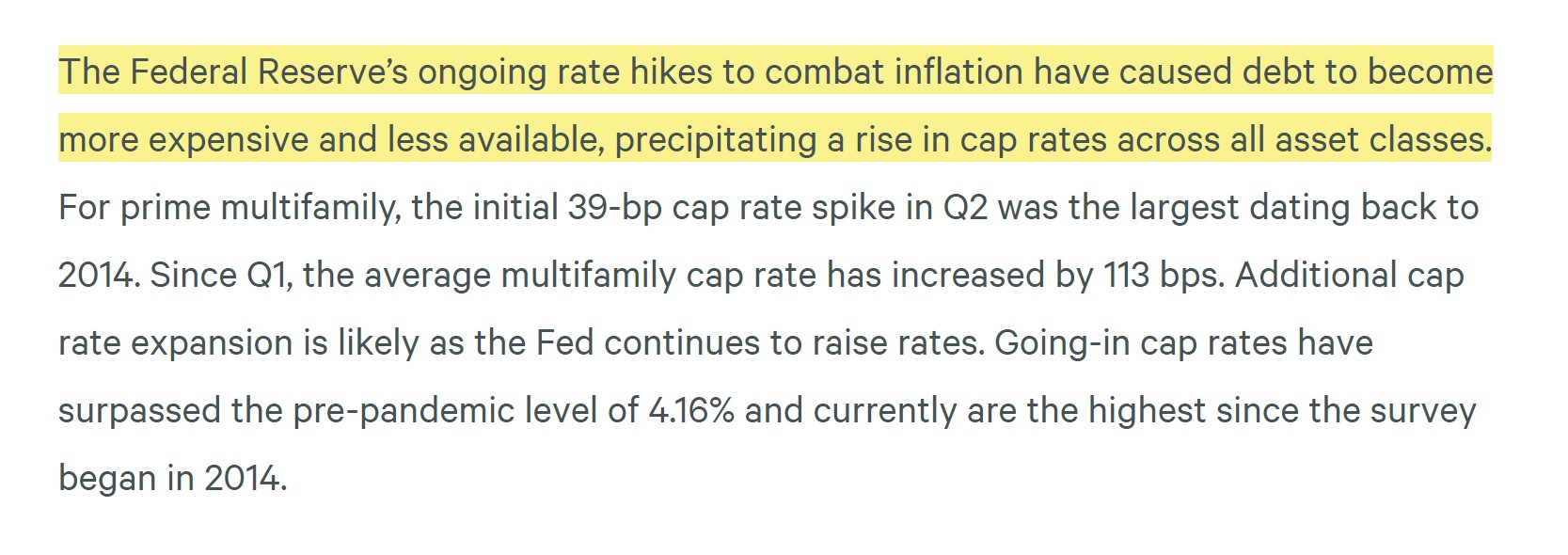
The interest rate hikes used to reduce inflation also increased the cost of borrowing – which, as we mentioned earlier, causes cap rates to expand and demand from buyers in the market to decline.
Therefore, the announced interest rate hikes and subsequent cap rate expansion in the U.S. was a predictable outcome, yet where the real estate market currently is in its cycle and if the peak is near remains the topic of much speculation as we enter 2023.
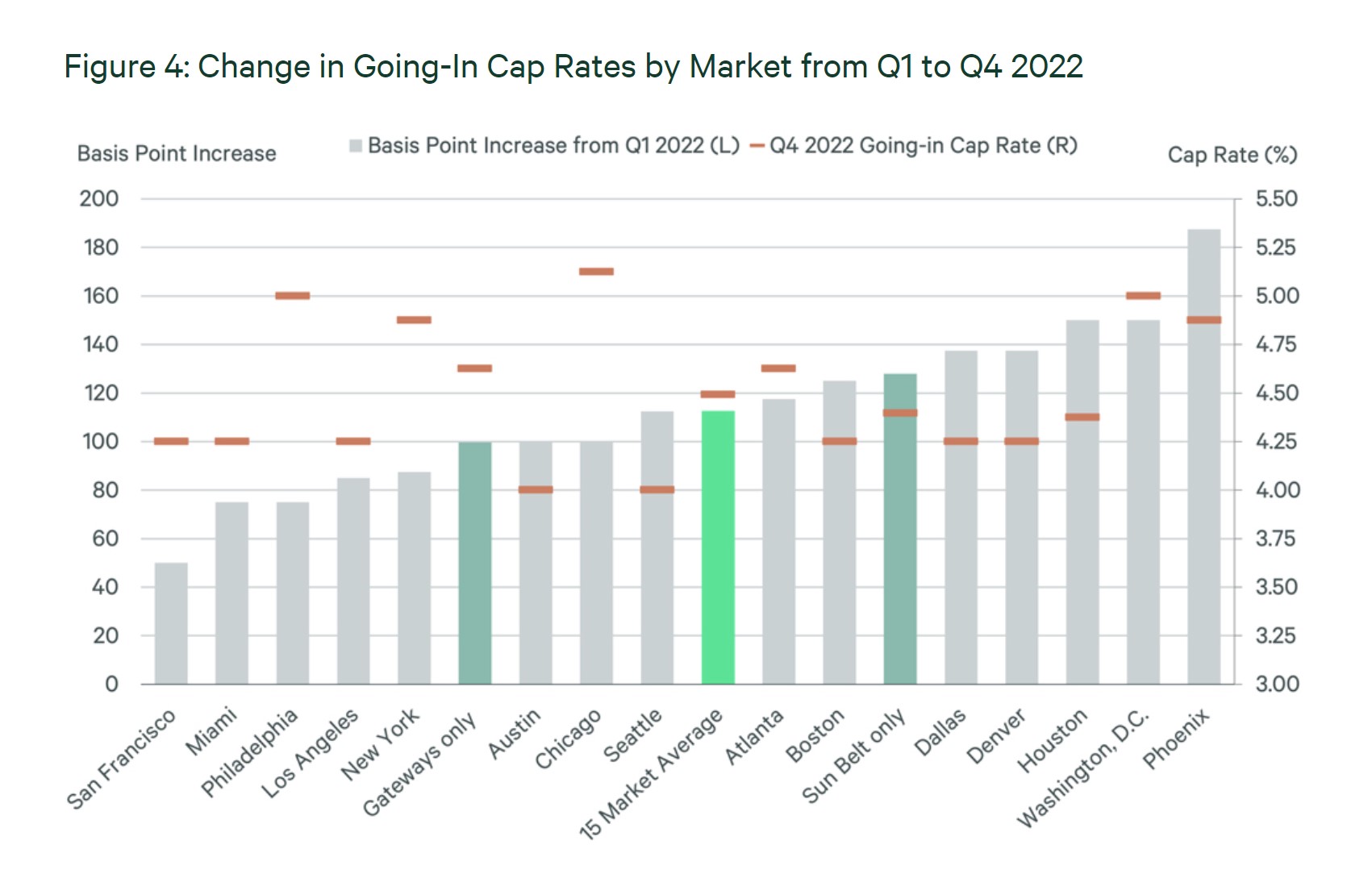
“Underwriting Assumptions Exceed Pre-Pandemic Levels for Prime Multifamily Assets” (Source: CBRE)

No comments yet.