What is Gross Rental Yield?
The Gross Rental Yield measures the profit potential and return on a property investment before adjusting for operating expenses.

The Gross Rental Yield measures the profit potential and return on a property investment before adjusting for operating expenses.
The gross rental yield, or “gross yield” for short, represents the return on a property investment prior to deducting operating expenses.
In general, the primary use-case of gross rental yield is to perform a “back of the napkin” analysis in order to determine if a property investment opportunity is worth spending more time on.
The gross rental yield is a quick method to confirm if the profit potential of a given property investment is enough.
If the potential return on a "gross" basis is insufficient to meet the minimum returns threshold specific to the real estate investor, then the probability of the return being appealing on a "net" basis is near zero.
In such scenarios, most rational investors would not proceed further in the investment evaluation process, since the property investment does not meet the returns criteria of the firm.
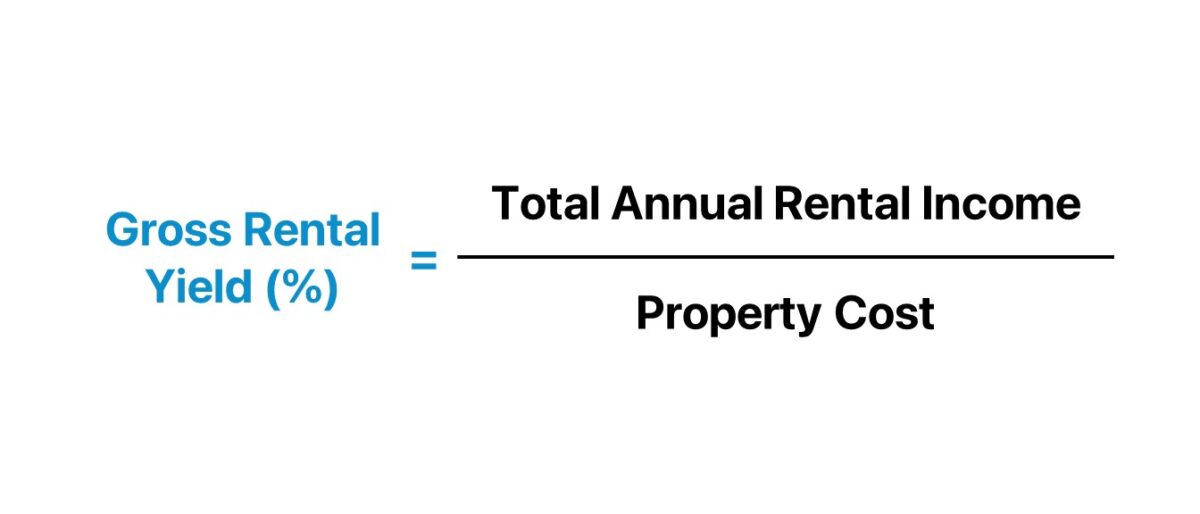
The calculation of the gross rental yield is straightforward, as the yield is simply the ratio between the total annual rental income and property cost.
The higher the gross rental yield, the greater the potential income and return on the property investment (and vice versa).
However, the income component does not factor in operating expenses, so further analysis must be conducted before any decisions are made.


In particular, there are two distinct types of rental yield metrics used by real estate investors and property owners.
The most common operating costs that the net rental yield factors into the return are the following:
Since the rental income component of the net yield is inclusive of operating costs, the implied return will be lower than the gross yield. Hence, the net rental yield is perceived as the more accurate view of the actual rental yield on a given property investment.
Another distinction between the two rental yield metrics lies in the denominator.
The denominator for the net rental yield is the appraised property value, so the metric reflects the return as of the present date.
Technically, the gross rental yield could also use the current property value, alike the net rental yield metric. The factor to consider is the timing and purpose of the analysis.
If an investor calculates the gross rental yield, it would be reasonable to assume that the investor is currently in the early stages of the potential acquisition, with limited access to historical operating data and no pro forma projections.
Given the context, the difference between the estimated purchase cost and current property value is unlikely to be significant. Therefore, the next step – assuming the gross yield appeals to the investor – is to delve deeper into conducting due diligence, which includes calculating the net rental yield among other return metrics.
The formula to calculate the gross rental yield is as follows.
To make comparisons among different properties easier, the resulting figure in decimal form should be multiplied by 100 to be converted into a percentage.
Level up your real estate investing career. Enrollment is open for the upcoming Wharton Certificate Program cohort.
We’ll now move on to a modeling exercise, which you can access by filling out the form below.

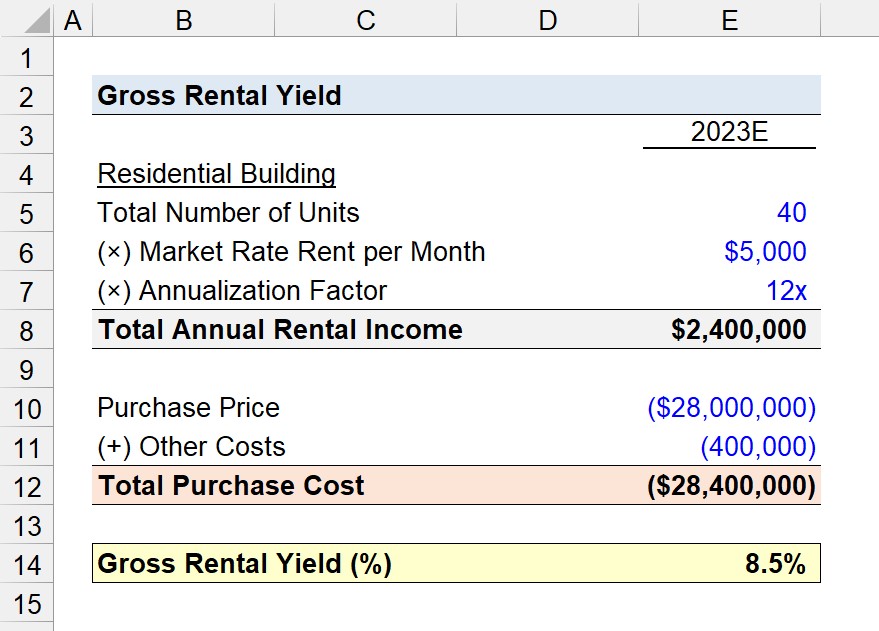
Suppose a real estate investor is offered the opportunity to acquire a residential building with a total of 40 units available for rent and a market rate rent of $5,000 per month.
The monthly rental income potential – assuming a vacancy rate of 0% – amounts to $200,000, which we must annualize by multiplying by 12.
The total annual rental income, or potential gross income (PGI), comes out as $2.4 million.
But to reiterate, the $2.4 million income amount neglects operating costs, as well as vacancy and credit losses.
From there, we must determine the total purchase cost, which we'll determine using the following assumptions.
The sum of those two cost inputs amounts to a total purchase cost of $28.4 million.
Upon dividing the total annual rental income by the total purchase cost, we arrive at a gross rental yield of 8.5%.
By no means is the gross rental yield comprehensive enough on its own for an investor to truly grasp the risk-reward profile of a property investment. Thus, it is crucial to understand that the gross rental yield is a preliminary method to vet potential property investment opportunities, rather than guide investment decisions.


No comments yet.