The ARR Multiple is an industry-specific valuation ratio commonly used in the SaaS industry and for subscription-based companies.
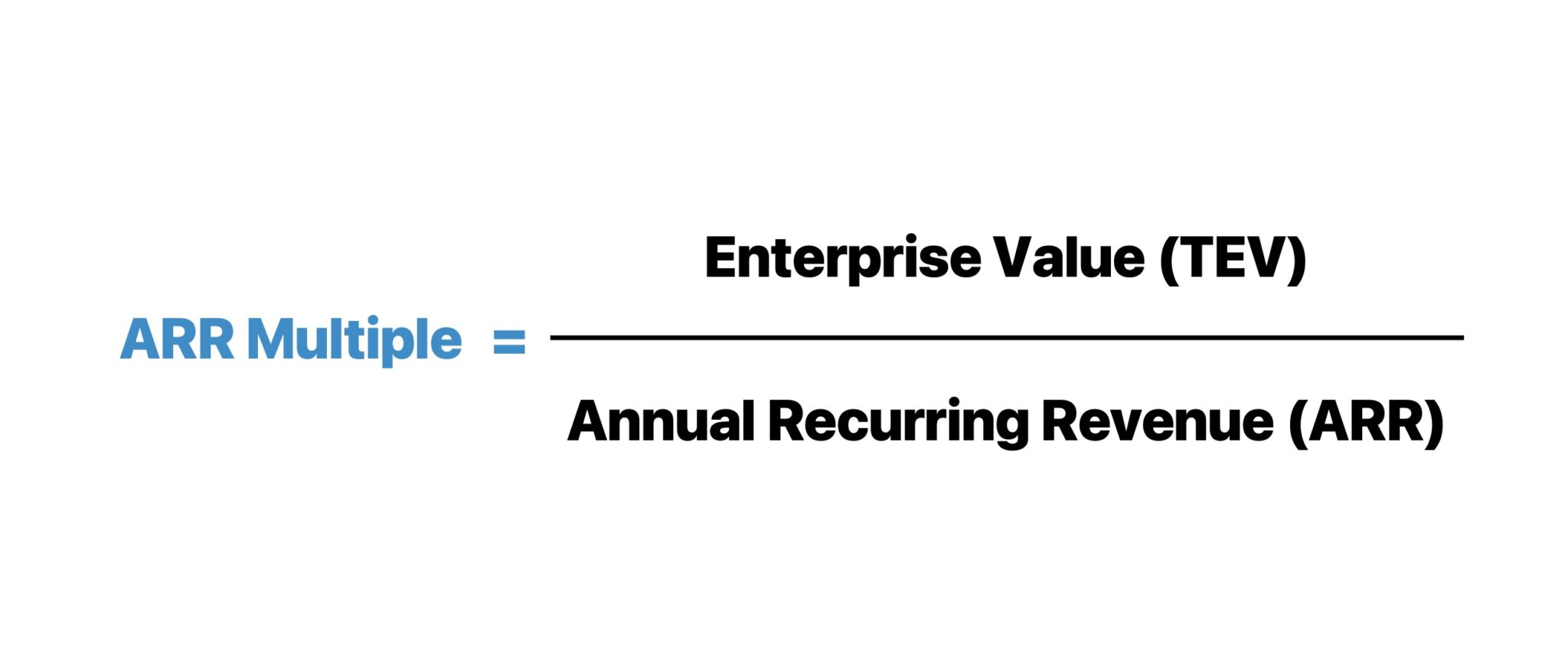
The ARR multiple is calculated as the ratio of a SaaS or subscription-based company’s enterprise value (EV) to annual recurring revenue (ARR).
By measuring the ARR multiple, institutional investors and equity analysts can perform comparative analysis and estimate the relative value of SaaS companies.
How to Calculate ARR Multiple
The ARR multiple is an industry-specific valuation metric used by SaaS practitioners and institutional investors, such as venture capital (VC) and growth equity (GE) firms.
In practice, the ARR multiple is most commonly applied for SaaS companies and subscription-based providers because their revenue model is oriented around recurring revenue and securing multi-year contracts with B2B clients.
The ARR multiple formula is composed of two metrics:
Enterprise Value (EV) ➝ The enterprise value (EV) is the total value of the company, including market capitalization, debt, and cash.
Annual Recurring Revenue (ARR) ➝ The ARR is the predictable, recurring revenue generated by a SaaS company on an annual basis.
The step-by-step process to calculate the ARR multiple is as follows:
Generally, a higher ARR multiple illustrates that investors are willing to pay more for each dollar of recurring revenue, often due to factors like higher growth rates, better profitability, or stronger competitive positioning.
However, the target ARR multiple can vary widely depending on the specific industry, company stage, and current market conditions.
The logic supporting the usage of net debt, rather than gross debt, is that the cash sitting on a company’s balance sheet could hypothetically be used to pay down debt, at any given moment.
Net Debt = Total Debt – Cash and Cash Equivalents
What is a Good ARR Multiple
SaaS Benchmark
ARR Multiple Range
High-Growth, Top-Tier Early-Stage SaaS Companies
15x to 30x+
Mid-Tier, Growth-Stage SaaS Companies
5x to 15x
Low-Growth, Mature SaaS Companies
Sub-5x
ARR Multiple Calculation Example
Suppose we're tasked with calculating the ARR multiple of a SaaS company with the following financial information:



No comments yet.