What is Retention Rate?
The Retention Rate is the percentage of customers who continue to use a company’s products or services across a specified period.

The Retention Rate is the percentage of customers who continue to use a company’s products or services across a specified period.
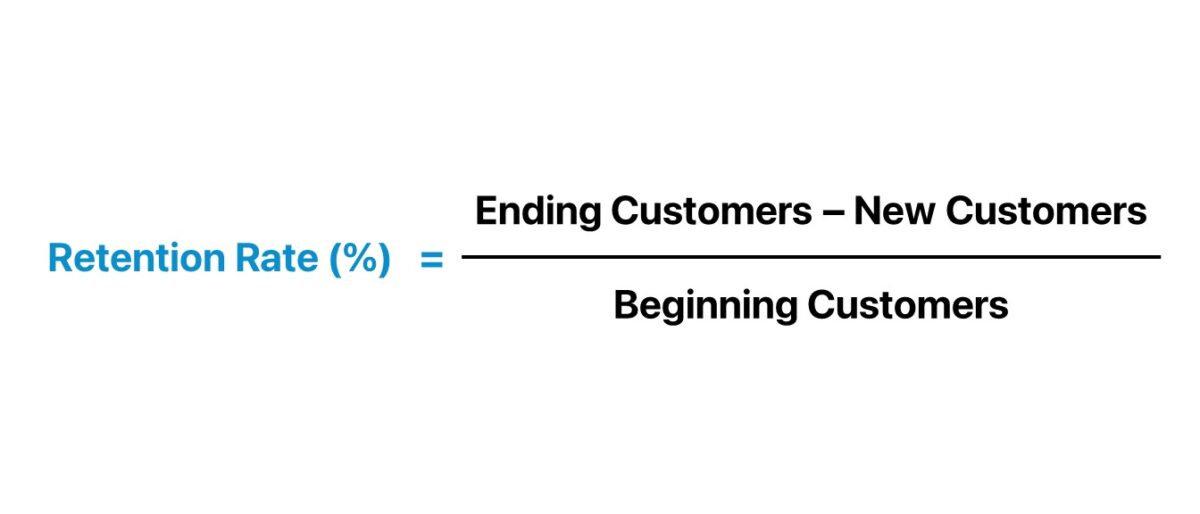
The retention rate measures the proportion of total customers that a company was able to retain over a given period, expressed as a percentage.
Since the sustainability of SaaS and subscription companies is contingent on generating long-term recurring revenue, the retention rate is a critical KPI.
The inverse of the retention rate is the churn rate, which refers to the percentage of a company’s existing customers that opted to cancel their subscriptions – i.e. discontinue being a customer – in a given time horizon.
With that being said, it would be in the best interests of a company to work on increasing its retention rate (and reducing its churn rate).
The higher the retention rate, the more customers a company has retained within a specific period, whereas the lower the retention rate, the more customers have churned.
Therefore, the customer retention rate is an objective “cause-and-effect” metric for companies to understand how their decisions impact customer behavior.
The process of calculating the retention rate requires three inputs:
The retention rate formula subtracts the number of new customers from the number of ending customers, which is then divided by the number of beginning customers.
The formula to calculate the retention rate is equal to the difference between the number of customers at the end of the period and new customers, divided by the number of customers at the beginning of the period.
Considering the retention rate is the inverse of the churn rate, the metric can also be calculated by subtracting the churn rate from one.
Companies must continuously improve their product offerings and value proposition to their customers base to improve their retention rate.
When a company’s retention is low, it may be necessary to question the effectiveness of the product offering (i.e. technical capabilities), pricing, sales & marketing, and customer support.
Particularly in highly competitive markets, customers are more susceptible to churn because competitors attempt to find weaknesses in the offerings of other competitors in the market to capitalize on (and steal market share with better products).
Market leaders will most often be the prime targets, so it is necessary to continually reinvest to improve product quality and make strategic adjustments based on historical data, as well as ensure that existing customer needs are met (i.e. by measuring the net promoter score, or “NPS”).
Some other methods to increase the customer retention rate include the following tactics:
At the earlier stages of a company’s life cycle, the number of new customers acquired tends to prevail over all else, including profit margins and even customer retention.
The higher a company’s retention rate, the greater the percentage of existing customers retained.
Therefore, a higher retention rate contributes to more recurring revenue – all else being equal.
But as the company continues to mature, patterns usually begin to emerge when assessing customer behavioral trends (i.e. churn vs. retention).
If the company interprets the data correctly and makes the proper implementations – i.e. adjusting the business model, targeting the most profitable end markets, setting prices appropriately on par with competitors, etc. – its churn rate should theoretically decline.
We’ll now move to a modeling exercise, which you can access by filling out the form below.


Suppose a SaaS company had 100 customers at the start of Year 1, with 20 new customers acquired and 10 churned customers.
Using those assumptions, we can calculate the customers as 110 remaining at the end of Year 1 as 110.
In the subsequent period, Year 2, the ending customer count from Year 1 is the number of beginning customers.
As for the new customers and churn assumptions, the new customers acquired are double the previous year, while the churned customers are half the prior year.
Since we now have all the necessary inputs to calculate the customer retention rate, we can enter the appropriate figures into the formula from earlier.
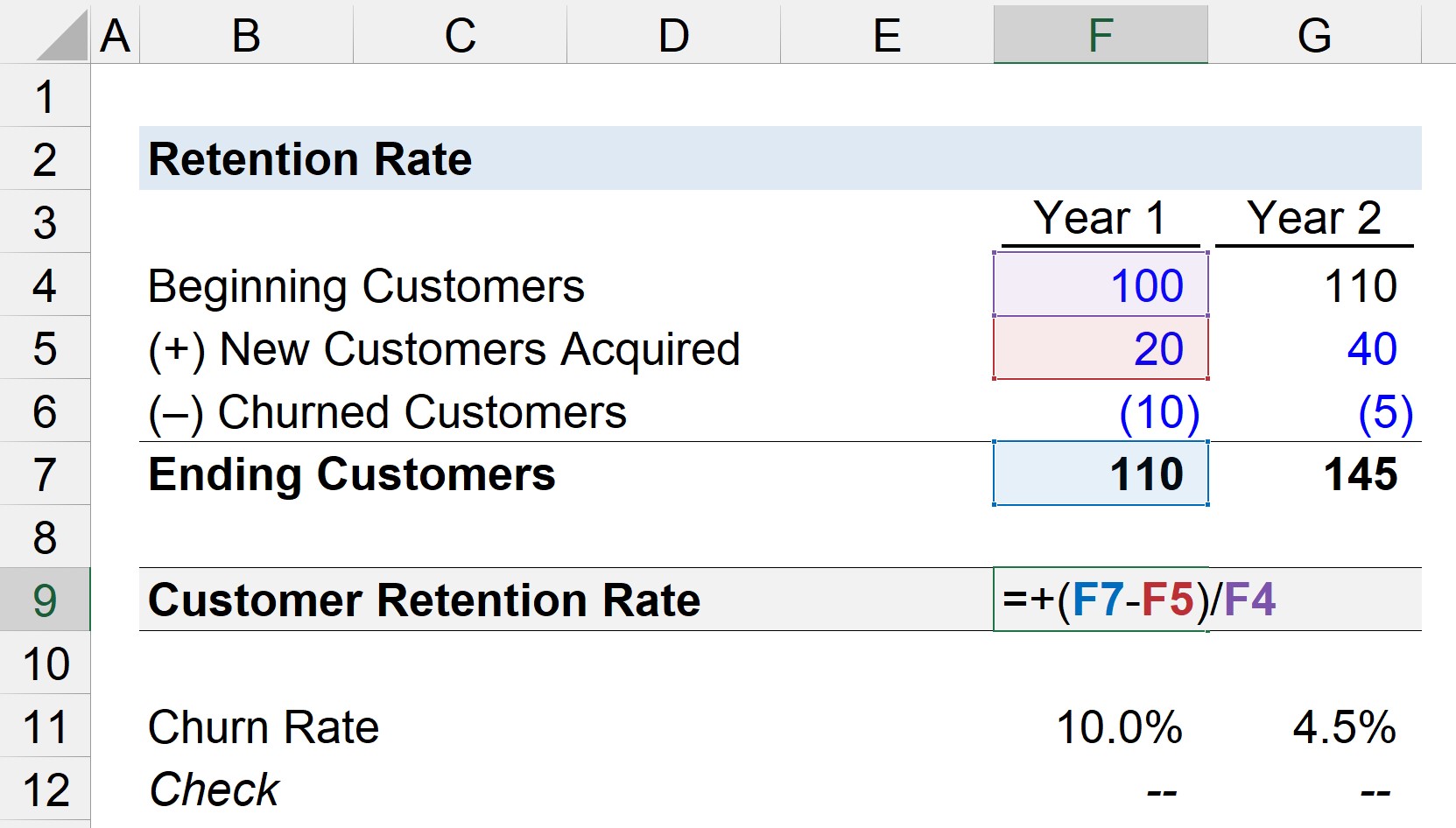
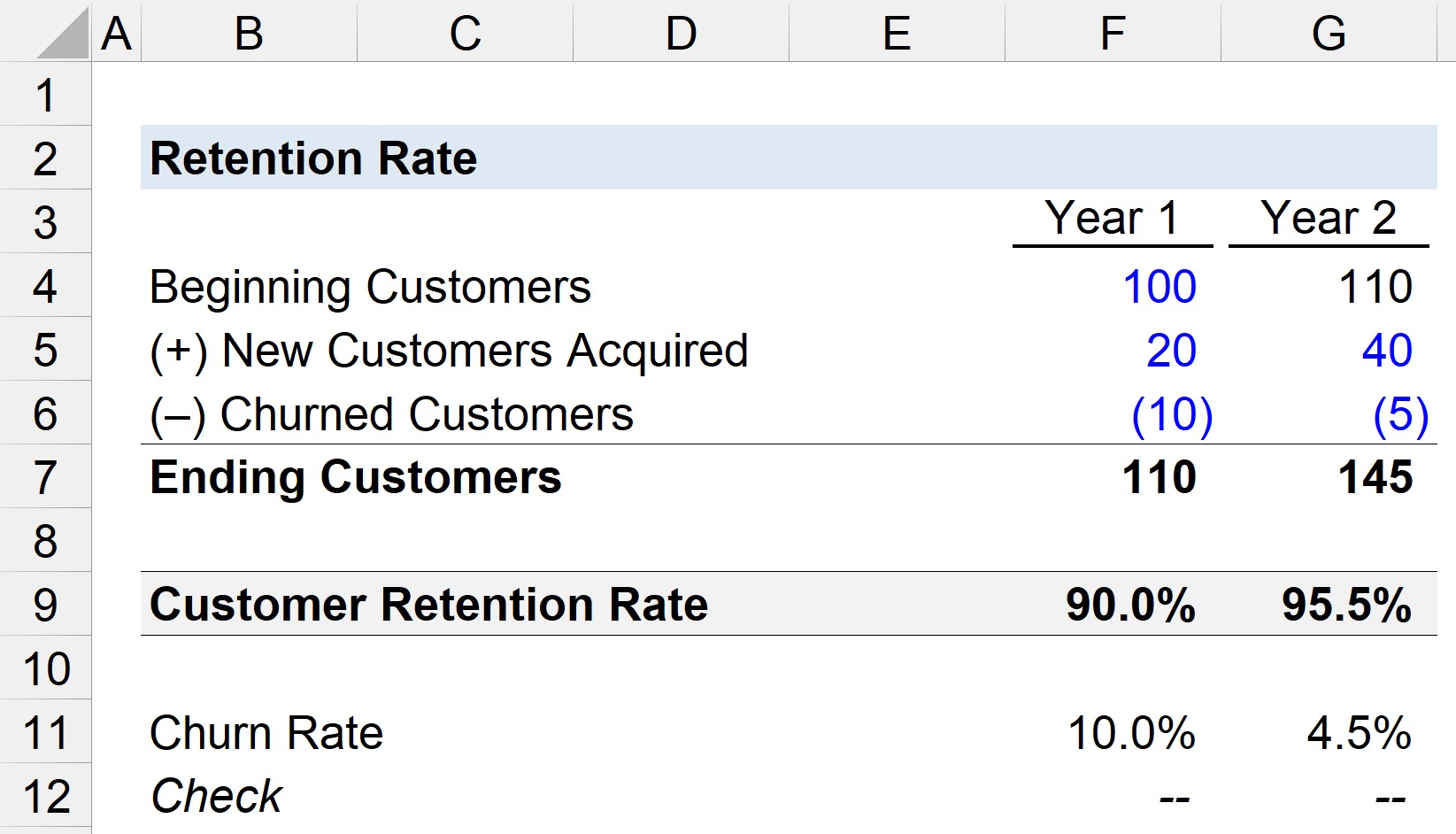
From Year 1 to Year 2, our company’s retention rate grew from 90.0% to 95.5%, which can be confirmed by adding the percentage to the churn rate.
The sum of the retention rate and churn rate equals 100% (or 1), confirming our calculations are correct.
The churn rate is equal to the number of lost customers in the current period, divided by the beginning customer count.
By adding the retention and churn rates together, we arrive at 100% for both periods, reflecting the inverse relationship between the two metrics.

Enroll in The Premium Package: Learn Financial Statement Modeling, DCF, M&A, LBO and Comps. The same training program used at top investment banks.


No comments yet.