What is CAC Payback Period?
The CAC Payback Period is the number of months needed by a company to recoup the initial costs incurred in the process of acquiring a new customer.

The CAC Payback Period is the number of months needed by a company to recoup the initial costs incurred in the process of acquiring a new customer.
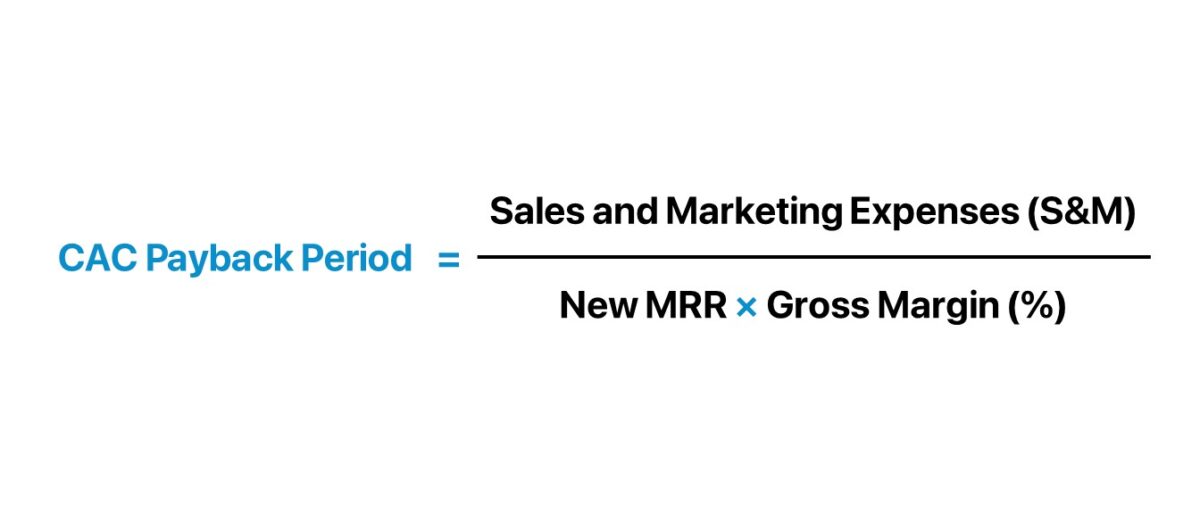
The CAC payback period is a SaaS metric that measures the time it takes a company to earn back their spending on new customer acquisitions, namely their sales and marketing expenses (S&M).
The CAC payback period—also known as “Months to Recover CAC”—determines the amount of cash necessary for a company to fund its growth strategies, i.e. it sets the ceiling for how much can be reasonably spent on acquiring new customers.
The CAC payback period formula consists of three components:
The CAC payback formula divides the sales and marketing (S&M) expense by the adjusted SaaS gross margin.
Note that there are numerous other methods to calculate the CAC payback, and it is thus important to understand the pros and cons of each approach.
But normally, the differences are related to the level of granularity needed, i.e. being as precise as possible vs. rough “back-of-the-envelope” math.
For instance, the net new MRR metric – in which the new MRR is adjusted for expansion MRR and churned MRR – could be used instead as the recurring revenue component.
For the net new MRR, the inclusion of expansion MRR is a discretionary decision, as those are not necessarily new customers, per se.
Likewise, churned MRR is not related to the company's new customer acquisition strategies, albeit an outsized rate could raise concerns that new customers are prioritized in lieu of existing customers.
As a general rule of thumb, most viable SaaS startups have a CAC payback period of fewer than 12 months.
However, the CAC payback period must be evaluated in conjunction with more data points regarding customer types, revenue concentration, billing cycles, working capital spending needs, and other factors in order to determine a company's viability and whether its payback period can be considered “good” or not.
Level up your career with the world’s most recognized private equity investing program. Enrollment is open for the upcoming cohort.
We’ll now move to a modeling exercise, which you can access by filling out the form below.


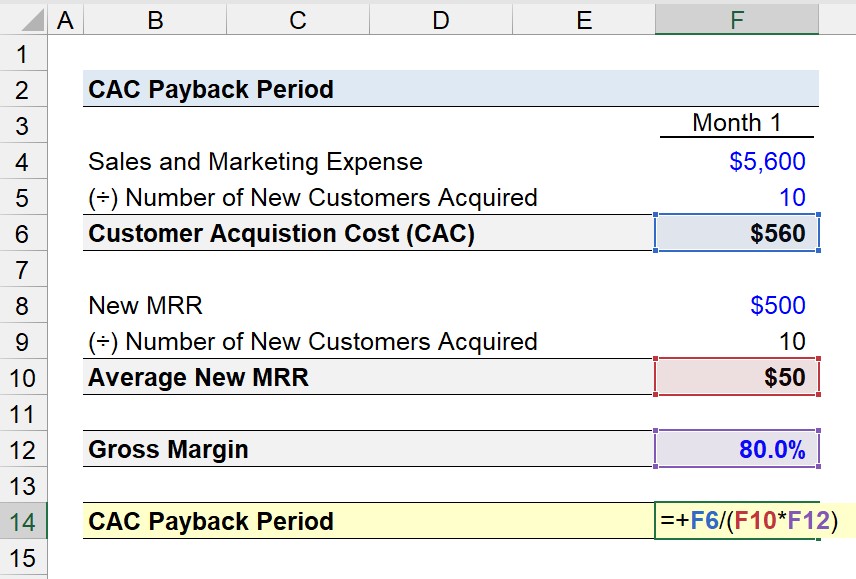
Suppose that a SaaS startup spent $5,600 in total on sales and marketing in its most recent month (Month 1).
The outcome was a total of 10 new customers—i.e. paying subscribers—were acquired by the sales and marketing team that same month.
The customer acquisition cost (CAC) is $560 per customer, which we calculate by dividing the total S&M expense by the total number of new customers acquired during that period.
Our next step is to calculate the average net MRR using the assumption that the new MRR for April was $500.
Since there were ten new customers, the average new MRR is $50 per customer.
The only remaining assumption is the gross margin on the MRR, which we’ll assume to be 80%.
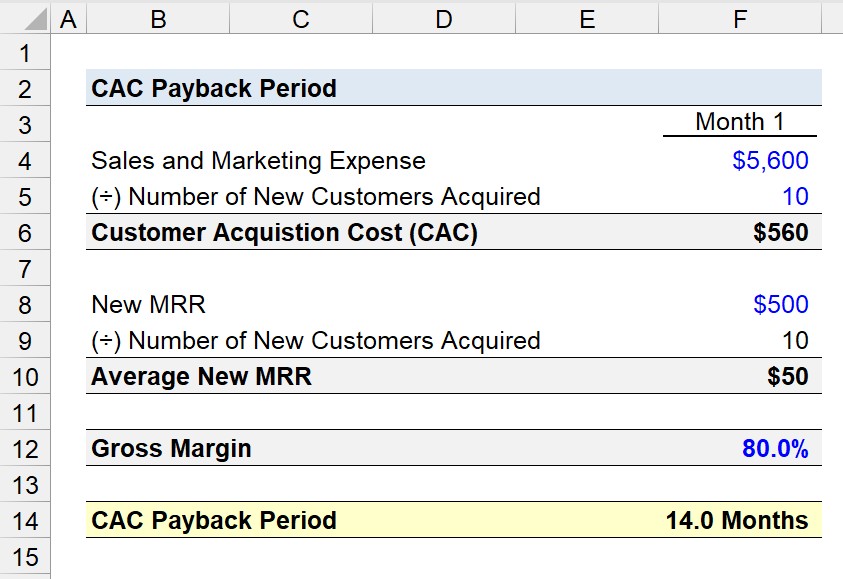
In closing, by dividing the customer acquisition cost (CAC) by the product of the average new MRR and gross margin, the implied CAC payback period is estimated to be 14 months.
Therefore, given the CAC payback period of 14 months, the SaaS company requires approximately 14 months to recoup its initial spending on new customer acquisition strategies and sales and marketing expenses (S&M).


No comments yet.