What is Net Negative Churn?
Net Negative Churn occurs when a SaaS or subscription-based company’s expansion revenue (e.g. from upselling, cross-selling) exceeds the lost revenue from churned customers and downgrades.

Net Negative Churn occurs when a SaaS or subscription-based company’s expansion revenue (e.g. from upselling, cross-selling) exceeds the lost revenue from churned customers and downgrades.
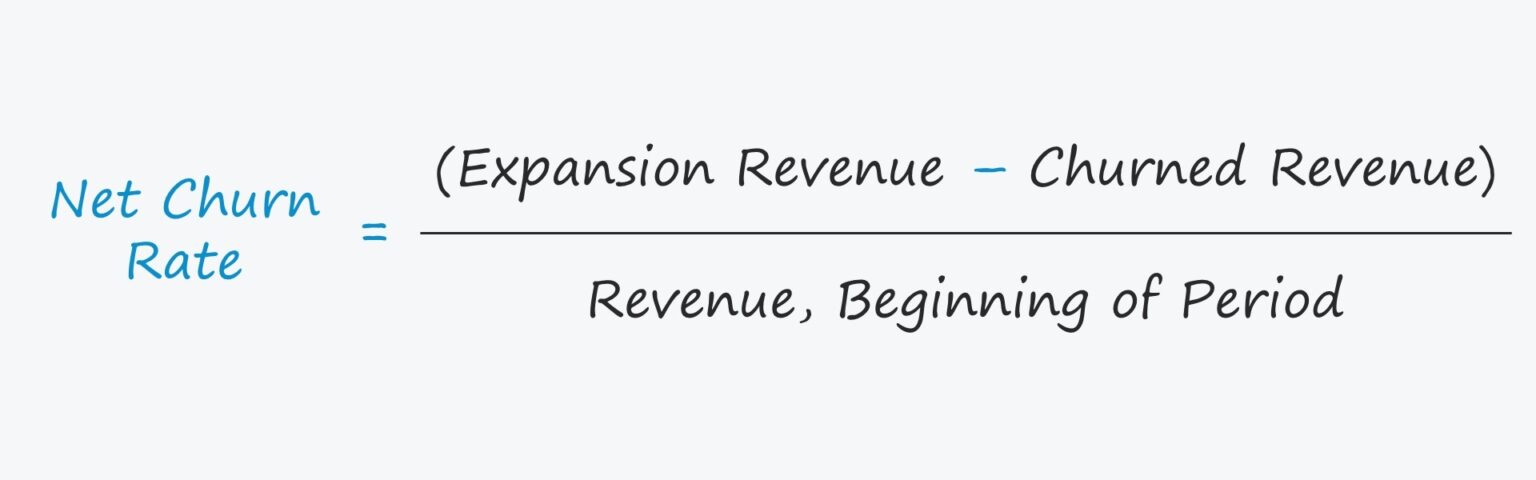
The gross churn rate is the percentage of a company’s beginning of period (BoP) revenue lost across a specified period.
The net churn rate is a similar metric, with the distinction of also including expansion revenue.
In certain scenarios, the net churn rate can become negative, in what is referred to as “net negative churn”.
One important distinction of this metric is the absence of revenue from new customer acquisitions.
Therefore, companies with net negative churn are able to grow their recurring revenue (and offset their churn) from their existing customer base.
The reduction of revenue churn is critical for the long-term viability of a SaaS company, but a net negative churn implies the company is capable of weathering a sharp drop-off in new customer acquisitions, such as during a global economic slowdown.
In order words, even if the company were to acquire zero new customers, its revenue would continue growing.
The formula for calculating the net churn rate subtracts churned revenue from expansion revenue and then divides it by the BoP revenue.
Most often, the monthly recurring revenue (MRR) is used for SaaS companies rather than the GAAP revenue.
Net Churn Rate Formula
- Net Churn Rate = (Churned MRR – Expansion MRR) / MRR BoP
For instance, let’s say a company generated $1,000 in MRR at the beginning of the month.
By the end of the month, the company lost $200 in MRR from customer cancellations and downgrades.
However, if the company obtained $600 MRR from existing customers upgrading their accounts, the MRR at the end of the month is $1,400.
We’ll now move to a modeling exercise, which you can access by filling out the form below.


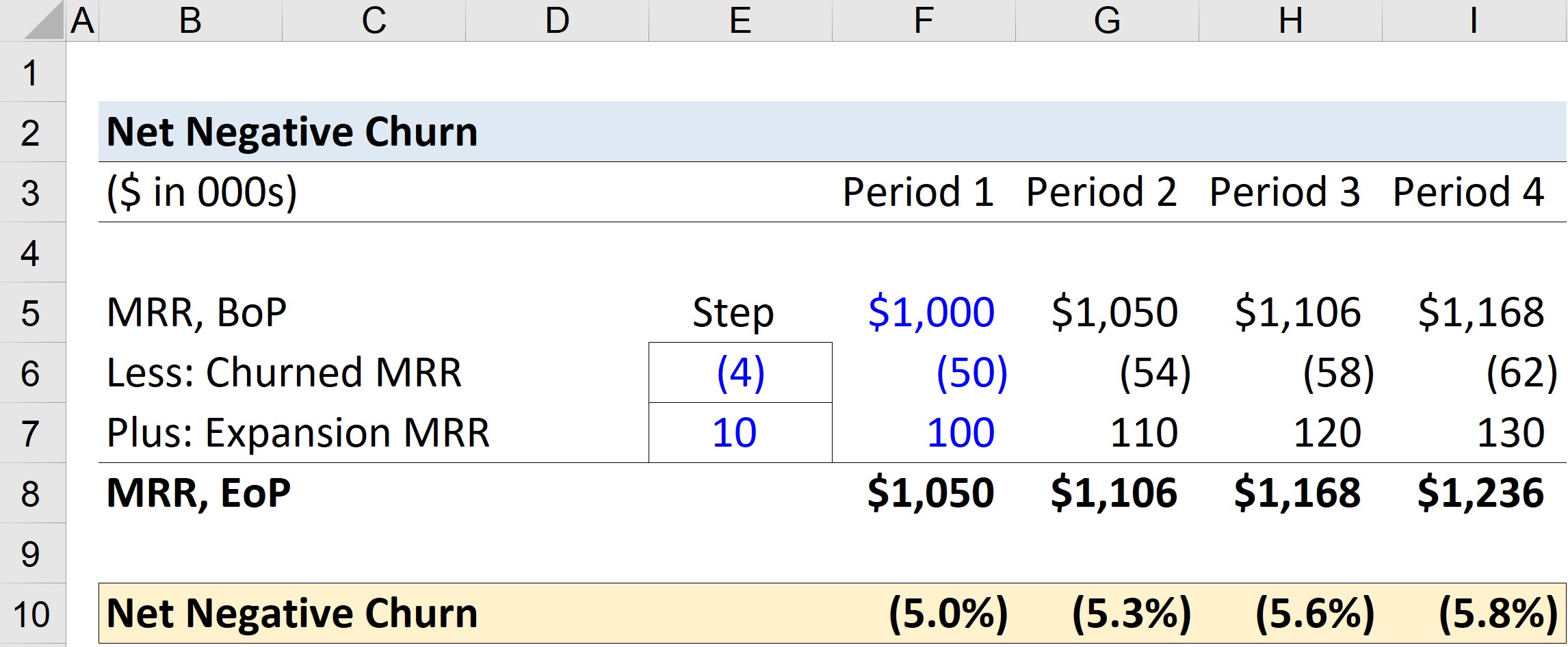
Suppose a SaaS company had $1 million in MRR at the beginning of the 1st period.
In Period 1, the churned MRR was $50,000 and the expansion MRR was $100,000.
The roll-forward for MRR is as follows.
Monthly Recurring Revenue (MRR) Formula
- MRR, EoP = MRR, BoP – Churned MRR + Expansion MRR
For the churned and expansion MRR, we’ll use the following step function to increase (or decrease) the amounts for each period.
From Period 1 to Period 2, the MRR, EoP values are shown below.
To calculate the net churn rate – which we can assume will be negative considering how expansion MRR clearly outweighs the churned MRR in all periods – we’ll subtract the churned MRR from expansion MRR and then divide by the MRR, BoP.
The net negative churn for our model is listed below.
Our hypothetical company’s MRR grew from $1.05 million in Period 1 to $1.24 million in Period 4, which is attributable to how its expansion MRR offset and surpassed its churned MRR.

Enroll in The Premium Package: Learn Financial Statement Modeling, DCF, M&A, LBO and Comps. The same training program used at top investment banks.


No comments yet.