What is Upselling?
Upselling refers to the strategies implemented by businesses to generate incremental revenue from their existing customer base, rather than acquiring new customers.

Upselling refers to the strategies implemented by businesses to generate incremental revenue from their existing customer base, rather than acquiring new customers.
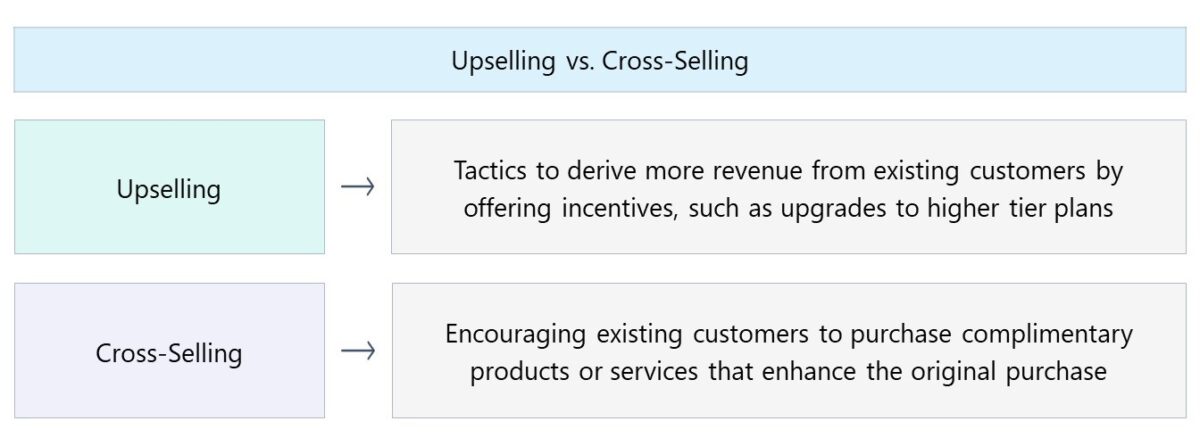
Upselling consists of the strategies employed by companies to encourage their existing customers to spend more on additional products or services in an effort to derive more revenue from customers that already made purchases in the past.
Simply put, upselling is the practice of convincing existing customers to spend even more by offering upgrades to their current purchases, the option to add more capabilities, and/or loyalty discounts.
At its core, the revenue of a company is the product of price and quantity.
Where:
Supporting those two core drivers is a concept termed “expansion revenue”, of which upselling is a part.
The premise of expansion revenue, as implied by the name, is to obtain more revenue by leveraging the initial customer purchase, which can be tracked by metrics such as “Average Revenue Per User (ARPU)” or “Average Order Value (AOV)”.
If a company’s efforts to upsell are effective, improvements will be reflected in either metric.
Upselling is appealing to companies due to the fact that the customer is an existing customer, rather than a potential customer, i.e. the customer’s foot is already in the door. While there are exceptions, of course, selling to an existing customer tends to be significantly easier than to a new customer.
Learn how institutional investors identify high-potential undervalued stocks. Enrollment is open for the upcoming cohort.
The following table outlines the most common types of upselling techniques:
| Upsell Technique | Description |
|---|---|
| Higher-Tier Upgrade |
|
| Product Bundling |
|
| Discounted Offerings |
|
| Loyalty Programs |
|
| Product Customization (Customer-Specific) |
|
Cross-selling also falls under the expansion revenue category but refers to encouraging existing customers to purchase complementary products and services that enhance the original purchase.
On the topic of pricing, discounts or incentives are not even necessary in cross-selling. For example, cross-selling could be as simplistic as a salesperson notifying an existing client about a newly launched product to gauge their interest. There likely are synergies between the two products, but the two are viewed as separate transactions.
Apple (NASDAQ: APPL) is a prime example of a company that is particularly adept at understanding the irrationality of consumer spending behavior and capitalizing on it.
| iPhone Model | 128GB | 256GB | 512GB | 1TB |
|---|---|---|---|---|
| iPhone 16 | $799 | $899 | $1,099 | - |
| iPhone 16 Plus | $899 | $999 | $1,199 | - |
| iPhone 16 Pro | $999 | $1,099 | $1,299 | $1,499 |
| iPhone 16 Pro Max | - | $1,199 | $1,399 | $1,599 |
Once the other revenue sources in Apple’s business model are taken into consideration—items such as the MacBook, AirPods, Apple Watch, Apple TV, and Apple Store (i.e. commissions, ad revenue)—it’s easy to understand the effectiveness of the Apple Ecosystem, which has accumulated arguably the most loyal customer base among all companies.
The interconnectedness of Apple devices and their upselling tactics to further establish recurring customers are major contributors the long-standing success of the company.
Sales on the iPhone 15 were lackluster, after most criticized it for only having marginal improvement from the prior model, and the general consensus was that the added features did not justify upgrading to the newest model (or the pricing for new customers).
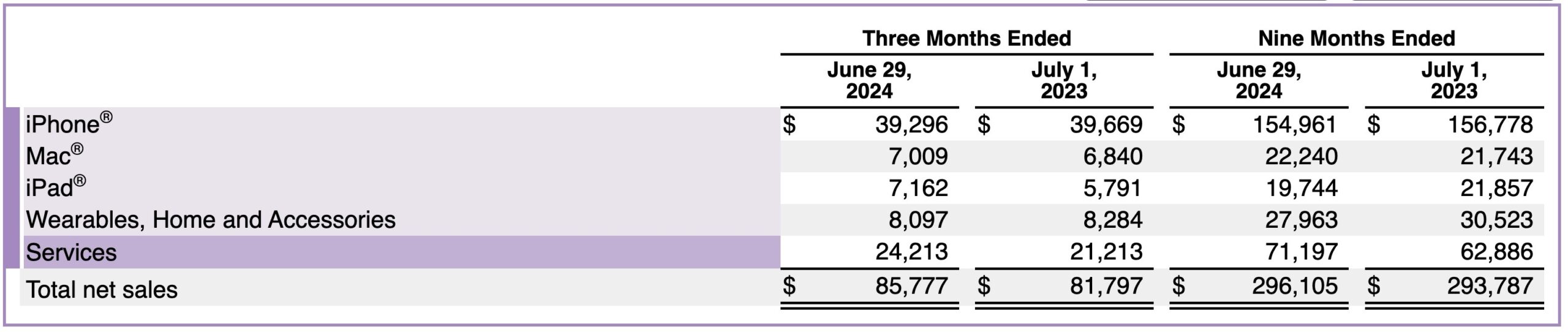
The revenue model of Apple (AAPL) continues to become more reliant on its services segment, per its most recent quarterly earnings report (10-Q).
In Q3-2024, Apple generated $85.8 billion in total net sales, of which, the services segment of Apple constituted 28.2% of the total, reflecting a shift from its historical reliance on one-time hardware sales to recurring, high-margin service offerings.
Apple’s long-term strategic pivot toward services and integration of its hardware products with its software offerings like iCloud, Apple Music, and Apple TV+, a central piece of the business model, was a deliberate shift to facilitate sustainable operating performance, with increasing importance of services as a revenue driver.
Apple has managed to build a comprehensive ecosystem that encourages upselling, thereby increasing its average revenue per user (ARPU) and retention rate (i.e., reduced churn) — not to mention, the services segment is a more consistent, high-margin revenue stream.
Apple Revenue Contribution (Source: Quilt Labs)
The efforts related to upselling existing customers are a critical component of the SaaS business model, where revenue is based on a subscription basis.
The necessity of upselling is of particular importance to B2B SaaS companies because their revenue is on a long-term contractual basis, while B2C is normally on a short-term, monthly basis (e.g. Spotify).
The valuation of a SaaS business is a byproduct of the quality of its recurring revenue—which in the context of multi-year contracts—is most often measured by the total contract value (TCV) and annual contract value (ACV).
The issue, however, is that recurring revenue can lose much of its value given an unsustainable churn rate.
A high churn rate implies internal problems within a company, in which its customers are not satisfied with the quality of the current offerings.
In contrast, a SaaS company with strong, predictable recurring revenue base understands its customers on an individual basis. Hence, the provider is best suited to serve them relative to other competitors in the market.
There are many variables that can determine the churn rate—both internal and external—but one of the most effective strategies to reduce churn is upselling.
Upselling improves a company’s recurring revenue because price-related incentives are necessary to retain customers, especially in hyper-competitive end markets.
Specific to the SaaS business model, the price incentives are more often than not tied to extending the contractual commitments, which is the main takeaway here.
Therefore, upselling and offering incentives can be practical for the sake of securing the time necessary to understand the customer and for the company to customize its offerings to cater to their specific needs, with the objective of eventually becoming an integral part of the customer’s operations.


No comments yet.