How to Calculate Monthly Recurring Revenue (MRR)
MRR stands for “Monthly Recurring Revenue”, and refers to the proportion of a company's revenue that is stable and predictable from subscription-based pricing, expressed on a monthly basis.
Monthly recurring revenue (MRR) represents the subscription-based revenue that a SaaS company can anticipate to earn per month from their active accounts (or customer base).
The active accounts refer to the monetizable user base belonging to an SaaS business at present, i.e. the customer or subscriber count.
When evaluating the growth profile and financial health of SaaS and subscription-based companies, MRR is a particularly meaningful KPI to track.
Calculating MRR provides a more detailed understanding of the stability of a company’s future revenue and user trajectory and helps shape forecasts.
By analyzing historical trends, a company's weak points can be identified in order for management to make adjustments appropriately to support future growth.
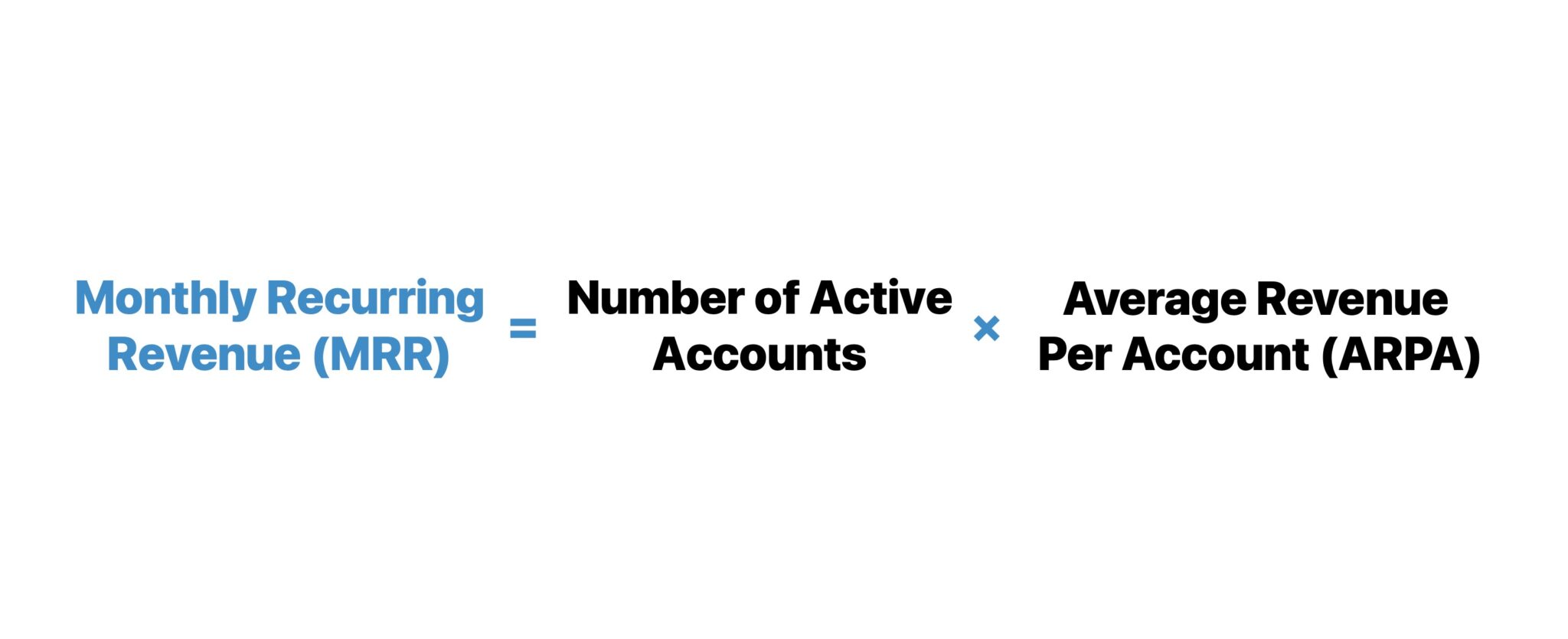
The formula to calculate monthly recurring revenue (MRR) is equal to the average revenue per account (ARPA) multiplied by the total number of active accounts for the given month.
Monthly Recurring Revenue (MRR) = Total Number of Active Accounts × Average Revenue Per Account (ARPA)
The average revenue per account (ARPA) is commonly used in the MRR calculation – or as an alternative, the average revenue per user (ARPU) could also be used.
Conceptually, ARPA and ARPU are identical in representing the average amount billed to a customer – and for either metric, the formula divides total recurring revenue by the total number of accounts (or users).
- Average Revenue Per Account (ARPA) = Total Recurring Revenue ÷ Total Active Accounts
- Average Revenue Per User (ARPU) = Total Recurring Revenue ÷ Total Active Users
It is important to ensure that only “recurring” revenue is used, instead of total revenue, which can include one-time fees.
Further, only active accounts must be included – i.e. paying customers – rather than those that signed up for a free trial. Each metric must also be normalized to be shown on a per-month basis.
- Quarterly Contract ➝ Divide by 4
- Semi-Annual Contract ➝ Divide by 6
- Annual Contract ➝ Divide by 12
The formula to calculate MRR can also divide the total contract value (TCV) by the length of the contract per customer, wherein the latter is expressed in months.
The MRR of a SaaS or subscription-based company is thereby equal to the sum of the contractual recurring revenue per customer, expected each month.
MRR = Σ (Total Contract Value (TCV) ÷ Total Length of Contract)
SaaS MRR Calculation Example
For instance, suppose a B2B software company's products are offered on a subscription basis and paid annually at a cost of $24,000 per user.
The $24,000 must be divided by 12 to calculate a monthly revenue of $2,000, which would be used in the MRR calculation, as opposed to the annual cost of $24,000.
- Normalized Monthly Revenue = $24,000 ÷ 12 Months = $2,000
Next, let’s assume the company has 50 active accounts for the given month.
Upon multiplying the total number of active accounts by the average monthly revenue per user, the resulting MRR is $100,000.
- Monthly Recurring Revenue (MRR) = 50 Active Accounts × $2,000 = $100,000
Why are One-Time Fees Excluded in MRR?
The most common mistake when calculating MRR is forgetting to remove one-time payments.
Unlike subscription-based payments, one-time payments are not recurring and should not be included in the MRR calculation.
Common examples of one-time payments excluded in the calculation of MRR include the following:
- Professional Service Fees
- Consulting Fees
- Installation Fees
- Set-Up Costs
MRR vs. ARR: What is the Difference?
MRR measures the recurring revenue brought in each month, whereas ARR measures the recurring revenue generated over the course of a full year.
If MRR is annualized, then the resulting figure is annual recurring revenue (ARR).
Annual Recurring Revenue (ARR) = MRR × 12
ARR is used to estimate revenue for the upcoming year, based on the most recent MRR, assuming that the given month is the most accurate indicator of future performance.
The drawback to ARR is the implicit assumption that there are no changes to your customer base during the course of the year (i.e. no customer churn, upselling, or downgrades).





No comments yet.