What is Cross-Sell Rate?
The Cross-Sell Rate measures the proportion of a company’s revenue attributable to cross-selling strategies, expressed as a percentage.

The Cross-Sell Rate measures the proportion of a company’s revenue attributable to cross-selling strategies, expressed as a percentage.
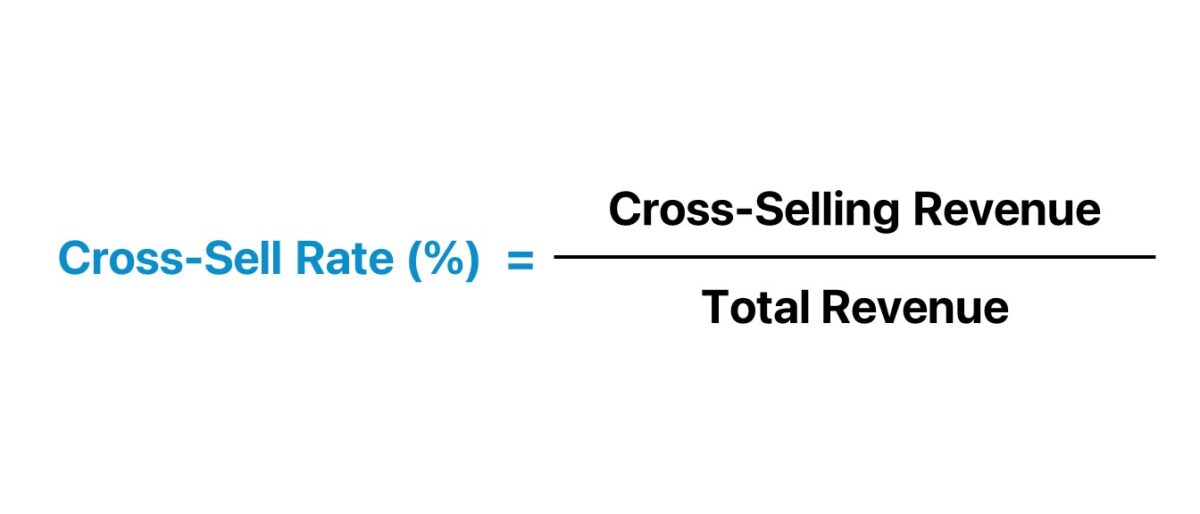
The cross-sell rate refers to the percentage of the total revenue of a business generated by cross-selling.
Cross-selling describes the strategies utilized by a business to incentivize customers to purchase more products (or services) to improve their revenue (“top line”) performance.
The target customer group in cross-selling tactics are existing customers who completed a purchase in the past, or customers currently in the process of completing a transaction, i.e. near the checkout stage.
For a cross-sell strategy to be deemed effective, a customer must purchase an adjacent, complementary product or service in addition to the initial, core purchase.
Therefore, the cross-sell rate reflects the proportion of a company’s total customers who purchased complementary items on top of the “core” product.
The most frequent cross-selling techniques to encourage customers to purchase complementary items are as follows.
In order to compute a company’s cross-sell rate – which can be determined on a customer or revenue basis – there are two pieces of data required.
To accurately collect the number of cross-sell conversions (and cross-sell revenue), customer-level data is necessary to extract the actual figures tied to cross-selling.
Counting all transactions with more than one item would be an inaccurate proxy to evaluate the effectiveness of a company’s cross-selling efforts, albeit there are times at which limited customer data can be a constraint.
Cross-selling, akin to upselling, is intended to derive more revenue from customers that already have their “foot in the door”. Hence, such strategies are viewed as easier (and more cost-efficient) relative to acquiring a new customer, which tends to be costly at times.
For instance, cross-selling is an integral part of long-term revenue generation and repeat purchases in the retail and eCommerce industries.
In practice, the cross-sell rate is a method to track the effectiveness of a company’s cross-selling strategies.
However, the importance of cross-selling is contingent on the sector that the company in question operates within, as the reliance on such strategies differs substantially by industry.
The cross-sell rate can be determined on either a revenue or customer basis, as mentioned earlier.
The formula to calculate the cross-sell rate divides a company’s cross-sell revenue by its total revenue over a given period.
On a customer basis, the number of cross-sell customer conversions is divided by the total customer count.
Since the cross-sell rate is expressed in percentage form, the resulting figure must then be multiplied by 100.
Learn how institutional investors identify high-potential undervalued stocks. Enrollment is open for the upcoming cohort.
We’ll now move on to a modeling exercise, which you can access by filling out the form below.

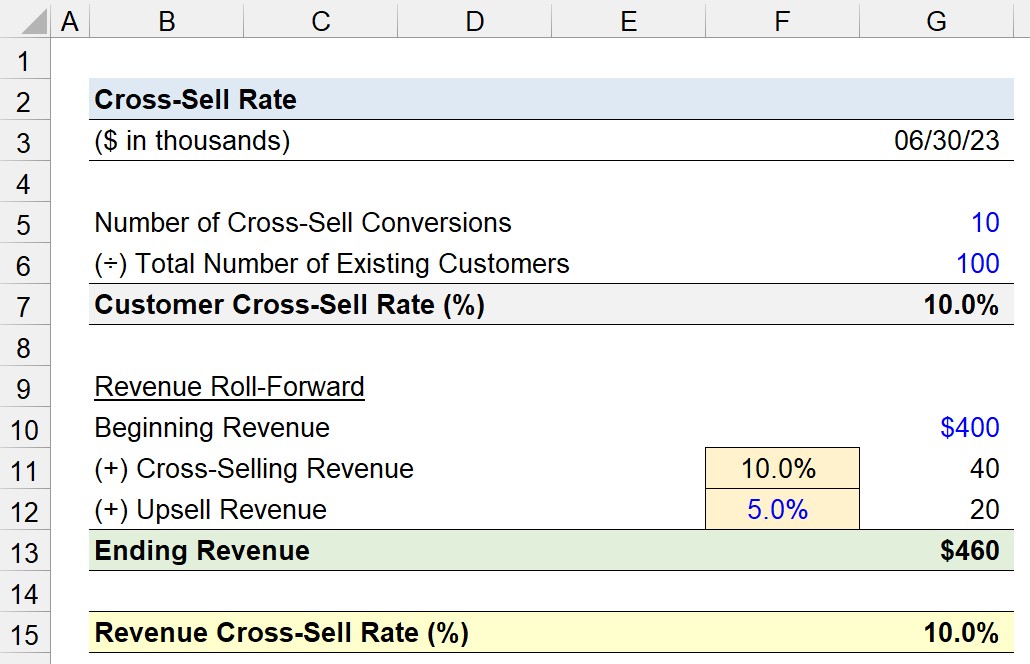
Suppose you’re tasked with calculating the cross-sell rate of a B2B SaaS business given the following operating data for the month of June 2023.
Of the 100 existing customers at the start of the month, 10 enterprises completed a cross-sale transaction, in which a complimentary product or service was purchased.
Given the two necessary pieces of customer-level data – the total customer count at the beginning of the month and the cross-sell conversions – we arrive at cross-sell rate of 10.0% by dividing the total customer count by the cross-sell conversions.
In the next part of our exercise, we’ll derive the cross-sell rate using the data from the prior example.
For the sake of simplicity, the implicit assumption in our model is that the revenue per customer and revenue per cross-sell conversion is equal.
In reality, the cross-sell revenue per conversion should be much lower, although there can be exceptions at times. For example, if a company's business model offers a multi-year subscription plan for the B2C market, the cross-sold product(s) may be a one-time purchase at a higher price point.
Our revenue roll-forward assumptions are as follows.
The cross-selling revenue and upselling revenue is the product of the beginning of period revenue and the coinciding model assumption.
The revenue from cross-selling and upselling amounts to $40k and $20k, respectively.
In closing, the cross-selling revenue ($40k) can be divided by the beginning of period revenue ($400k) to arrive at an implied revenue cross-sell rate of 10.0%, which matches our initial assumption.


No comments yet.