Annual Recurring Revenue (ARR) estimates the predictable revenue generated per year by a SaaS company from customers on either a subscription plan or a multi-year contract.
ARR—or Annual Recurring Revenue—is the industry-standard measure of revenue for SaaS companies that sell subscription contracts to B2B customers, whereby the plan is active in excess of twelve months.
Generate Key Takeaways
How to Calculate Annual Recurring Revenue (ARR)
ARR stands for “Annual Recurring Revenue” and represents a company’s subscription-based revenue expressed on an annualized basis.
While not a GAAP metric, the annual recurring revenue (ARR) metric measures a SaaS company’s historical (and future) operating performance more accurately than the revenue recognized under accrual accounting standards.
The annual recurring revenue (ARR) reflects only the recurring revenue component of a company’s total revenue, which is indicative of the long-term viability of a SaaS company’s business model.
In practice, the ARR is the primary KPI used to measure the health of SaaS and other subscription-based companies with business models oriented around recurring revenue and multi-year contracts, particularly for forecasting year-over-year (YoY) growth.
Since ARR represents the revenue expected to repeat into the future, the metric is most useful for tracking trends and predicting growth, as well as for identifying the strengths (or weaknesses) of the company.
Annual Recurring Revenue Formula (ARR)
The annual recurring revenue (ARR) metric is a SaaS or subscription-based company’s total recurring revenue, expressed on an annualized basis.
Conceptually, the ARR metric can be thought of as the annualized MRR of subscription-based businesses.
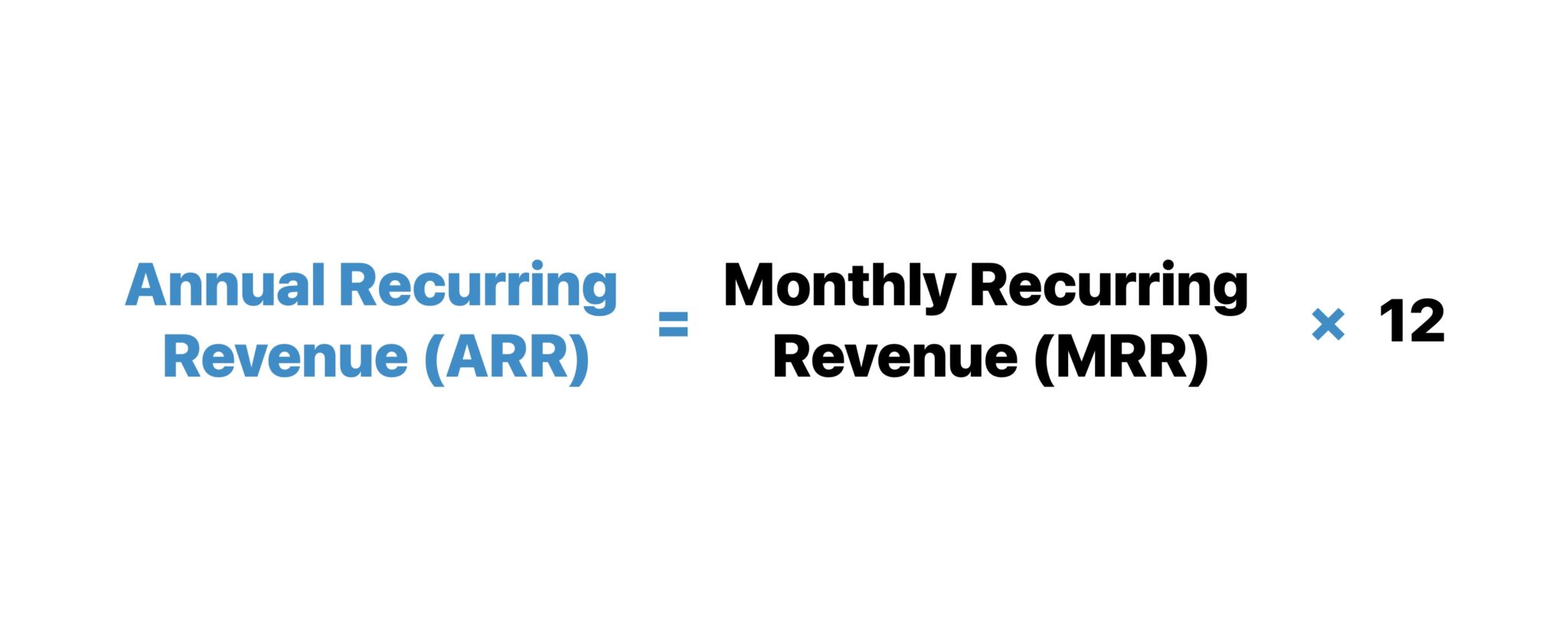
The formula to calculate the annual recurring revenue (ARR) is equal to the monthly recurring revenue (MRR) multiplied by twelve months.
The ARR metric factors in the revenue from subscriptions and expansion revenue (e.g. upgrades), as well as the deductions related to canceled subscriptions and account downgrades.
In order to properly calculate the metric, one-time fees such as set-up fees, professional service (or consulting) fees, and installation costs must be excluded, since they are one-time/non-recurring.
For example, let’s say a customer negotiated and agreed to a four-year contract for a subscription service for a total of $50,000 over the contract term.
To calculate the ARR of the SaaS provider on this particular customer, we would divide the contract value ($50,000) by the number of years (4), which comes out to an ARR of $12,500 per year.
There are a total of six components to annual recurring revenue (ARR), which must be analyzed to truly understand the underlying growth drivers and customer engagement rates.
ARR Component
Description
New ARR
New ARR is the revenue earned from new subscriptions
Expansion ARR
Expansion ARR is the revenue earned from subscription upgrades (upselling, cross-selling, product bundling)
Renewal ARR
Renewal ARR is the revenue earned from existing subscription renewals
Churned ARR
Churned ARR is the revenue lost from canceled subscriptions
Contraction ARR
Contraction ARR is the revenue lost from downgraded subscriptions
Reactivation ARR
Reactivation ARR is the revenue earned from customers that had cancelled their subscription in the past, but decided to re-subscribe
ARR vs. MRR: What is the Difference?
The monthly recurring revenue (MRR) and annual recurring revenue (ARR) are two of the most common metrics to measure recurring revenue in the SaaS industry.
The difference between ARR and MRR, including the relationship between the two, is as follows.
Monthly Recurring Revenue (MRR) ➝ MRR is a company's normalized revenue, expressed on a per-month basis. Like the annual recurring revenue (ARR) metric, MRR only captures the revenue from active accounts on subscription-based payment plans. When evaluating companies with short-term contracts that last less than one year, MRR is the appropriate metric to focus on.
Annual Recurring Revenue (ARR) ➝ Both KPIs, MRR and ARR, are intended to measure the predictable and recurring revenue of a SaaS company, but ARR is more “forward-looking” as it is commonly used to estimate revenue for future years. Moreover, ARR is derived from the most recent MRR, which also represents the main drawback to ARR because this assumes that the most recent month is the most accurate indicator of future performance.
SaaS ARR Valuation Multiple Formula
The ARR multiple is a method to quantify the implied valuation of a SaaS company into a valuation multiple, facilitating comparisons to peer companies and the industry benchmark.
The formula to compute the ARR multiple divides a SaaS company’s implied valuation by its annual recurring revenue (ARR).
If the SaaS company is publicly-traded (post-IPO), the measure of value is the enterprise value (TEV), whereas for private companies, such as start-ups, the measure of value is the latest round valuation at which funding was raised.
Generative AI startup Hebbia raised $130 million at an estimated $700+ million valuation in its most recent funding round, demonstrating the outsized market demand and positive sentiment around the disruptive potential of Gen AI, particularly around workflow automation in the financial services and legal industry.
Hebbia, founded by George Sivulka in 2020, reportedly generated $13 million in ARR while raising institutional capital from venture capital (VC) firms.
Matrix—the core product of Hebbia—can analyze a significant quantify of documents and datasets at scale, and extracts insights with citations per custom prompts input by the user, akin to instructing AI agents to complete tasks. The responses to each prompt are output into an interface with a structure comparable to a spreadsheet, and each template can be continuously refined and improved upon.
The $130 million Series B of Hebbia was led by Andreessen Horowitz (a16z), with participation from Index Ventures, Google Ventures (GV), and Peter Thiel.
Therefore, the implied ARR multiple at which Hebbia raised its Series B funding comes out to approximately 54x, reflecting the market size and revenue opportunity of the one of the top Gen AI startups at present.
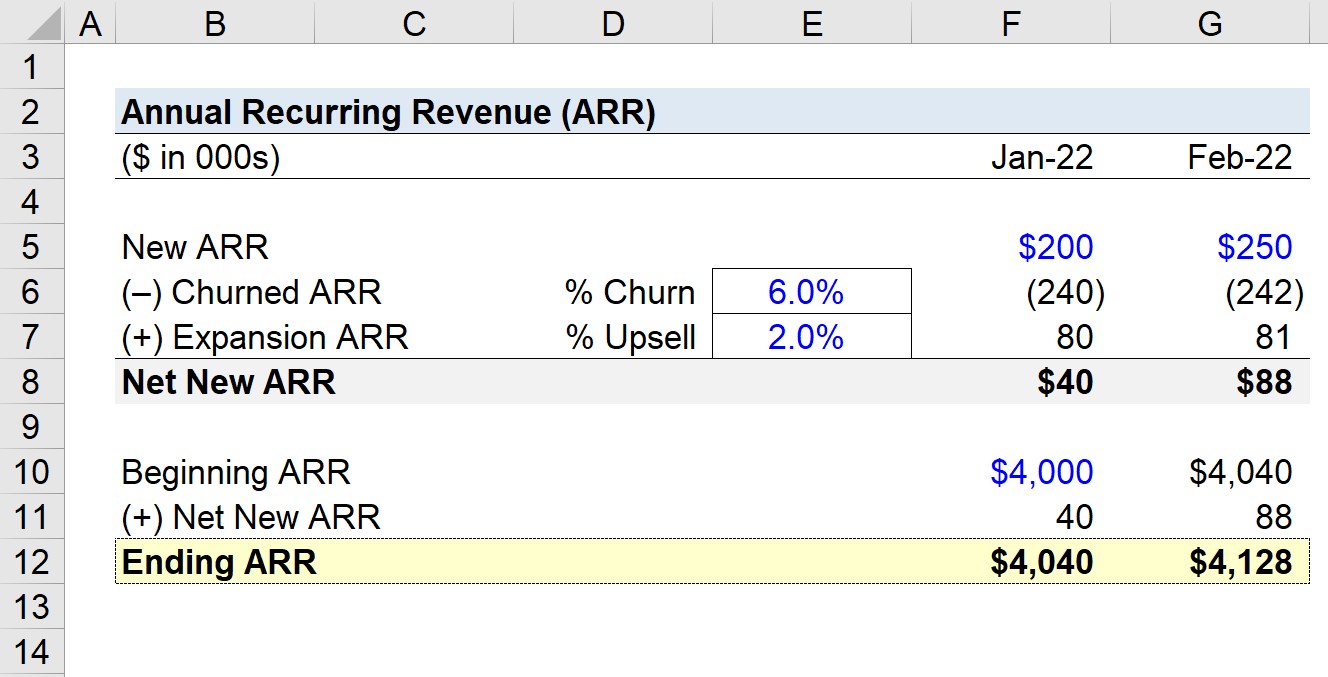
The new ARR will be hard coded for January and February, and then the beginning ARR will be multiplied by the respective churn rate and upsell assumptions.
January 2022:
Churned ARR = –$240,000
Expansion ARR = +$80,000
February 2022:
Churned ARR = –$242,000
Expansion ARR = +$81,000
2. ARR Calculation Example
Since we now have all the necessary inputs for our annual recurring revenue (ARR) roll-forward schedule, we can calculate the new net ARR for both months.
Net New ARR, January = $200,000 – $240,000 + $80,000 = $40,000
Net New ARR, February = $250,000 – $242,000 + $81,000 = $88,000
The ending ARR for January comes out to $4,040,000, which becomes the beginning ARR for February.
If we add $88,000 to the beginning ARR, we calculate the ending ARR in February of $4,128,000.
Ending ARR, January = $4,000,000 + $40,000 = $4,040,000
Ending ARR, February = $4,040,000 + $88,000 = $4,128,000







No comments yet.